Are you producing content your sales team never uses? Or running a sales process that can't point a prospect to a single piece of published content they could have found on their own?
Both problems come from the same misunderstanding, and they are far more common than they should be. As a certified Endless Customers coach who has audited content operations for founder-led B2B teams, I see this exact structural gap on repeat: it is rarely a content quality problem. It is a content classification problem.
This article is for founders, marketing leads, and sales directors in B2B businesses who want a clear, practical answer: what is the difference between sales enablement and buyer intent content, and which one should you build first?
By the end, you will have a comparison framework, a decision guide, and a step-by-step model for connecting both into one system.
Key takeaways
-
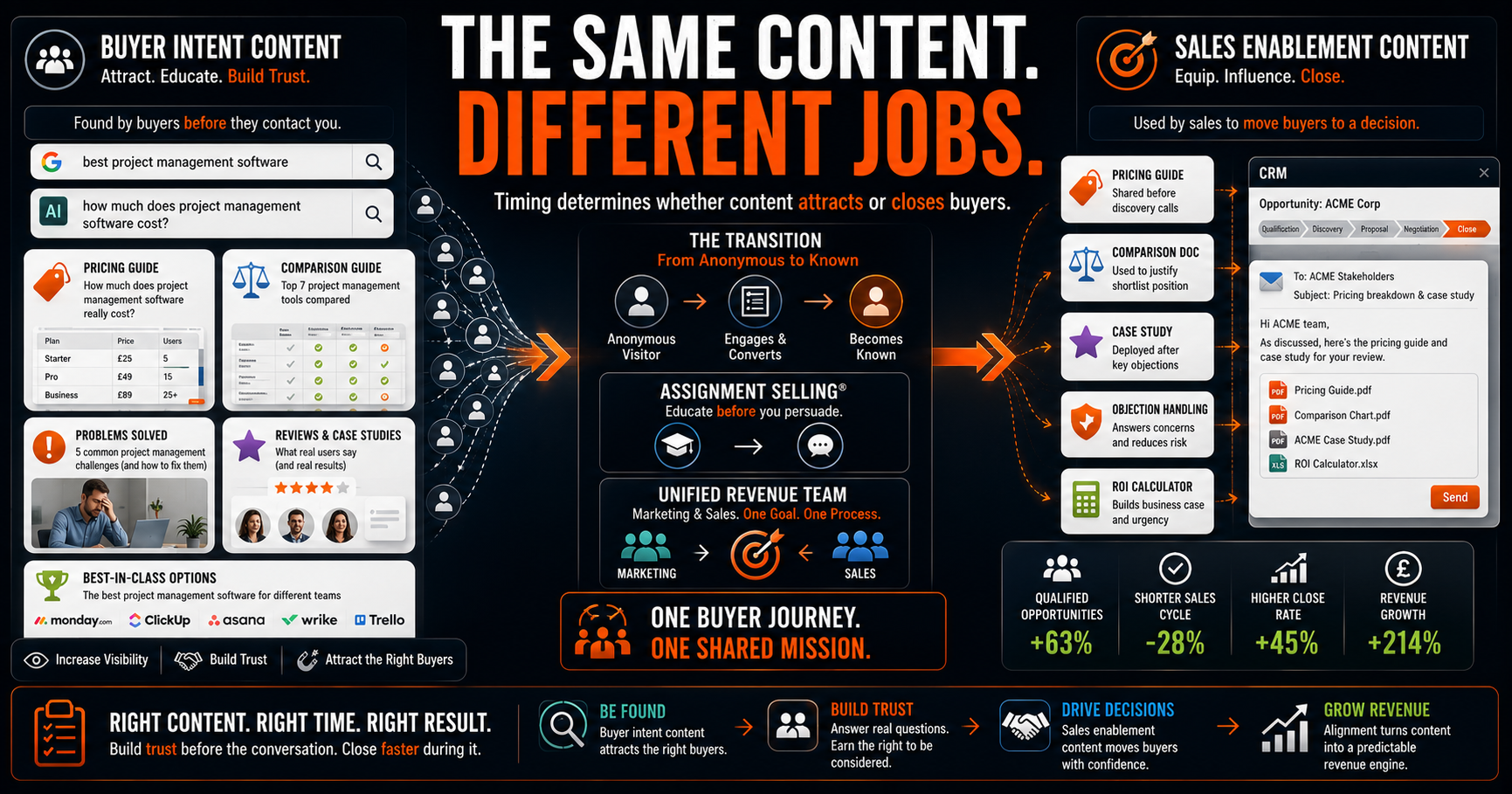
Sales enablement content is deployed inside the sales process to move a prospect toward a decision. Buyer intent content is published publicly to attract buyers who are researching before they contact you.
-
The clearest separation is timing: buyer intent content is found before a prospect contacts you; sales enablement content is deployed after the first conversation begins.
-
Businesses that align content to the buyer's journey see 73% higher conversion rates than those that don't. (Source: Aberdeen, 2024, via Madison Logic)
-
If your pipeline is empty, build buyer intent content first. If you have inbound interest but a low close rate, build sales enablement content first.
-
The best content does both jobs. A pricing guide on your website is buyer intent content. When your sales rep emails it before a call, it becomes sales enablement content.
What is the difference between sales enablement and buyer intent content?
Sales enablement content is created to help your sales team move prospects toward a decision, while buyer intent content is created to attract and educate buyers who are actively researching before they ever contact you.
Both types serve buyers, but at different moments, and often in response to very different problems inside your business.
Sales enablement content: definition and purpose
Sales enablement content is material your sales team uses directly, in emails, calls, and follow-ups, to move a prospect closer to a purchase.
It includes pricing breakdowns sent before discovery calls, case studies deployed after objections, and comparison documents shared at near-close. Its audience is already in your pipeline. It lives in CRM templates and shared folders, not on a public website.
Buyer intent content: definition and purpose
Buyer intent content is publicly published material designed to attract buyers who are already searching for answers, before they have ever contacted your business.
It is typically a blog post, guide, or video that answers the exact questions buyers type into search engines or AI tools when they are close to a purchase. The Big 5 topics form the most reliable foundation for this type of content across every industry.
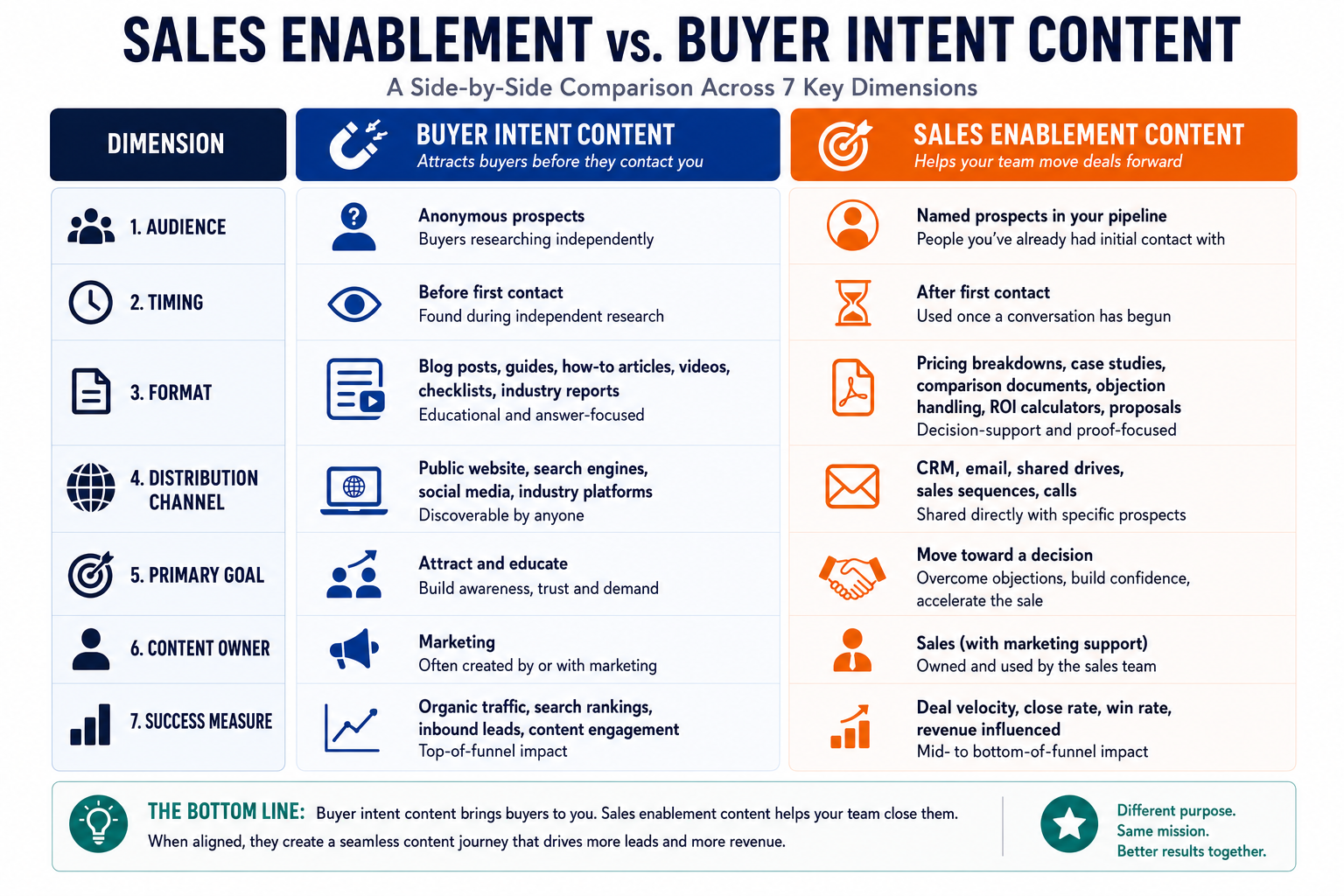
Sales enablement vs buyer intent content: a side-by-side comparison
The clearest way to separate the two is by timing: buyer intent content is found before a prospect ever contacts you, while sales enablement content is deployed after the first conversation has already begun.
A blog post answering "How much does X cost?" is buyer intent content. A pricing breakdown your sales rep emails before a discovery call is sales enablement content, even if the underlying information is identical. The deployment context is what changes.
| Dimension | Buyer intent content | Sales enablement content |
|---|---|---|
| Audience | Anonymous prospects researching independently | Named prospects already in your pipeline |
| Timing | Before first contact | After first contact |
| Format | Blog posts, guides, videos | Pricing breakdowns, case studies, comparison documents |
| Distribution channel | Public website, search, social | CRM templates, email, shared folders |
| Primary goal | Attract and educate | Move toward a decision |
| Content owner | Marketing | Sales, often built by marketing |
| Success measure | Organic traffic, rankings, inbound leads | Deal velocity, close rate |
The costly mistake of treating these two content types as the same thing
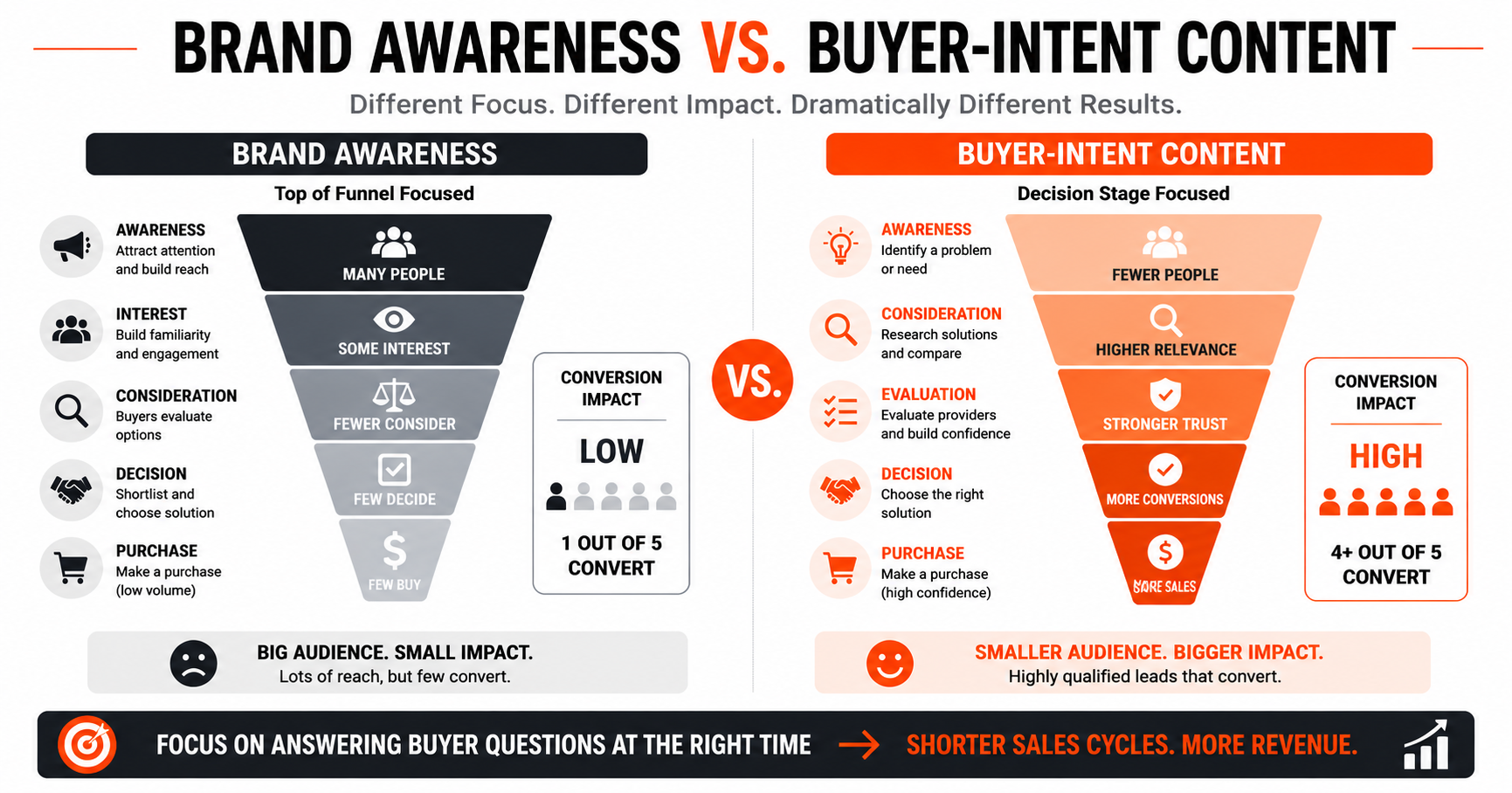
Confusing sales enablement and buyer intent content produces content that is either invisible to buyers or ignored by your sales team, and often both.
Businesses that align content to the buyer's journey see 73% higher conversion rates than those that don't. Yet most organisations create content without a clear sense of which job each piece is meant to do.
The three most common failure modes:
- Only creating sales materials: You have pricing decks and case studies, but no content that attracts buyers who haven't heard of you.
- Only publishing educational content: Your blog has traffic, but your sales team sends none of it to prospects.
- Sending buyer intent content mid-funnel: A top-of-funnel explainer sent to a near-close prospect lands at the wrong moment and slows the process.
Each failure costs you differently. The first limits reach. The second wastes marketing budget. The third extends your sales cycle unnecessarily.
Related reading: Why Sales Ignores Your Marketing Content, and How to Fix It
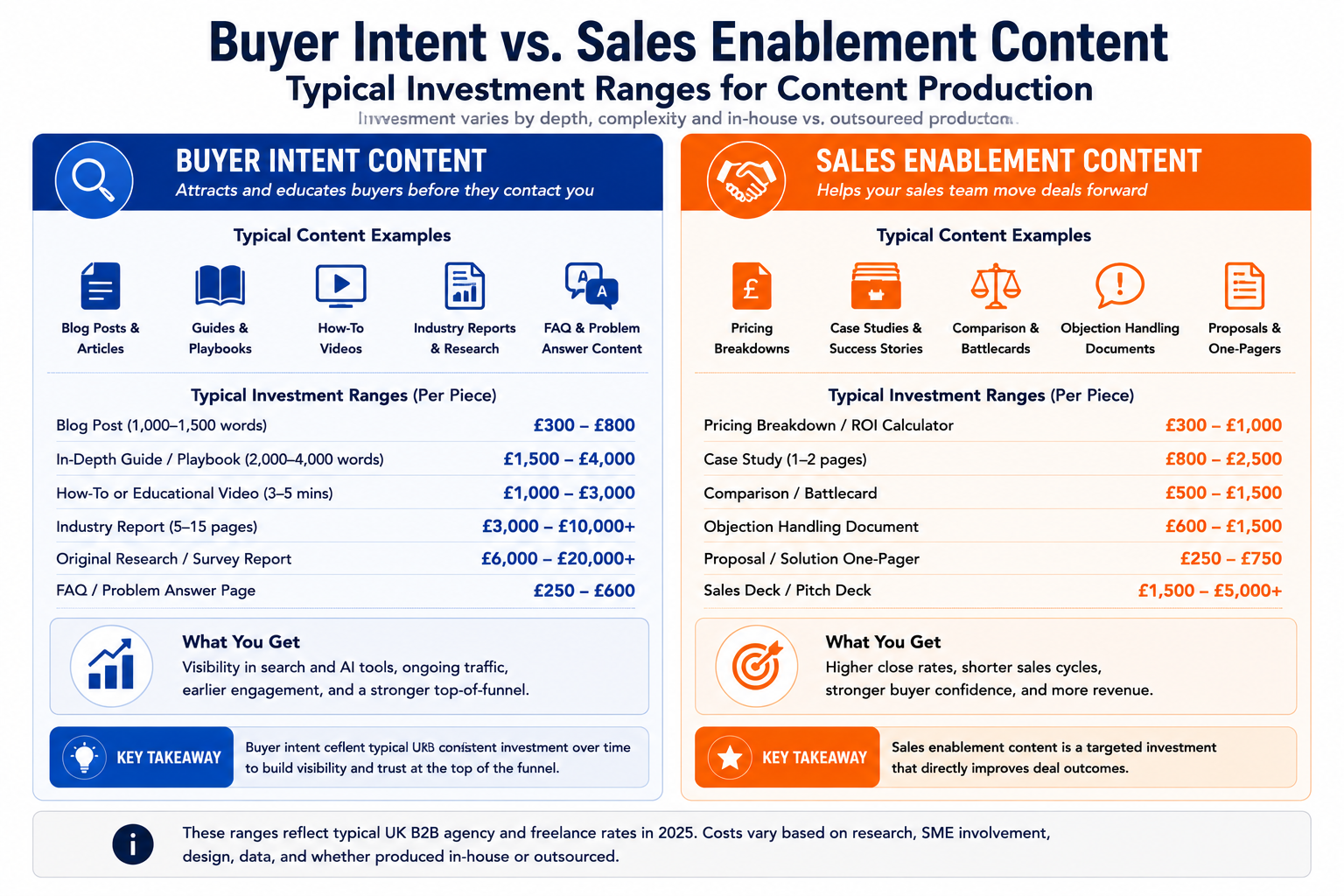
What does it cost to create sales enablement vs buyer intent content?
Buyer intent content typically requires a larger upfront investment in research, SEO, and distribution, while sales enablement content is less expensive to produce but delivers higher value per individual use.
The table below reflects typical UK/US B2B market norms and should be treated as indicative estimates only.
| Content type | Typical format | Indicative cost (GBP) | Indicative cost (USD) |
|---|---|---|---|
| Buyer intent: blog post or long-form guide | Written, SEO-researched | £500–£1,500 | $625–$1,875 |
| Buyer intent: pillar page or comprehensive resource | Written, multi-section | £1,500–£4,000 | $1,875–$5,000 |
| Buyer intent: produced video | Video | £1,000–£3,000 | $1,250–$3,750 |
| Sales enablement: pricing one-pager | Written, template | £300–£600 | $375–$750 |
| Sales enablement: case study | Written, interview-based | £500–£1,200 | $625–$1,500 |
| Sales enablement: comparison or battlecard document | Written, template | £400–£800 | $500–$1,000 |
The real cost businesses overlook is the price of having neither: longer sales cycles, more price-sensitive prospects, and buyers who choose a competitor that simply answered their questions more clearly.
The pattern holds across measurement-led marketing teams: the driver is rarely more content; it's the right content, deployed at the right moment.
Which type of content should you prioritise first?
If your pipeline is empty, buyer intent content comes first — it creates the top-of-funnel awareness that makes any sales enablement content useful in the first place.
Use these three criteria to decide:
- No organic traffic or inbound leads: Prioritise buyer intent content using the Big 5 topics. Start with cost and price, then problems, then comparisons. See: The Big 5 Questions Every Buyer Wants Answered
- Inbound interest but a weak close rate: Invest in sales enablement content immediately. Build a library mapped to three sales stages: first contact, mid-funnel, and near-close.
- Both traffic and an active pipeline: Form a Revenue Team. Sales and marketing meet regularly to align what is being published with what is being used in conversations.
If you already have inbound interest but a low close rate, sales enablement content built around the Big 5 topics will have the most immediate commercial impact.
5 steps to build a content strategy that uses both
Building a content strategy that uses both types starts with a single shared map: a clear picture of what buyers need to know at every stage of their journey, from first search to signed contract.
- Audit your existing content: List every piece and map it to a buyer journey stage. Identify gaps at each stage.
- Identify your Big 5 content gaps: Which of the five topics are you not currently answering for buyers?
- Build a sales enablement library: Create or repurpose content for each sales stage: fundamentals at first contact, options at mid-funnel, decision support at near-close.
- Form a Revenue Team: Marketing and sales meet regularly to align production with deployment. Neither team creates content in isolation.
- Track which content influences closed deals: Monitor which pieces sales reps actually send, and correlate them with won opportunities.
The Revenue Team model, where marketing and sales collaborate on both content creation and deployment, is the most reliable way to make sure no piece of content sits unused on either side of the business.
Related reading: How to Map Content to the Buyer's Journey: The Complete Marketing Playbook
Assignment selling: how to turn buyer intent content into your best sales tool
Assignment selling is the practice of giving prospects specific content, such as articles, guides, or videos, before each sales interaction, turning your buyer intent content into a qualifying and closing tool.
River Pools and Spas found that prospects who had engaged with roughly 30 pages of educational content before a sales call closed at around 80%, compared with roughly 25% for prospects who had viewed only a handful of pages. Prospects who engaged with content before a sales call arrived informed, pre-qualified, and far less focused on price.
The mechanism is simple: before a discovery call, send a specific piece of content, explain why it matters, and ask the prospect to review it. Those who won't engage with it reveal themselves as unlikely to be a strong fit.
Related reading: Why Every Sales Conversation Should Start With a Blog Post (Assignment Selling Explained)
Frequently asked questions
Is sales enablement content the same as bottom-of-funnel content?
Not exactly. Sales enablement content can be used at any stage of the sales process, from answering fundamentals at first contact to facilitating a decision at close. Bottom-of-funnel content is a category within buyer intent content.
Sales enablement content is a separate distribution mechanism that can carry content from any funnel stage.
Can the same piece of content serve both purposes?
Yes, and the best content often does. A transparent pricing guide published on your website is buyer intent content. When a sales rep emails that same guide before a call, it becomes sales enablement content. The content is identical; the deployment context is what changes.
How do I know if my current content is working for sales or marketing?
Ask your sales team which pieces they actually send to prospects, then check whether those same pieces rank in search and generate inbound traffic. If the answer to both is yes, your content is doing both jobs. If either answer is no, you have a structural gap.
What are the Big 5 content topics, and why do they matter for buyer intent?
The Big 5 are the five content topics that most reliably influence buying decisions across every industry: cost and price, problems and drawbacks, comparisons, reviews, and best-in-class options.
These are the exact questions buyers type into search engines, and AI tools, when they are close to a purchase decision.
Conclusion
If you have been producing content without a clear sense of whether it belongs in your marketing engine or your sales process, that is not a creative problem. It is a structural one.
You now have the definitions, the comparison, and the decision framework. The gap between knowing this and benefiting from it is the gap between understanding a map and actually following it.
How to take action now
- Audit your existing content and label each piece as buyer intent or sales enablement.
- Identify which Big 5 topics your buyer intent content does not yet answer.
- Ask your sales team which pieces they actually send to prospects — and why.
- Build a single-page content map covering every stage of the buyer journey.
- Schedule your first Revenue Team meeting to connect both sides of the business.
For a practical walkthrough of building buyer intent content from scratch, read How to Create Buyer-Intent Content That Shortens Sales Cycles.
If you want help installing both content types inside a structured, self-sufficient growth system your team can run without external dependency, explore the Endless Customers™ Implementation programme.

About the author
Tom Wardman is a marketing strategist, author of Build a Trusted Brand, and the creator of the In-House Growth Engine™. He works with founder-led B2B businesses to replace agency dependency with structured, self-sufficient growth systems that deliver measurable, predictable revenue. His work sits at the intersection of content strategy, trust-based marketing, and sales alignment.
Pricing disclaimer: All GBP–USD price conversions are rounded estimates and correct at the time of publishing. Exchange rates fluctuate and figures should be treated as indicative only.
Topics: