Are your sales and marketing teams working toward different goals? And do you keep investing in content, campaigns, and training, only to find nothing quite connects?
This article is for founders, sales directors, and in-house marketing leads who suspect the problem isn't effort. It will help you understand what a Company Alignment Workshop is, what it costs you to avoid one, and how to run one that produces results beyond the day itself.
Key takeaways
- A Company Alignment Workshop is a structured one-day session that brings sales, marketing, and leadership into a shared strategy for building buyer trust.
- Sales-marketing misalignment costs businesses in wasted content, lost leads, and slower sales cycles, none of which shows up clearly on a single report.
- Organisations with strong alignment experience roughly 70% higher conversion rates and over 200% more revenue than those where teams operate in silos.
- The three most common alignment pitfalls, the Mandate Trap, the Quantity Trap, and the Training Trap, are all avoidable with the right post-workshop structure.
- Lasting alignment requires a clear operating cadence: 90-day improvement cycles supported by weekly, monthly, and quarterly Revenue Team meetings.
What is a Company Alignment Workshop?
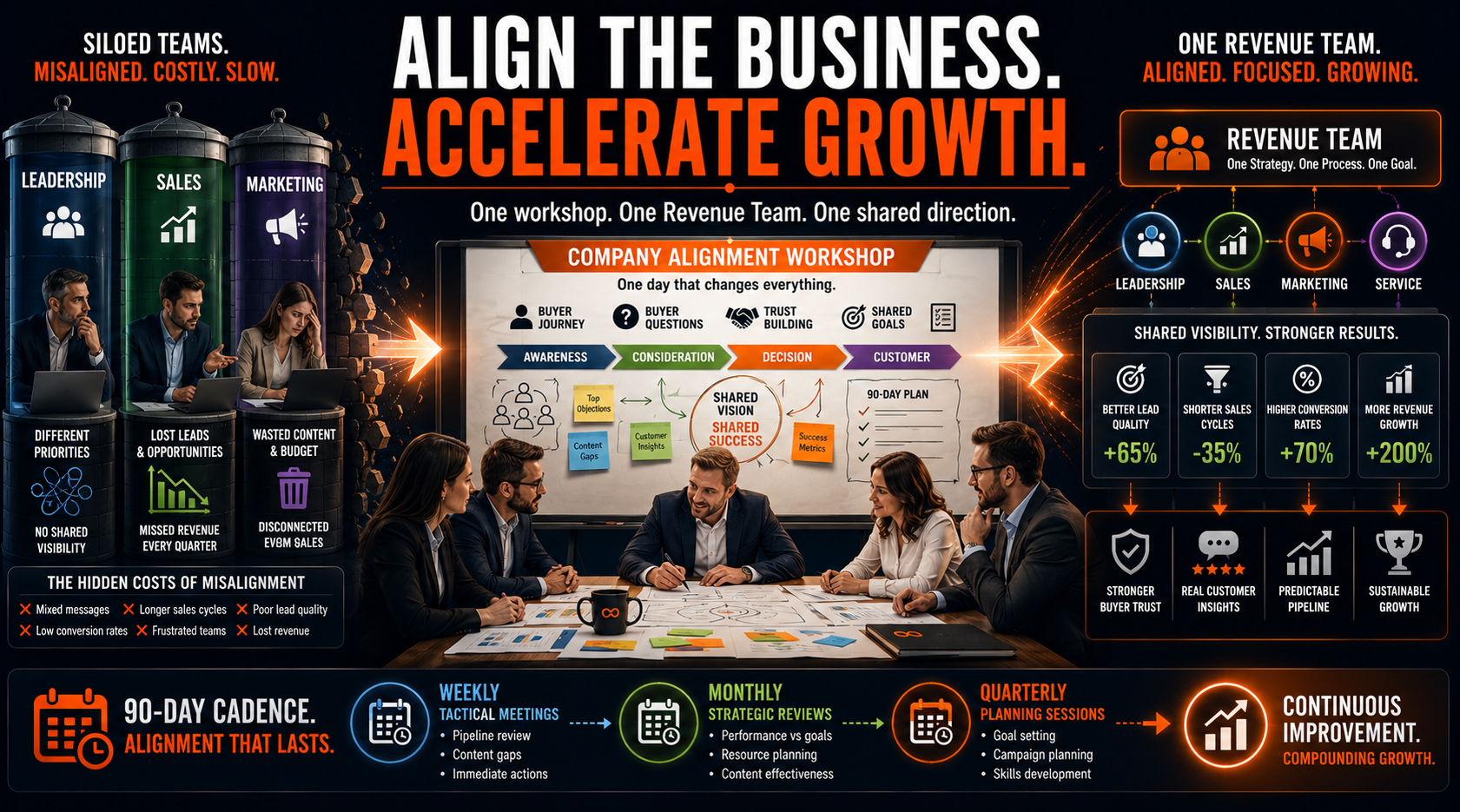
A Company Alignment Workshop is a structured one-day session that brings together key people from sales, marketing, and leadership to create a shared vision for building buyer trust.
It is not a training day, a presentation, or a motivational away-day. It is a working session that surfaces misalignment, agrees shared direction, and produces a documented action plan your team can act on immediately.
The workshop breaks down departmental silos, creates a common language around trust-building, and gives every team a clearly defined role in your revenue strategy.
Who attends: Every person who influences your growth decisions, leadership, sales, and marketing, without exception. Partial attendance produces partial alignment.
What teams leave with:
- A shared understanding of how your buyers make decisions
- Agreed content types that support and shorten sales conversations
- Defined roles across sales, marketing, and leadership
- A 90-day starting plan for the next phase of work
What does sales-marketing misalignment actually cost?
Sales-marketing misalignment is one of the most expensive and overlooked drains on business growth — showing up in wasted content, lost leads, and missed revenue that never appears clearly on any report.
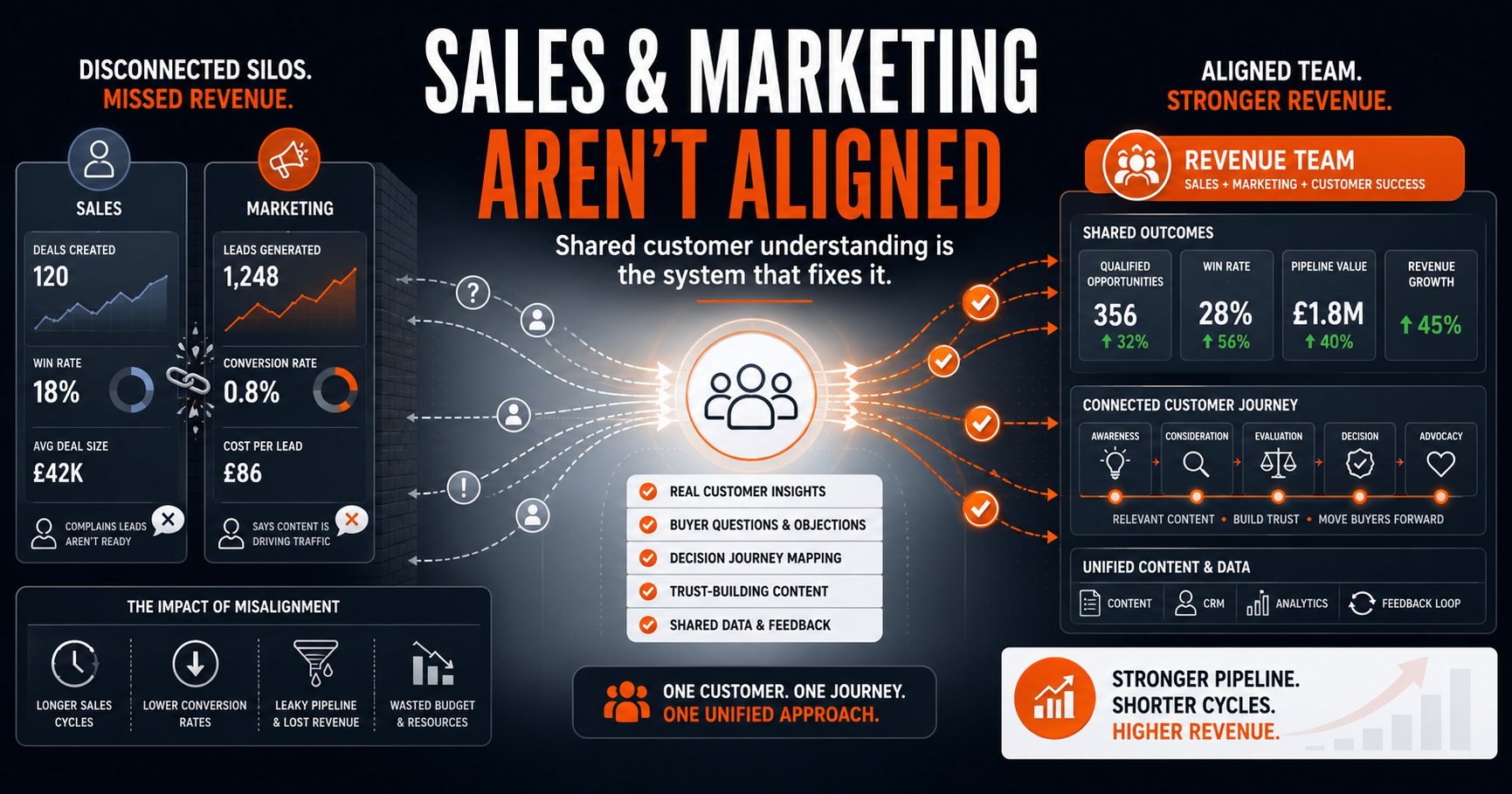
Organisations with strong alignment experience roughly 70% higher conversion rates and over 200% more revenue than those where teams operate in silos.
The costs accumulate quietly across teams:
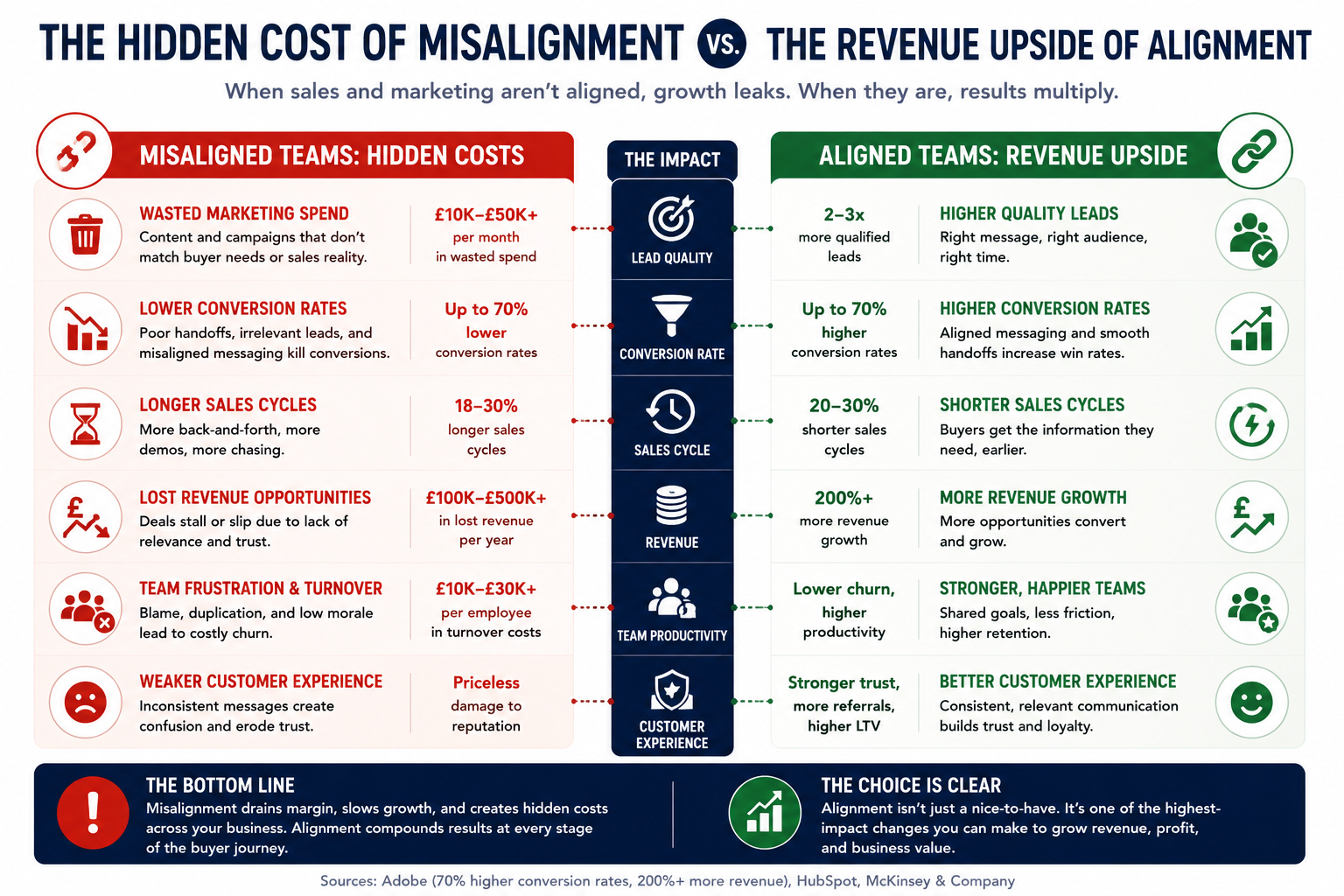
Every week two teams operate from different assumptions, the gap widens, and becomes harder to close without a structured intervention.
What's the difference between aligned and siloed teams?
The difference between a siloed business and an aligned one is not more marketing spend or more sales pressure; it is a shared understanding of what success looks like and who owns it.
In the siloed approach, marketing announces: "We generated 1,000 leads." Sales responds: "None of them were ready to buy." Both teams are working hard. Neither is producing results that build on each other.
In the aligned approach, a unified Revenue Team, which is where sales and marketing are working as one unit around a shared revenue goal, reports: "We built content around our top 10 sales objections. That produced 50 qualified opportunities and 15 closed deals."
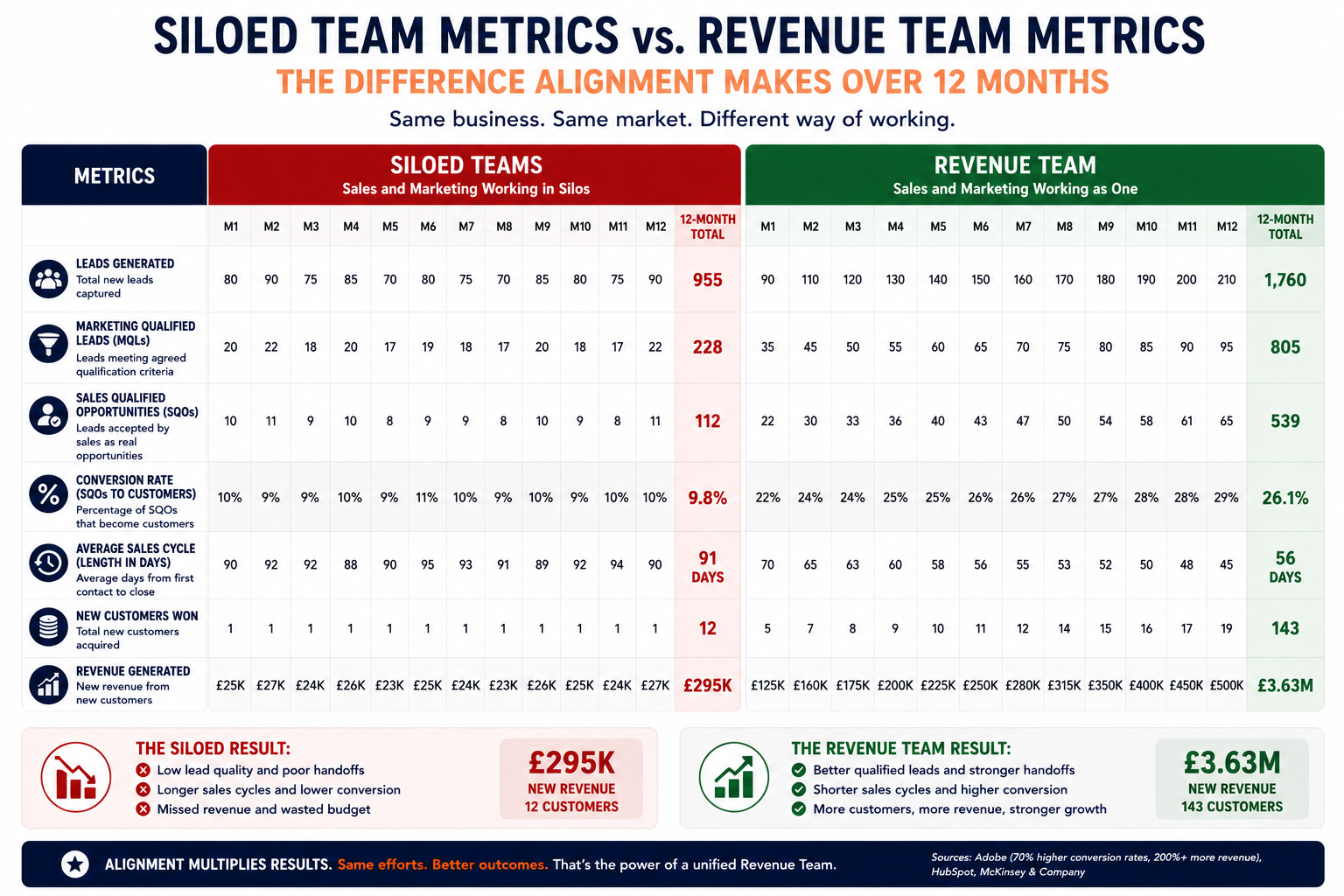
A unified Revenue Team doesn't just perform better in isolation; shared data improves targeting, content quality, and sales conversations simultaneously, each quarter.
How does a Company Alignment Workshop work?
A Company Alignment Workshop creates change at three levels: strategic, process, and cultural, and the post-workshop operating structure is what turns a single day into sustained results.
The three levels of alignment:
- Strategic: Shared revenue goals, joint planning sessions, and a collaboratively agreed customer journey map.
- Process: Clear lead handoff procedures, content workflows that incorporate sales feedback, and follow-up protocols so leads don't fall away.
- Cultural: Regular joint meetings between sales and marketing, cross-team training, and shared recognition when targets are met.
The post-workshop cadence:
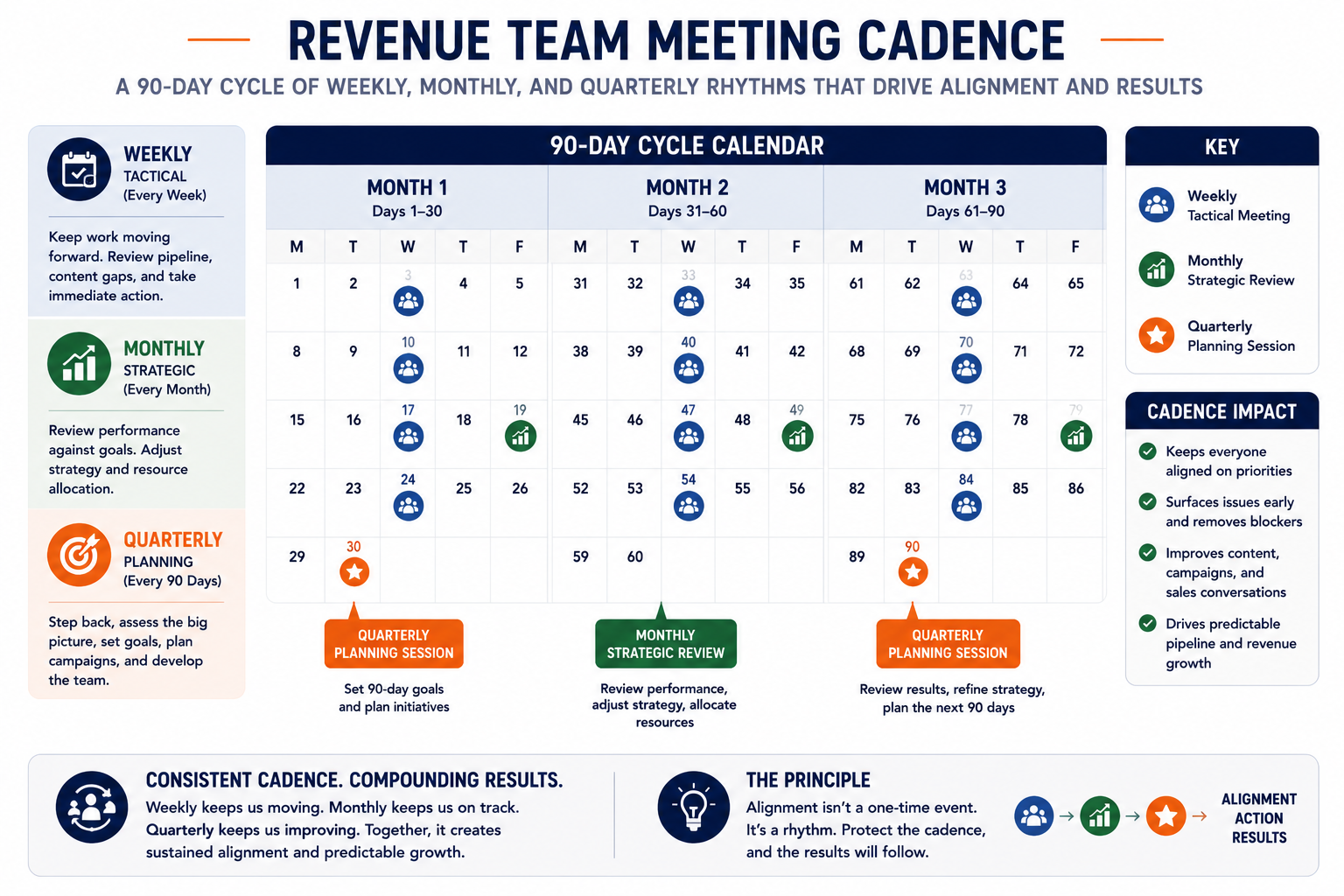
Businesses that sustain alignment operate in structured 90-day improvement cycles, supported by:
- Weekly tactical Revenue Team meetings: pipeline reviews, content gaps, immediate actions
- Monthly strategic reviews: performance against metrics, resource planning
- Quarterly planning sessions: goal setting, campaign planning, skills development
This operating rhythm is what separates businesses that see one strong quarter from those that build sustained revenue growth, quarter after quarter.
What are the most common alignment pitfalls — and how do you avoid them?
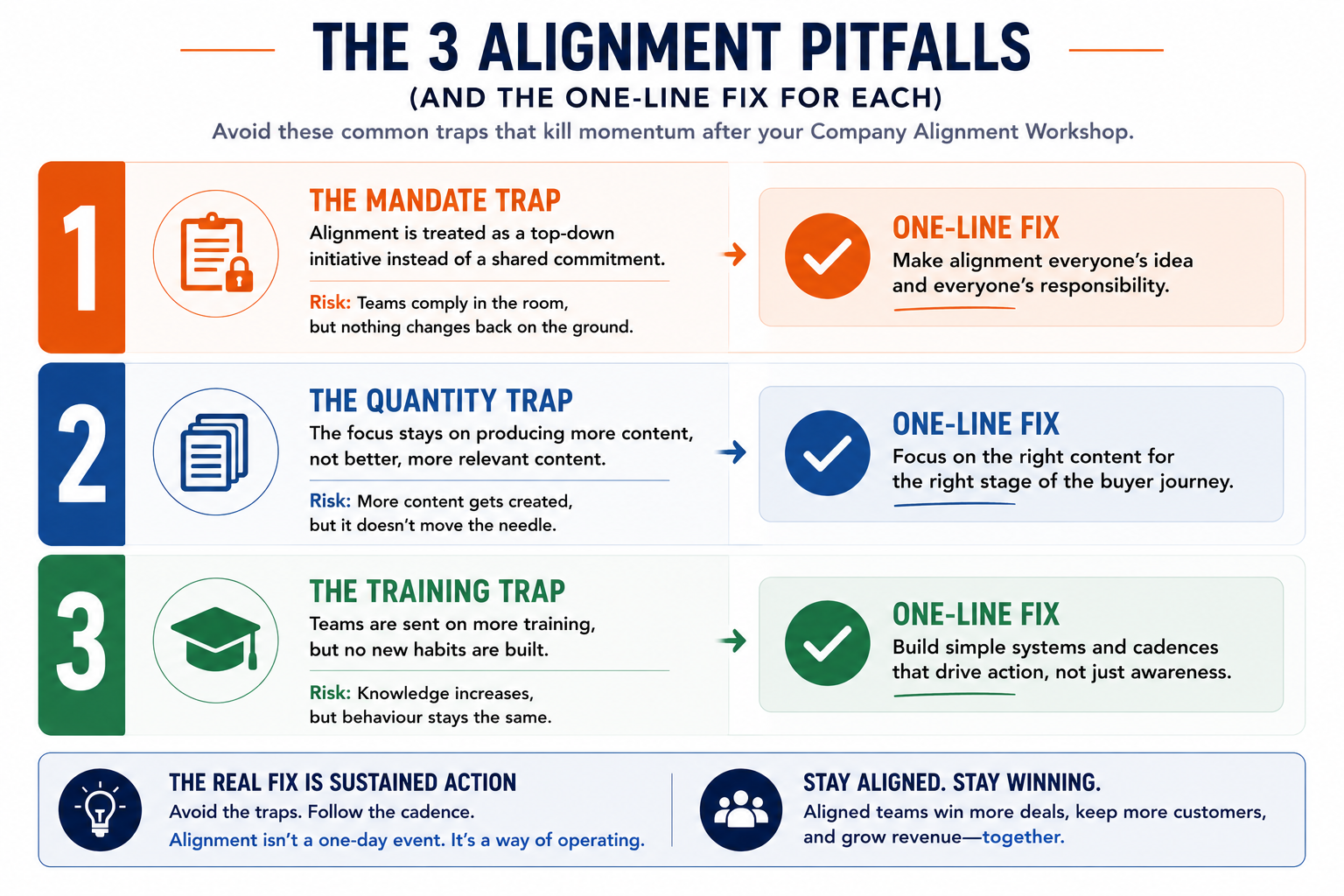
Even businesses that run a Company Alignment Workshop can lose momentum quickly by falling into one of three common traps.
-
The Mandate Trap: Forcing participation creates resistance and poor-quality output. Fix: Start with volunteers. Let their results build internal momentum organically.
-
The Quantity Trap: Focusing on content volume leads to burnout and declining quality. Fix: Produce fewer, more useful pieces at a sustainable pace. Measure impact, not output.
-
The Training Trap: Running a one-off session and expecting permanent change. Fix: Build continuous learning into your operating cadence. Skills only become habits through repetition.
Each of these pitfalls stems from treating alignment as a project with a finish line rather than a system with a rhythm.
What results can you expect when a business genuinely aligns?
Yale Appliance grew from a business turning over roughly £37 million ($46.25 million) to over £180 million ($225 million) in revenue after its CEO made trust-building a company-wide commitment, not a marketing department initiative.
When Steve Sheinkopf made content creation a company policy, every department contributed. The results built over time:
- Over 8 million website visitors annually
- An average of 3,700 leads generated per month
- £700,000 ($875,000) less spent on advertising each year
Companies with organisation-wide trust initiatives see an estimated three times higher customer retention than those where trust sits only inside the marketing team, a benchmark drawn from Endless Customers™ case study data, treated as indicative.
What makes a Company Alignment Workshop effective? 5 key criteria
Not all alignment workshops produce lasting change; the most effective ones share five characteristics.
- Cross-functional attendance: Leadership, sales, and marketing all present. No representatives in place of decision-makers.
- Shared revenue goals: Both teams win or lose by the same number.
- Defined content workflows: Sales input shapes what marketing produces and when.
- A clear post-workshop cadence: 90-day cycles with structured weekly, monthly, and quarterly Revenue Team meetings.
- Motivated rather than mandated participation: Buy-in earned through visible results, not enforced through policy.
On the question of facilitation, in-house marketers often find that an external facilitator is the more effective catalyst. Even the most capable internal marketer can face resistance that an outside voice simply doesn't encounter. The difference between internally led attempts and a structured external session is rarely subtle. See my Company Alignment Workshop page.
Related reading: Random Acts of Marketing: The Hidden Costs (And How to Fix Them)
FAQ: Company Alignment Workshop
How long does a Company Alignment Workshop take?
A Company Alignment Workshop is structured as a single day. It brings together leadership, sales, and marketing to agree a shared direction and leave with a documented 90-day starting plan.
Who should attend?
Every person who influences your growth decisions must be present: leadership, sales, and marketing. Partial attendance produces partial alignment, and partial alignment deepens into ongoing friction over time.
Is it a one-off event?
The workshop is a starting point, not a conclusion. Businesses that sustain alignment do so through a post-workshop operating cadence: 90-day cycles, weekly tactical meetings, and monthly and quarterly reviews.
Do we need an external facilitator?
You can run it internally. Many businesses find, however, that an external facilitator produces more durable buy-in, particularly where internal marketers have struggled to get leadership and sales into the same room with shared intent.
Conclusion
You have likely already felt the disconnect; sales frustrated with marketing, marketing frustrated with sales, and leadership wondering why activity isn't converting to revenue. That is the starting point for most businesses.
A Company Alignment Workshop doesn't add more activity to the pile. It gives the activity already underway a shared direction, a shared language, and a structure that sustains momentum beyond the first month.
If you'd like support designing and facilitating that process, I run Company Alignment Workshops specifically for founder-led businesses, built around the Endless Customers System™ and designed to produce a documented plan your team can act on immediately.
How to take action now
- Audit your current setup: are sales and marketing measured against the same revenue goal?
- Identify which of the three pitfalls, Mandate, Quantity, or Training, your team is most exposed to.
- Map your post-workshop cadence: weekly, monthly, and quarterly Revenue Team meetings.
- Book a scoping call to confirm whether a facilitated workshop is the right first step.
Related reading

About the author
Tom Wardman is a growth strategist and one of the UK's first five certified coaches in the Endless Customers System™, trained directly under Marcus Sheridan. Tom works with founder-led businesses to install growth systems built on buyer trust, systems their teams can own and run independently, without ongoing external reliance.
Pricing disclaimer: All GBP–USD price conversions are rounded estimates and correct at the time of publishing. Exchange rates fluctuate and figures should be treated as indicative only.