Are you using AI tools to shape your brand trust strategy? Are you getting advice that sounds credible enough in a document but leaves your actual buyers completely unmoved?
ChatGPT is useful for a lot of things. Building brand trust strategy, on its own, isn't one of them.
I've spent over a decade building trust frameworks for business owners and marketing teams, and I wrote Build A Trusted Brand, a nine-step methodology for turning credibility into commercial traction. The gap between what AI generates on this topic and what actually moves buyers is not subtle. It's structural.
A note on framing: I build brand trust strategy for a living. That's worth knowing upfront, but it's also why I can tell you precisely where the advice most buyers are currently acting on falls short.
This article is for business owners and marketers who want to understand exactly where AI-generated trust advice fails, what it consistently misses, and how to build a brand that buyers choose, stay with, and recommend.
You'll leave knowing the five trust signals AI consistently misses, the real cost of acting on generic advice, and a six-stage framework for building credibility your buyers actually respond to.
Key takeaways
- Brand trust is built through specific, human signals, not generic tactics any AI can reproduce
- ChatGPT reflects patterns in existing content, not what builds trust in your specific market
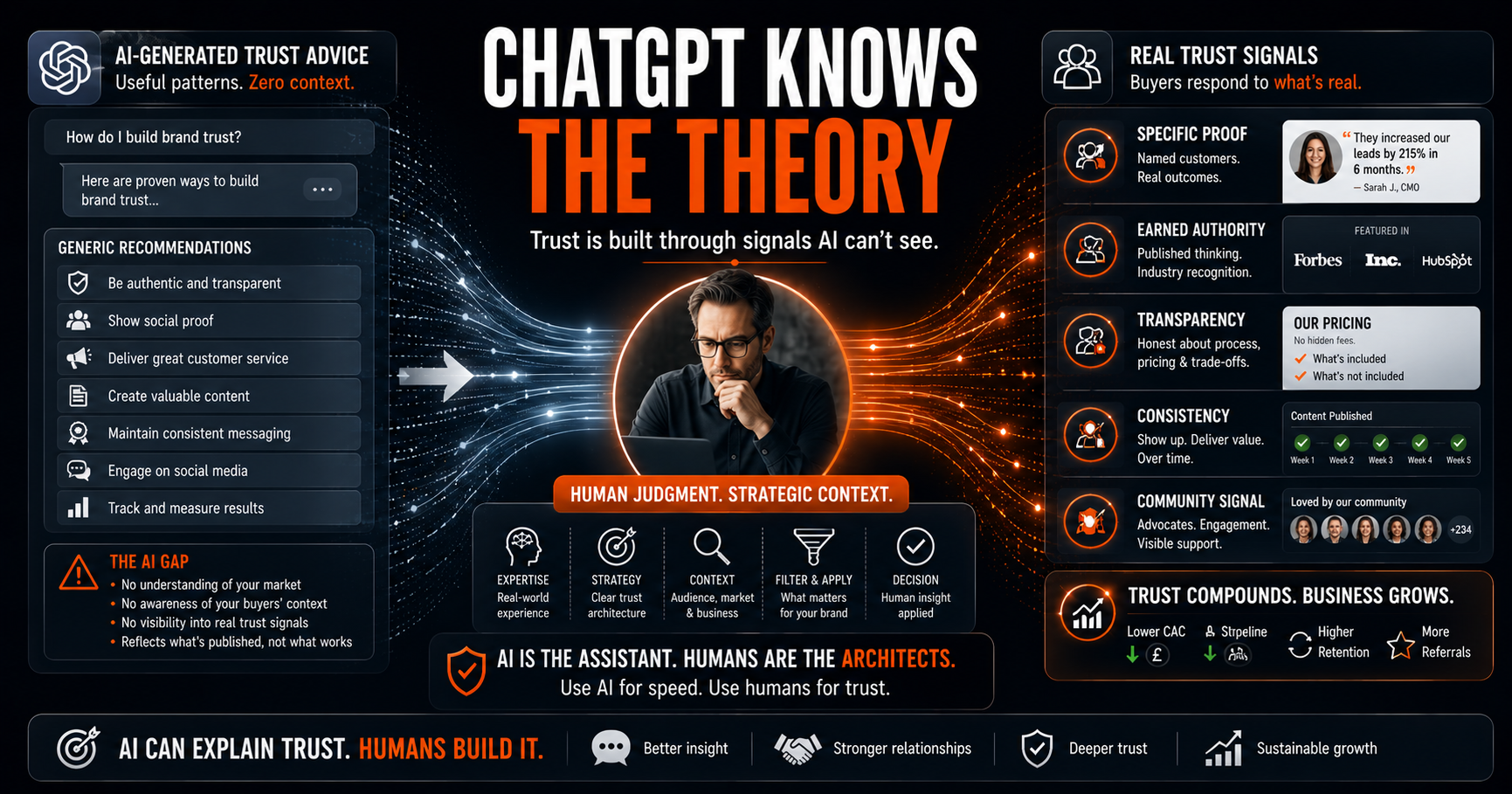
- The five trust elements AI most often overlooks: specificity of proof, earned authority, consistency, transparency, and community signal
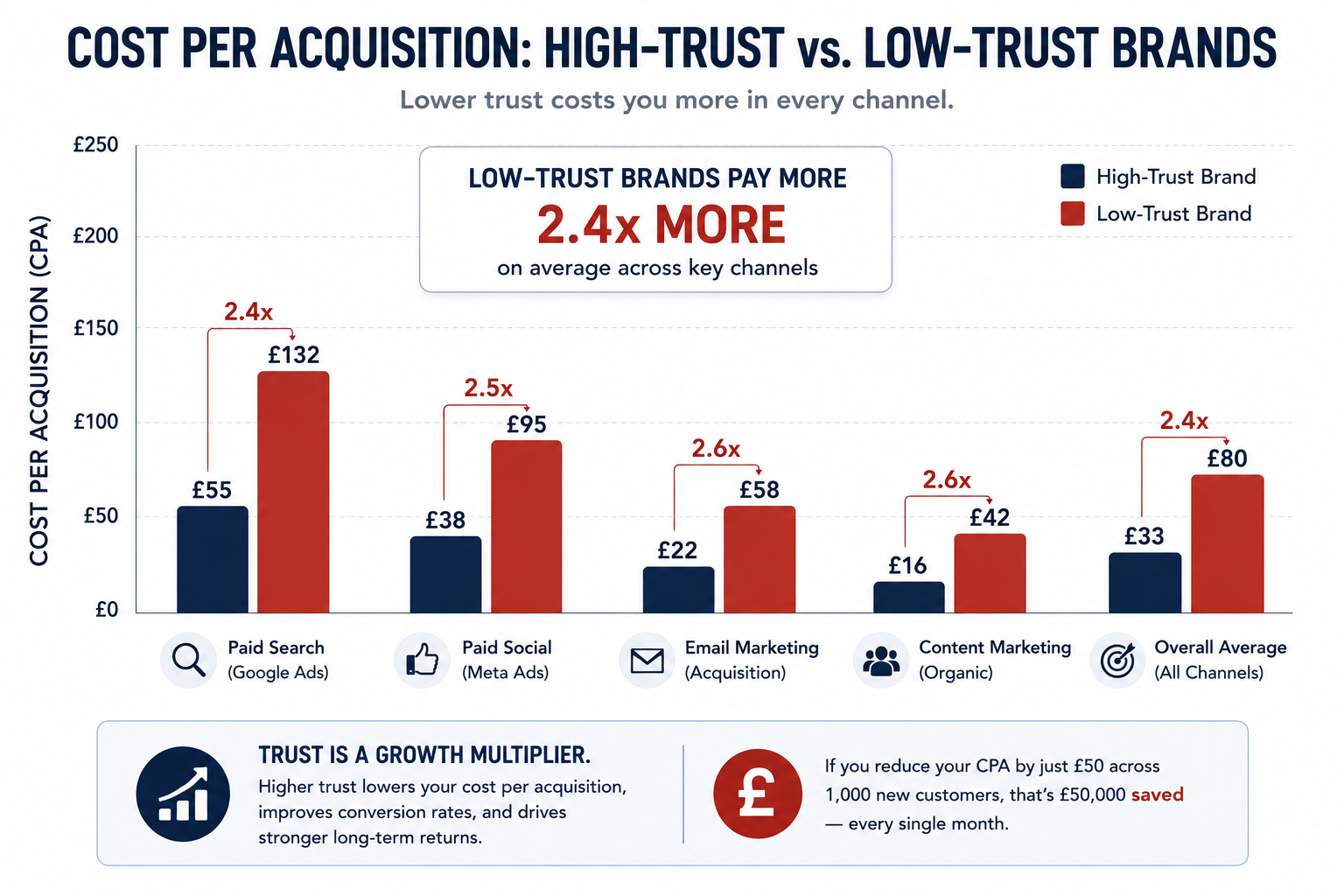
- Low brand trust raises your cost of acquisition and weakens every marketing channel you use
- AI works best as an assistant within a human-designed trust framework, not as the architect of one
What is brand trust-building, and why does it matter?
Brand trust-building is the deliberate, ongoing process of demonstrating to your audience that your business is credible, reliable, and genuinely has their best interests at heart.
It is not a one-off campaign. It is the accumulation of signals, including proof, consistency, honesty, and relevance, that makes a buyer feel safe choosing you over a competitor.
Without trust, marketing spend is wasted. Buyers may find you, but they won't choose you, stay with you, or tell others about you. Trust is the multiplier that makes everything else in your marketing work harder.
Why ChatGPT gives incomplete advice on building brand trust
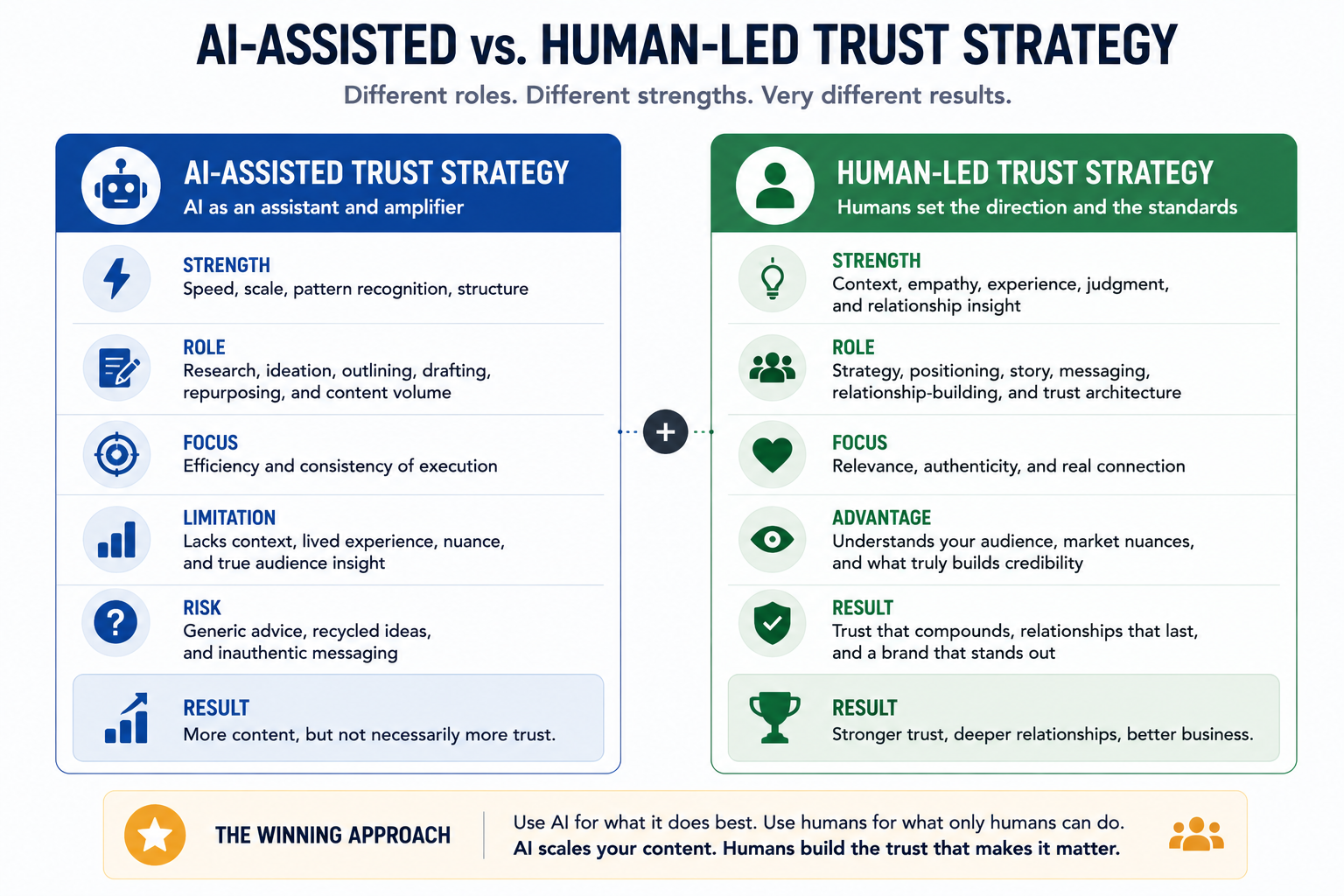
AI tools cannot assess whether the tactics they generate are authentic to your specific brand, audience, or business context, and that gap is precisely where trust strategies fail.
What AI tools do well
AI tools are fast and genuinely good at pattern recognition. They surface commonly cited tactics, including social proof, transparent messaging, consistent tone, and present them in a structured list.
They're also useful for maintaining content volume, speeding up first drafts, and structuring buyer-focused articles. For ideation, operational content tasks, and building out initial frameworks, that's real value.
The structural limits of AI-generated trust strategy
Your buyers aren't generic. The credibility signals that move them aren't generic either.
AI tools are trained on patterns in existing content; they reflect what has been said about trust, not what actually builds it in your market. The trust gap you need to close almost certainly isn't in any AI model's training data.
The real cost of poor brand trust, and of bad advice about it
A lack of brand trust does not just cost you individual sales; it raises your cost of acquisition, suppresses your pricing power, and makes every marketing channel less effective.
Businesses that follow generic AI advice risk compounding the problem. Appearing inauthentic actively erodes the credibility they're trying to build.
Tangible costs of low brand trust:
- Higher cost per lead: Buyers don't self-qualify as readily
- Price sensitivity: Buyers push back harder when trust is low
- Poor retention: Customers leave faster when the relationship lacks depth
- Weak referrals: Satisfied-but-unattached customers don't advocate for you
- Fragile reputation: One bad review lands harder when trust reserves are low
The 5 trust-building elements AI consistently overlooks
There are five core dimensions of brand trust that AI tools routinely underweight or omit entirely, and they're the ones buyers actually use to make decisions.
These aren't abstract ideals. They're the observable signals buyers use, often without realising it, to decide whether a business is worth their time and money.
-
Specificity of proof: Generic testimonials don't move buyers. Specific, named, outcome-focused social proof does.
-
Earned authority: Authority built through published thinking and consistent education carries far more weight than authority you simply claim.
-
Consistency over time: Trust accumulates through repeated, reliable signals. One great piece of content doesn't build trust; showing up consistently does.
-
Transparency and vulnerability: Businesses that admit trade-offs and limitations are trusted more than those projecting only perfection. See: Why Admitting Weaknesses Builds More Trust Than Bragging
-
Community signal: Buyers look to see who else trusts you. The visible behaviour of your existing audience is one of the strongest trust signals available.
How to build genuine brand trust: a step-by-step framework
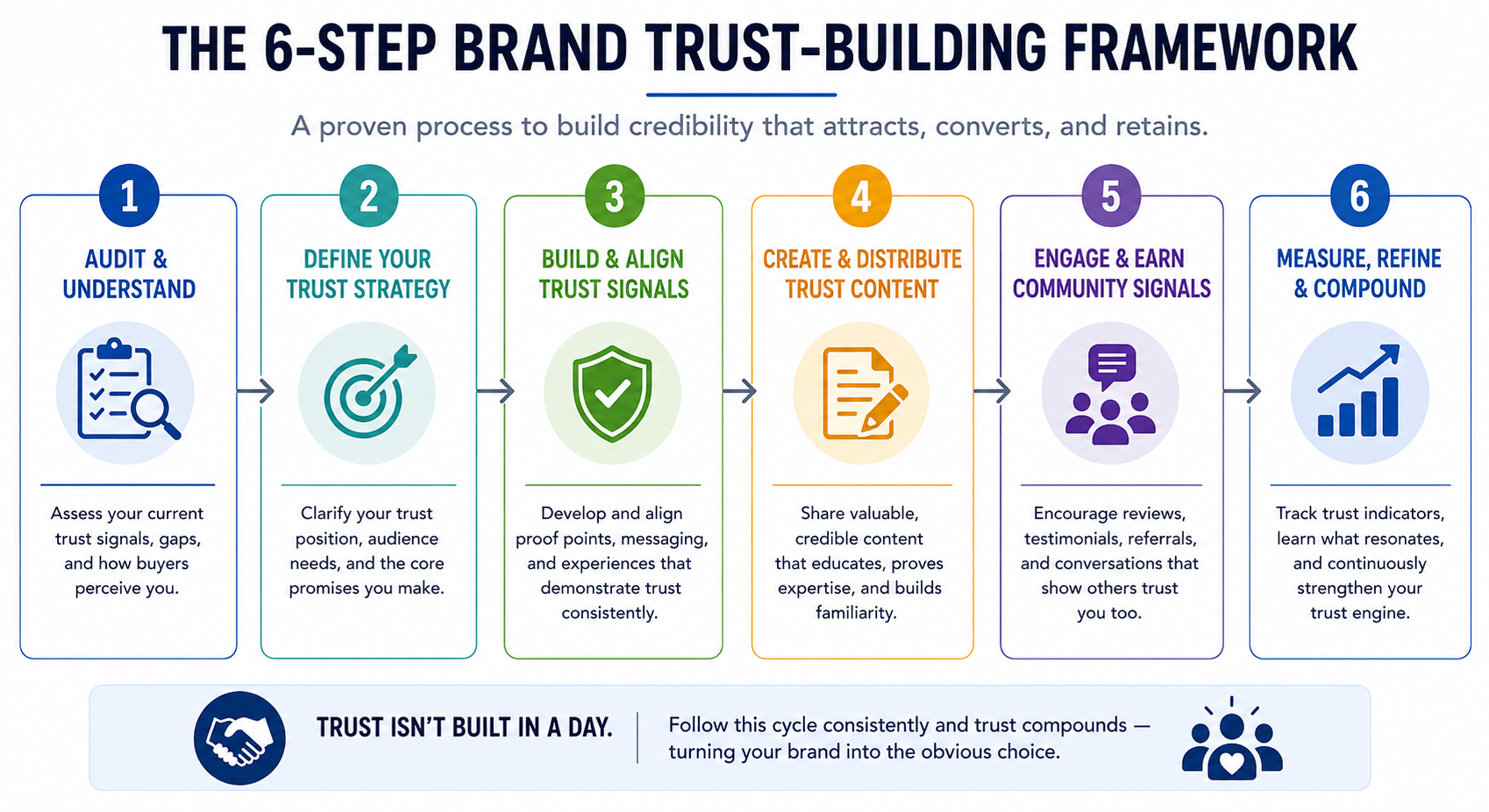
Building genuine brand trust follows a repeatable process — one that starts with an honest audit of where your credibility currently stands and ends with your audience doing the trust-building work for you.
The framework I use with clients in my Build a Trusted Brand services moves through six stages:
- Audit your current trust signals: What proof does a first-time visitor actually see?
- Define your credibility pillars: What three to five areas do you want to be known for?
- Align messaging with proof: Make sure every claim is backed by visible, specific evidence.
- Build consistency across touchpoints: Website, content, emails, and sales conversations should all reinforce the same signals.
- Answer the hard questions honestly: Address cost, comparisons, and weaknesses before buyers have to ask. See: Stop Being Mysterious: Why Answering the Hard Questions Your Competitors Avoid Is Your Secret Weapon
- Activate your audience as advocates — Create conditions for loyal customers to amplify your reputation for you.
What AI-generated brand advice gets right, and where to use it
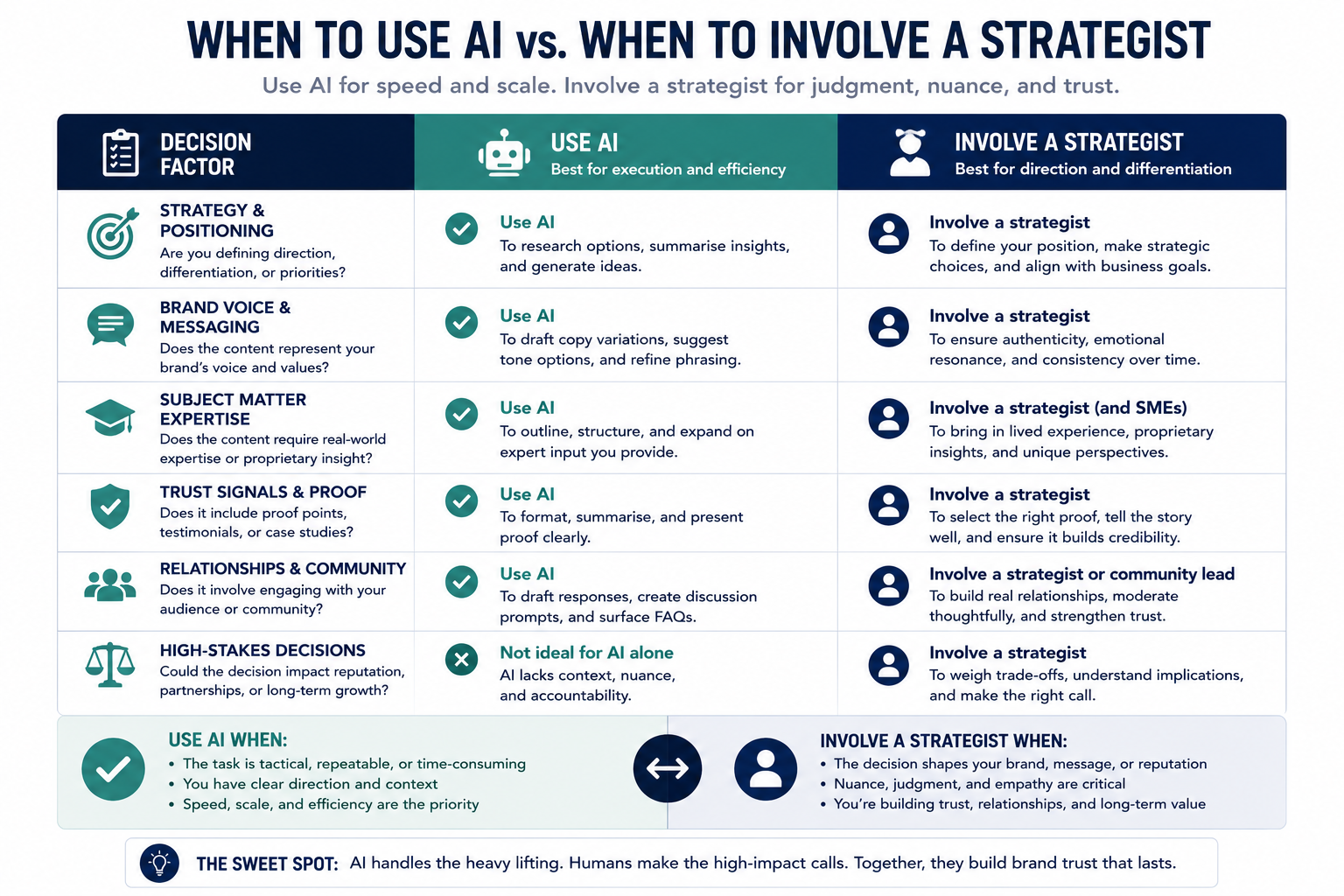
AI tools are genuinely useful for brand-building tasks that involve volume, speed, and pattern recognition, but they are a poor substitute for the strategic judgment that trust-critical decisions require.
Used well, AI can help you maintain a consistent publishing schedule, generate first drafts of buyer-focused educational content, structure FAQ responses, and repurpose long-form articles into shorter formats. These are high-value applications, particularly for teams without dedicated content resource.
The most effective approach treats AI as a capable assistant operating within a human-designed trust framework, not as the architect of that framework.
5 habits that separate trusted brands from merely visible ones
The businesses that build lasting brand trust share a small number of distinctive habits, and almost none of them appear in the average AI response to "how do I build brand trust".
What separates a trusted brand from a merely visible one is not budget or reach; it's a consistent, deliberate commitment to the signals that make buyers feel safe.
Trusted brands consistently:
- Answer the questions buyers are actually asking, including uncomfortable ones about cost and limitations
- Publish proof that is specific and outcome-focused, not vague and generic
- Show up with the same voice and values across every channel
- Treat education as a trust asset, not just a traffic strategy. See: Education-Based Marketing: How to Build Trust and Authority Before You Sell
- Make it easy for buyers to self-qualify, and easy for loyal customers to refer them
Frequently asked questions
Can ChatGPT help me build brand trust?
ChatGPT can support tasks like content drafting, ideation, and structuring buyer-focused articles. It cannot replace the strategic, context-specific judgment that deciding what to say, how vulnerable to be, and which proof points matter most requires.
What is the biggest mistake businesses make when building brand trust?
Treating trust as a messaging problem rather than a behavioural one. Changing your copy rarely builds trust. Changing what you prove and consistently do across every buyer touchpoint does.
How long does it take to build genuine brand trust?
There's no single definitive benchmark, but in my experience working with clients, consistent trust-building activity, such as regular educational content, specific proof, honest communication, typically begins to shift buyer perception within three to six months. Becoming a recognised, trusted authority in your market generally takes 12–24 months of consistent effort.
Is AI-generated brand advice ever reliable?
For general principles and tactical ideas, yes. For strategy specific to your buyers and the credibility gap you need to close, AI-generated advice is a starting point, not a solution.
External link: Harvard Business Review: The Elements of Trust
Conclusion
You arrived questioning whether AI tools are giving you reliable brand trust advice. The short answer: partly. AI is useful, but it cannot replicate the specific, human, and relational elements that genuine trust requires.
You now know the five dimensions AI underweights, the real cost of acting on generic advice, and a six-stage framework for building trust that actually moves buyers from sceptical to loyal. The problem isn't using AI, it's using it without the structural thinking that makes trust-building work.
How to take action now
- Audit your current trust signals; what proof does a first-time visitor actually see on your site?
- Identify which of the five trust dimensions is your weakest area
- Start answering the hard questions your buyers are asking before they have to look elsewhere
- Use AI for volume and speed, but keep strategic decisions human
- Work through the full nine-step Build a Trusted Brand framework to build a complete trust architecture for your business
Your next step is to read Trust-Building Content: The Psychology That Makes Buyers Say Yes; it explains the buyer psychology behind why the five trust signals above work, and how to apply them in your content strategy.

About the author
Tom Wardman is a brand trust strategist and the author of Build A Trusted Brand. He helps business owners and marketing teams build the credibility, consistency, and content strategy that turn browsers into buyers, and buyers into advocates. His work is grounded in buyer psychology, education-based marketing, and the real-world signals that drive commercial trust.
Pricing disclaimer: All GBP–USD price conversions are rounded estimates and correct at the time of publishing. Exchange rates fluctuate and figures should be treated as indicative only.