

Key Takeaways
- Marketing Qualified Leads (MQLs) prioritise quantity over quality, measuring actions rather than genuine intent or trust. Research shows 81% of consumers need to trust a brand before buying, yet MQL systems reward volume — not readiness.
- Poor sales-marketing alignment caused by focusing on MQL volume can lower conversion rates by 70%. The hidden costs include wasted sales time, damaged customer relationships, and missed revenue opportunities.
- Trust metrics measure engagement depth, self-qualification, and conversion quality — revealing whether prospects are building genuine relationships. These include time on page, assignment selling completion, and educated prospect close rates.
- Companies like River Pools achieved 95% closing rates by focusing on trust over lead volume. The transition typically shows early indicators within 6–8 weeks and meaningful sales impact within 3–6 months.
Are your marketing qualified leads actually turning into customers? Or is your sales team chasing prospects who downloaded something but never intended to buy?
For years, B2B marketing teams have relied on MQLs to measure success, yet many companies discover that high lead volume doesn't translate into revenue.
After helping businesses move beyond outdated lead metrics and implement trust-based marketing systems, I've seen the same pattern repeatedly: fewer leads, but dramatically higher close rates.
In this article, you'll learn:
- why MQLs fail as a predictive metric
- the hidden cost of chasing lead volume
- the trust-based metrics that actually signal buying intent
- how to transition from MQL reporting to trust-based measurement
What are marketing qualified leads (MQLs)?
Marketing Qualified Leads (MQLs) are prospects who have taken specific actions, like downloading content or filling out forms, that suggest they might be interested in your product or service.
For decades, MQLs have been the primary metric marketing teams use to demonstrate their value. Marketing teams score leads based on demographics and behaviour, then pass 'qualified' leads to sales for follow-up.
The system sounds logical, but in practice, it often breaks down.
What's wrong with MQLs as a marketing metric?
The fundamental problem with MQLs is that they prioritise quantity over quality, measuring actions rather than genuine intent or trust. Research from Edelman shows that 81% of consumers need to trust a brand before they'll buy, yet MQL systems reward volume, pushing leads to sales who aren't ready or don't trust your brand.
In B2B, where buying decisions involve multiple stakeholders, extended research, and internal approval processes, trust develops through education and repeated engagement, not a single form fill. That's why surface-level actions like downloads are poor proxies for buying readiness.
The truth is that someone downloading a guide doesn't mean they're ready to buy, it often means they're still in early research mode and need education, not a sales pitch.
It's worth noting: MQLs aren't entirely useless. They can help identify early-stage interest and give marketing a starting point for nurturing. But relying on them as the primary performance metric often creates misalignment between marketing activity and sales outcomes, and that's where the real damage occurs.
Why MQL metrics encourage lead volume instead of buyer readiness
When you measure success by form fills, your team optimises for form fills. They gate content and create lead magnets, all to capture contact details. But these tactics don't build trust. They extract information.
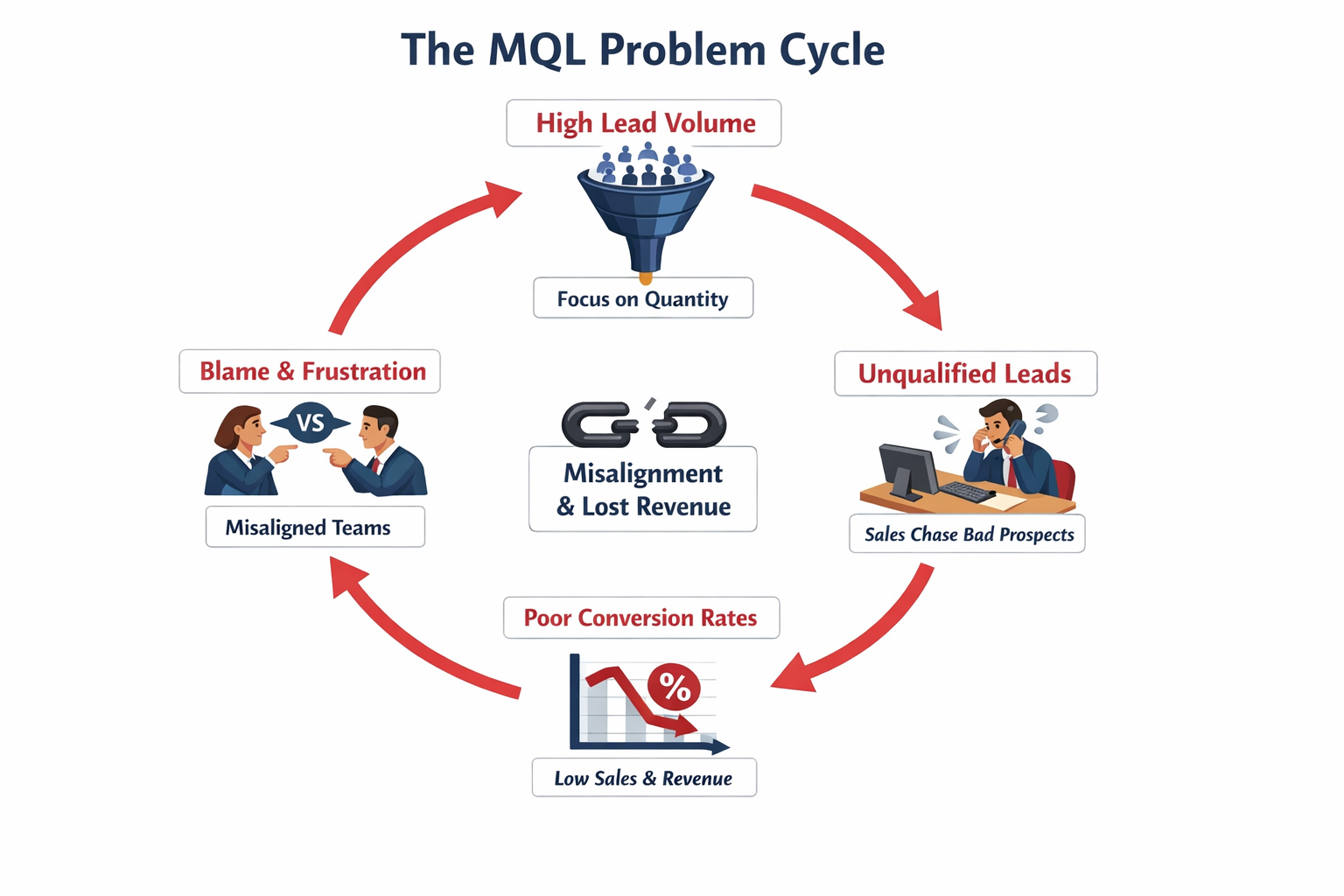
The hidden cost of low-quality MQLs for sales teams
Sales teams waste hours chasing prospects who never had buying intent. The cycle breaks down entirely.
| MQL Problem | Real-World Impact |
|---|---|
| Measures actions, not intent | Sales waste time on unqualified prospects |
| Rewards volume over quality | Marketing budgets spent on wrong tactics |
| Creates misalignment | Sales and marketing blame each other |
| Ignores buyer journey stage | Prospects pitched before they're ready |
How much does an MQL-focused strategy cost?
The hidden costs of MQL-focused marketing include wasted sales time on unqualified leads, damaged customer relationships from premature outreach, and marketing budgets invested in tactics that generate numbers rather than revenue. According to Marketo research, organisations with poor sales-marketing alignment experience 70% lower conversion rates.
A typical B2B sales rep spends 5–7 hours per week following up on marketing leads that go nowhere. At a fully loaded cost of £50,000–£70,000 ($62,500–$87,500) per sales rep annually, that's £12,000–£16,000 ($15,000–$20,000) wasted per person, per year.
When your entire marketing system is designed to generate form fills for MQL targets, you're training your team to optimise for the wrong outcome.
MQLs vs trust metrics: what's the difference?
Understanding the cost of MQL-driven marketing raises an important question: if MQLs aren't reliable indicators of buying intent, what should you measure instead?
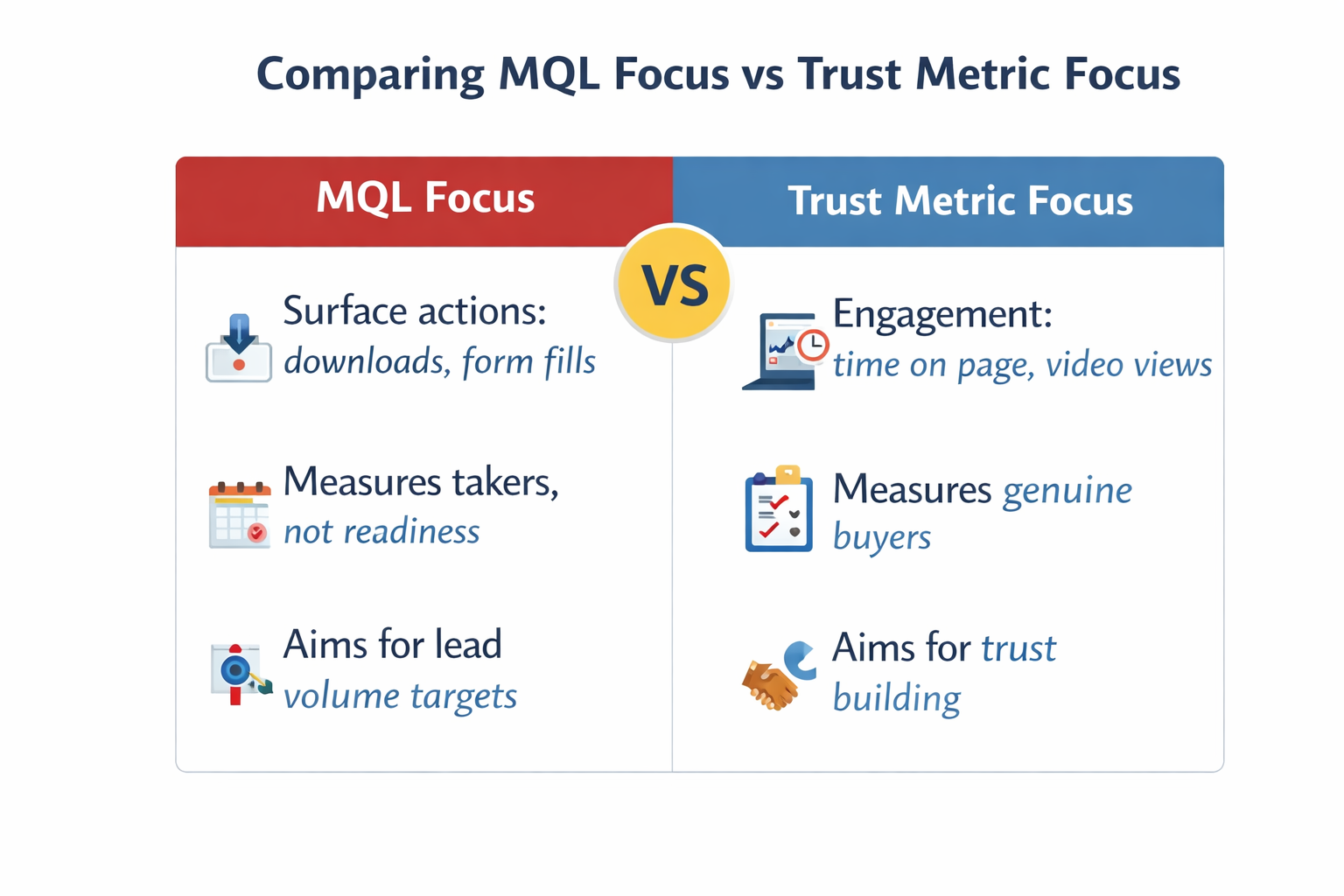
MQLs measure surface-level actions — form fills, downloads, demo requests — whilst trust metrics measure genuine engagement, education, and relationship depth. The key difference is that MQLs ask 'did they take an action?' whilst trust metrics ask 'are they actually ready to make an informed buying decision?'
Trust metrics include engagement depth (time on page, scroll depth, content consumed), self-qualification (assignment selling completion), and conversion quality (close rates, deal value, customer lifetime value).
These metrics tell you whether prospects are building the trust needed to become customers, not just whether they clicked a button.
Trust metrics: what to measure instead of MQLs
The most effective trust metrics fall into three categories that together paint a complete picture of how well you're building genuine relationships with prospects.
Engagement and education metrics
- Time on page (aim for 3+ minutes on educational content)
- Scroll depth (80%+ indicates genuine reading)
- Return visitor rate
- Video completion rates
Self-qualification metrics
- Assignment selling completion rate
- Comparison content engagement
- Problem/limitation content views
- Self-service calculator usage
Sales impact metrics
- Sales cycle length (educated vs uneducated prospects)
- Close rate by content engagement level
- Customer lifetime value by acquisition source
Should you stop using MQLs completely?
This is the most common question that comes up when businesses start exploring trust-based measurement, and it deserves a direct answer.
No, you don't need to abandon MQLs entirely overnight. The more practical approach is to demote them: treat MQLs as one early-stage signal among many, rather than the primary measure of marketing success.
The real problem isn't that MQLs exist; it's that they've been elevated to a status they don't deserve. When MQL volume drives compensation, reporting, and strategy, it distorts behaviour across your entire revenue team.
The transition looks like this: keep MQLs as a rough filter for early-stage interest, but layer in trust and engagement metrics to determine which of those prospects are actually worth your sales team's time.
How to implement trust-based measurement in your business
Transitioning from MQL-focused to trust-based measurement requires a systematic approach that aligns your sales and marketing teams around quality rather than quantity.
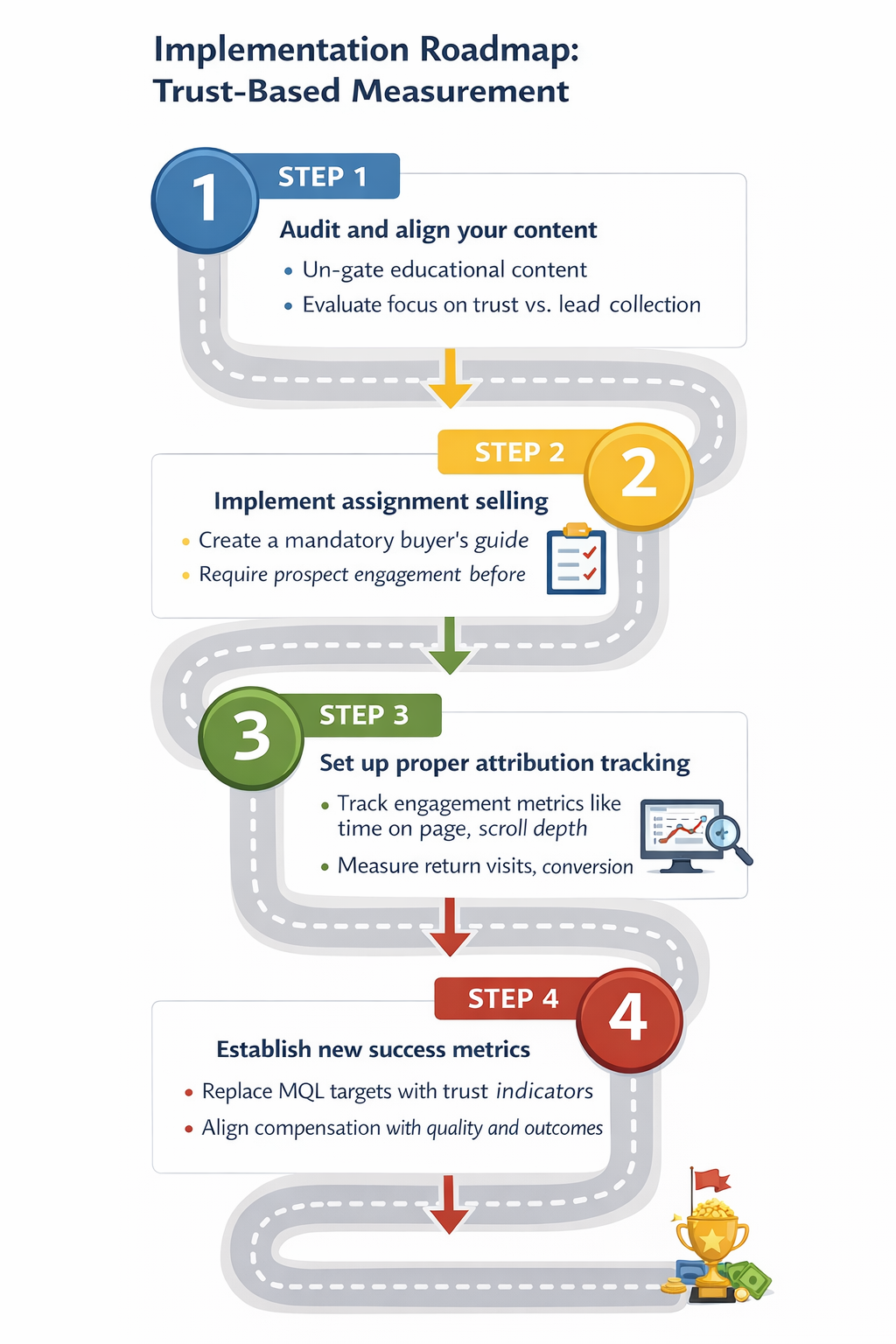
Once you understand which trust metrics matter, the next challenge is implementing them across your marketing and sales systems. Here's how to do that in four structured steps.
Step 1: Audit and align your content
Review every piece of content and ask: does this build trust, or does it just collect email addresses? Un-gate your best educational content.
Step 2: Implement assignment selling
Create comprehensive resources that answer every question prospects have. Make engagement mandatory before sales calls. When River Pools implemented this with their 30-page buyer's guide, their closing rate soared to 95%.
Step 3: Set up proper attribution tracking
Use your CRM or analytics tools to track engagement depth, not just conversion events. Measure scroll depth, time on page, and return visits.
Step 4: Establish new success metrics
Replace MQL targets with trust-building indicators. Align compensation around engagement quality and sales outcomes, not lead volume.
7 best practices for trust-based marketing
The most successful trust-based marketing programmes share seven common characteristics:
- Ungated content: Make your best educational resources freely accessible
- Honest problem discussion: Address limitations and challenges openly
- Assignment selling: Require prospect education before sales conversations
- Self-service tools: Provide calculators, comparisons, and assessments
- Sales-marketing alignment: Unite both teams around shared quality metrics
- Long-form, comprehensive content: Create resources that genuinely educate
- Transparent positioning: Deliberately attract ideal customers whilst repelling poor fits
Case study: How trust-based marketing increased close rates
Marcus Sheridan's River Pools and Spas provides the textbook example: after publishing honest content about fibreglass pool problems and implementing assignment selling, they achieved a 95% closing rate whilst reducing their sales cycle by 75%. By openly answering questions buyers were already researching, including problems, costs, and comparisons, they built trust long before the sales conversation began.
The key wasn't generating more leads; it was generating more trust.
In my consulting work, I've seen this pattern repeatedly: when companies shift from lead-volume metrics to trust indicators, they often experience fewer leads but significantly higher conversion rates. Lead volume typically drops 30–50% initially, but close rates double or triple, and sales cycles shorten dramatically.
Common mistakes when measuring trust
The biggest mistake companies make is trying to measure everything at once rather than starting with high-impact indicators that reveal genuine behaviour change.
Another critical error is failing to align sales and marketing around the new metrics, continuing to compensate marketing teams based on MQL volume whilst expecting them to focus on quality.
Five common mistakes:
- Measuring everything: Start with 3–5 high-impact metrics only
- Misaligned incentives: Change compensation before changing metrics
- Impatience: Trust-building takes 3–6 months to show revenue impact
- Ignoring sales input: Involve sales in defining "qualified"
- Forgetting attribution: Invest in tracking technology from day one
Frequently asked questions about trust metrics
How long does it take to see results from trust-based marketing?
Early indicators appear within 6–8 weeks (engagement metrics, content consumption), whilst meaningful sales impact typically materialises within 3–6 months. The timeline depends on your sales cycle length.
Will our lead volume decrease if we stop focusing on MQLs?
Yes, initially by 30–50%. But lead quality improves dramatically — close rates often double or triple. Your sales team will thank you for fewer, better-qualified prospects.
How do we get executive buy-in for measuring trust instead of leads?
Present the cost analysis: calculate time wasted on poor-quality MQLs and compare it to potential improvement in close rates. Frame it as improving sales efficiency.
What is a good MQL-to-SQL conversion rate?
Industry benchmarks vary widely, but a typical B2B MQL-to-SQL conversion rate sits between 13% and 27%. If yours is consistently below that range, it's often a signal that your MQL definition is too loose — capturing interest rather than intent. Trust-based measurement helps here: when you layer engagement signals onto your MQL criteria, the prospects that do reach sales are far more likely to convert.
What's the difference between an MQL and a sales-qualified lead (SQL)?
An MQL is a prospect who has taken actions suggesting potential interest — typically based on marketing-defined criteria like downloads or form fills. An SQL is a prospect that the sales team has evaluated and confirmed as a genuine buying opportunity. The gap between the two is where most B2B revenue leakage occurs.
Can trust metrics work in B2B and B2C environments?
Absolutely. The principles remain consistent: measure engagement, education, and genuine intent rather than surface actions.
Can you measure trust without removing lead forms?
Yes. You don't have to remove lead forms to begin tracking trust metrics. Start by layering engagement data — time on page, scroll depth, return visits — alongside your existing form-fill data. Over time, you'll be able to identify which MQLs show genuine trust signals and which don't, and use that insight to prioritise sales activity more effectively.
What tools do we need to measure trust metrics?
Start with what you have: Google Analytics 4 for engagement metrics, your CRM for attribution, and basic scroll-tracking tools like Hotjar.
Conclusion
For years, marketing teams have relied on MQL volume to prove their value, even when those numbers failed to produce revenue.
Now you've seen a different approach: measuring trust, education, and engagement instead of surface actions.
When you align marketing and sales around trust-based metrics, something powerful happens: fewer leads, but more informed buyers, shorter sales cycles, and dramatically higher close rates.
The question isn't whether to move beyond MQLs; it's how quickly you can implement trust-based measurement before your competitors do.
How to take action now
- Audit your current content: Identify your best educational resources and un-gate them immediately
- Define your trust metrics: Choose 3–5 key indicators that reveal genuine engagement
- Align your teams: Redefine what "qualified" actually means together
- Implement assignment selling: Create one comprehensive resource prospects must engage with before calls
- Adjust your reporting: Start tracking engagement depth alongside lead volume
Ready to implement trust-based measurement? Explore my Fractional Marketing Director services. As your outsourced marketing director, I'll build and execute strategies that create trust with customers and drive steady growth.

About the author
I'm Tom Wardman, and I help businesses build marketing that creates trust and drives reliable revenue growth. Using the Endless Customers System™, I've worked with companies across industries to move beyond outdated lead generation tactics and implement trust-based strategies that actually convert.
Pricing disclaimer: All GBP–USD price conversions are rounded estimates and correct at the time of publishing. Exchange rates fluctuate and figures should be treated as indicative only.
Topics: