

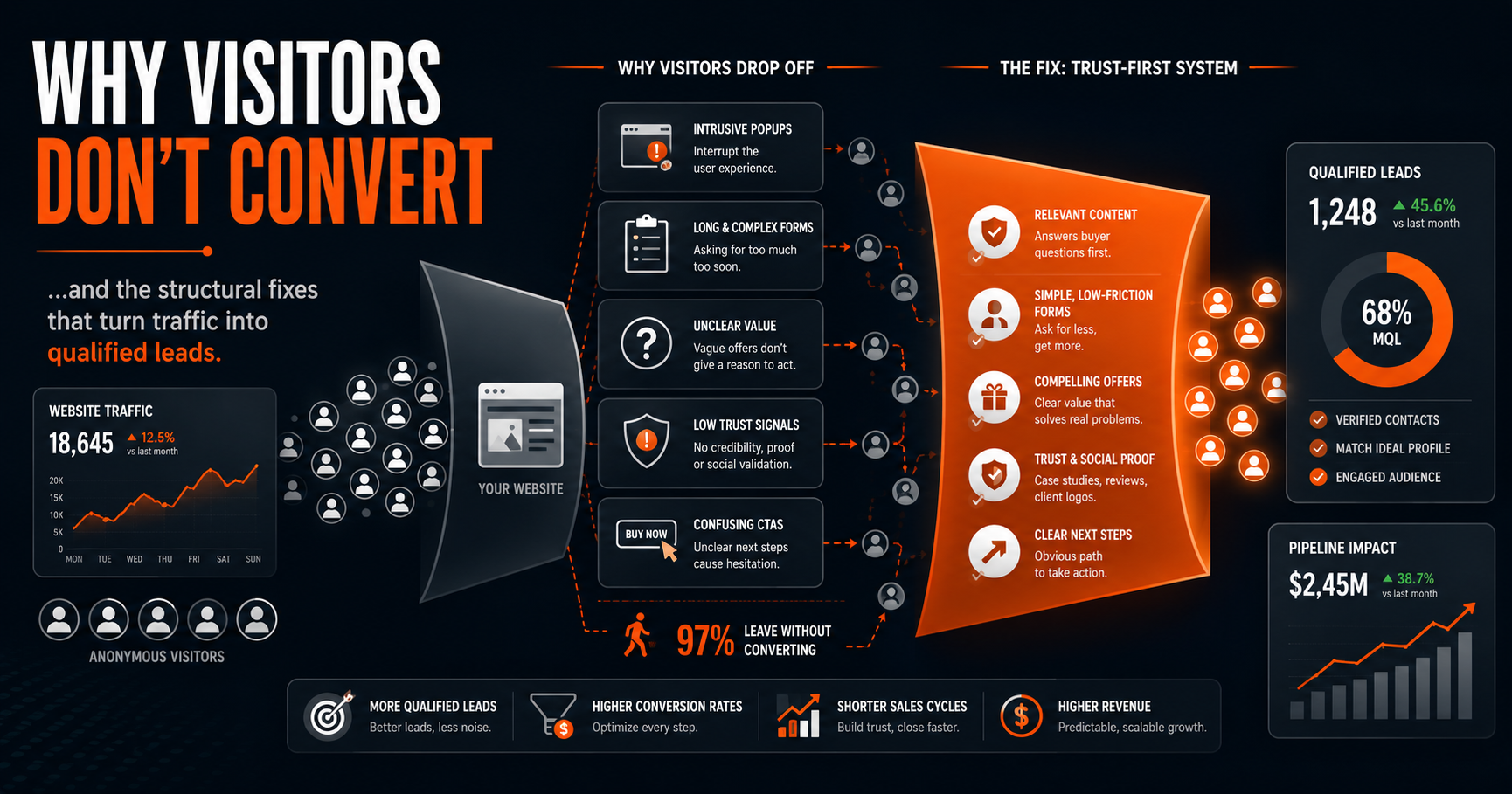
Does your website attract a steady flow of visitors but produce very few leads? Are you unsure whether the problem sits with your content, your forms, or what you're offering in return for someone's contact details?
This article is for business owners and marketing leads who are generating traffic but not capturing qualified prospects. It explains the structural reasons most websites fail to convert — and gives you a clear, repeatable system to fix it.
You will learn the most common mistakes, what poor lead conversion costs you over time, how to choose between gated and ungated content, and a step-by-step guide to building a trust-first lead capture system your team can own.
Key Takeaways
- A qualified lead is a visitor who has voluntarily shared their contact details because they trust you enough to want more, and who matches your ideal buyer profile.
- On average, 80% of a buyer's purchasing decision is made online before they ever contact a business. Your website is your most important sales asset.
- Most websites fail to convert visitors into leads because they ask for trust before earning it, not because they lack traffic.
- Copyblogger increased sign-up conversions by 400% simply by asking for email only, removing all other fields.
- Companies serious about lead nurturing generate 50% more sales-ready leads at 33% lower cost.
What does it mean to convert a website visitor into a qualified lead?
A qualified lead is a website visitor who has voluntarily shared their contact details because they trust you enough to want more — and who matches the profile of your ideal buyer.
There is a meaningful difference between these three stages:
| Stage | Definition |
|---|---|
| Visitor | Someone who lands on your website but takes no action and leaves no trace. |
| Prospect | Someone who has engaged with your content, for example, read an article, watched a video, returned multiple times, but has not yet identified themselves. |
| Qualified lead | Someone who has exchanged their contact details for something of value and whose profile matches your ideal buyer. |
On average, 80% of a buyer's purchasing decision is made online before they ever contact a business. This is what Google calls the "Zero Moment of Truth", the research phase buyers go through before picking up the phone or filling in a form. Your website is either building trust during that window or losing the buyer permanently without a word exchanged.
Why most website visitors don't convert, and it's not what you think
Most websites fail to convert visitors into leads not because of low traffic, but because they ask for trust before they have earned it.
Three structural mistakes cause most of the damage.
Mistake 1: Asking for too much, too soon
Pop-ups that fire on arrival. Forms demanding phone number, company size, and job title before delivering a PDF download. These signal to the visitor that you value your data more than their experience.
Adding more fields to your contact forms doesn't get you better leads, it gets you fewer leads. Copyblogger proved this when simplifying their form to email only produced a 400% increase in conversions.
Mistake 2: Offering nothing compelling in return
"Sign up to our newsletter" describes what you want, not what the visitor receives. Generic offers produce weak conversion rates because they give the reader no clear reason to act.
The contrast is stark. "Download our guide" tells a visitor nothing. "The exact checklist we use to reduce client onboarding time by 50%" tells them exactly what they'll walk away with. The more specific the offer, the more clearly the value of the exchange lands, and the higher your conversion rate.
Mistake 3: No trust established before the ask
Your content, like articles, guides, comparisons, and honest answers to buyer questions, is where trust is built before any form is ever seen. Skip this step and your forms will remain empty regardless of how well they are designed.
What does poor lead conversion actually cost your business?
The real cost of poor lead capture isn't a low conversion rate — it's the compounding loss of every visitor who leaves without a reason to return, multiplied across months and years of marketing spend.
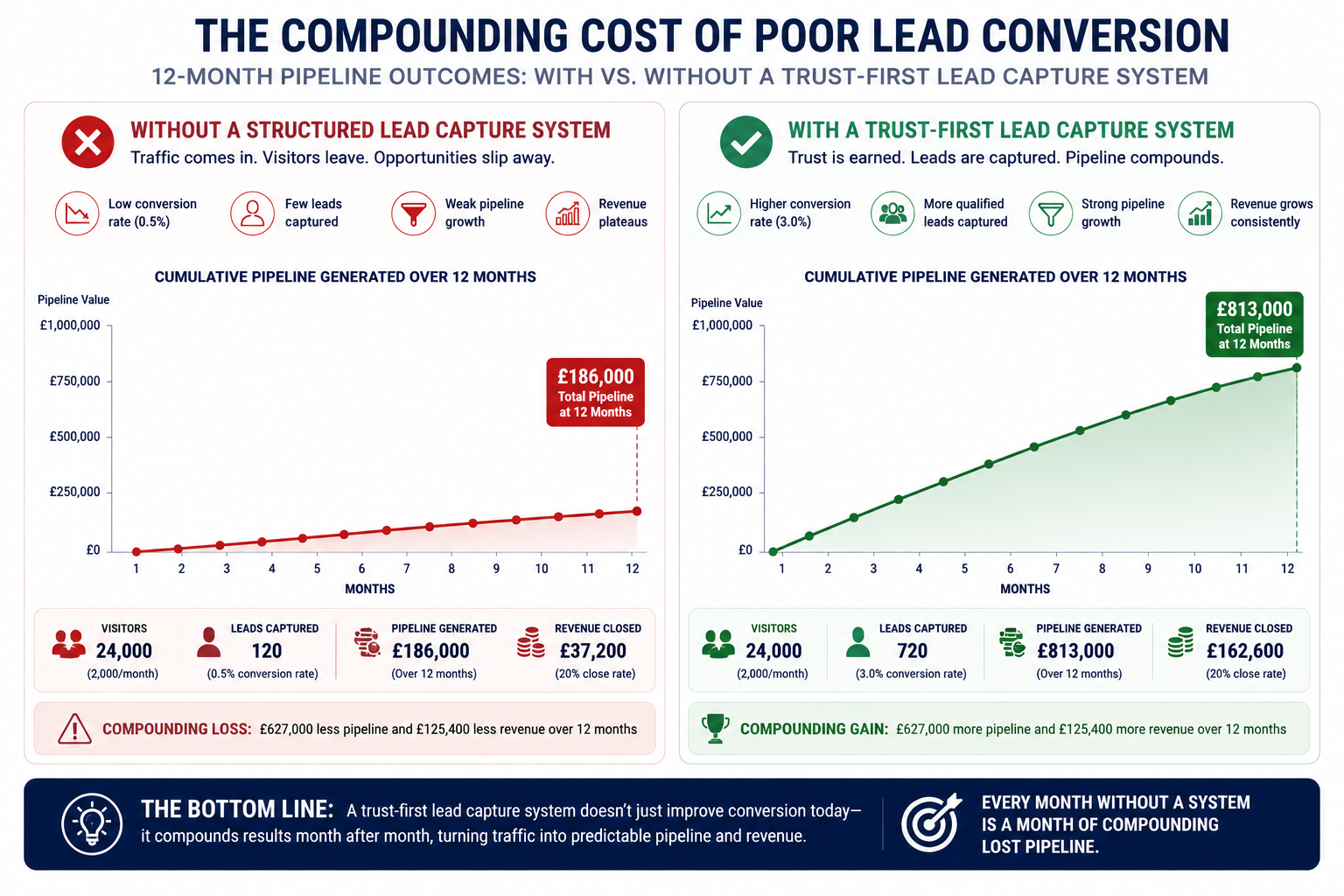
To put it plainly: every month without a structured system is a month of compounding lost pipeline. Traffic without capture is marketing spend with no return.
Companies that take lead nurturing seriously generate 50% more sales-ready leads at 33% lower cost than those that don't. That gap widens every month a structured system is absent.
Gated content vs. ungated content: which produces more qualified leads?
Gated content generates qualified leads by exchanging valuable resources for contact details, while ungated content builds broader trust and reach. The most effective websites use both, depending on where the buyer is in their journey.
Grammarly's growth to millions of daily active users illustrates this approach well. Rather than requiring a sign-up immediately, Grammarly offered a free browser extension first. Users experienced the value, then chose to register. Grammarly made signing up feel like a natural next step rather than a toll gate, and that distinction matters.
It is worth noting this approach does not work universally. Some B2B buyers expect to register before accessing premium resources, and in certain sectors, early gating can signal exclusivity rather than friction. The right balance depends on your audience, your content maturity, and how much trust your brand has already built.
Use ungated Big 5 content, covering cost, comparisons, problems, reviews, and best-in-class answers, to build trust early. Then offer gated resources such as templates, guides, and frameworks as a fair exchange once the buyer is engaged.
The 5 best lead capture strategies that actually convert
The fair trade lead magnet
Offer something specific and immediately useful. "The exact checklist we use to cut client onboarding time in half" outperforms "download our guide" because the value is concrete and the trade feels fair.
The Learning Hub
A central repository of gated downloadable resources that builds a qualified email list while positioning your brand as the authority in your space. See: Building a Learning Hub That Converts: Complete Guide
The minimal-friction form
First name and email only. Enough to personalise follow-up; not so much that it deters interested prospects.
Trust-building content
Big 5 articles that answer cost questions, make honest comparisons, and address real problems pre-qualify visitors before they ever reach a form. See: The Big 5 Questions Every Buyer Wants Answered Before They Buy
Personalised automated follow-up
A sequence that references what the person downloaded, adds related value, and extends a logical next step. Automation that still feels human converts. Automation that feels robotic doesn't.
The common thread across every high-converting lead capture system is the same: demonstrate value before requesting information, not after. This principle applies across most contexts, though the sequencing will vary depending on audience sophistication and the complexity of what you sell.
How to build a trust-first lead capture system: step-by-step
Building a trust-first lead capture system starts with one honest question: if you were a visitor to your own website, would you fill in your contact form?
-
Audit your forms. Review every form on your site. Remove every field you cannot justify. First name and email is the default starting point.
-
Create a specific lead magnet. Use this formula: specific outcome + mechanism + effort saved. The more precise the promise, the higher the conversion rate.
-
Build a Learning Hub. Organise your downloadable resources around buyer questions and pain points, not product categories or internal assumptions. See: Build a Learning Hub, Not a Blog: How to Create Scalable Content That Converts
-
Set up a human-feeling automated sequence. Your welcome email should arrive immediately. Each follow-up should add related value before making any further ask. Avoid sending the same generic message to every subscriber.
-
Measure what matters. Landing page conversion rate, form completion rate, and email open rates tell you exactly where the system is leaking. Fix one at a time.
The three rules of effective lead capture: make it clear what the visitor will receive, ask for the minimum information needed to start a meaningful conversation, and follow up quickly and personally, even if that follow-up is automated.
Frequently asked questions about converting website visitors into leads
What is the most effective type of lead magnet for B2B businesses?
The most effective B2B lead magnets are specific, immediately actionable, and tied to a problem your ideal buyer is actively solving. Templates, checklists, and frameworks consistently outperform general guides. The more specific the promise, the higher the conversion rate.
How long does it take to see results from a lead capture system?
Most businesses see improvement in conversion rates within 30–60 days of implementing a structured lead magnet and simplified form. A full Learning Hub with compounding content and a growing organic audience typically takes 6–12 months to produce consistent, predictable lead flow.
Should I use a pop-up to capture leads?
Pop-ups can convert well when timed correctly — but timing and relevance determine whether they help or harm. A pop-up triggered after 60 seconds on a relevant article, offering a related resource, can add conversion volume without friction. A pop-up that fires immediately on arrival signals to the visitor that data collection matters more than their experience.
How do I know if my lead capture system is actually working?
Track three numbers: landing page conversion rate, form completion rate, and email open rate on your welcome sequence. If your landing page converts below 2–3%, the offer or the page needs work. If the form completion rate drops sharply, the form has too many fields. If open rates fall after the first email, the follow-up sequence isn't earning continued attention. Measure one metric at a time and fix the biggest leak first.
Do I need a CRM to manage leads effectively?
A CRM makes lead management significantly more structured, but it is not the starting point. A well-designed form connected to an email sequence can generate and nurture leads before any CRM is in place. The priority is building the capture and follow-up system first. A CRM becomes essential once lead volume grows beyond what a shared inbox or spreadsheet can manage reliably.
Conclusion
Most websites that fail to convert visitors into leads are not suffering from a traffic problem. They have a structural gap between what visitors need to receive and what the site is currently offering in exchange.
The fix is built in layers. Start with an honest audit of your main contact form. Build outward from there, a specific lead magnet, a simplified form, content that answers buyer questions before they are asked, and a follow-up sequence that earns trust rather than demands it. Each improvement compounds into the next.
How to take action now
- Audit your contact form today and remove every field that cannot be justified.
- Write a specific, outcome-led lead magnet offer and test it against your current one.
- Review your automated follow-up sequence — does it feel personal or mechanical?
- Read Why Your Blog Isn't Getting Leads (And How to Fix It) to identify gaps in your content architecture.
If you want a complete lead capture system built and transferred to your team, the Endless Customers™ Implementation programme installs the full framework over 18–24 months.

About the author
Tom Wardman is a fractional marketing consultant and Growth Independence Architect™ helping founder-led B2B businesses replace agency dependency with self-sufficient growth systems. He is the author of Build a Trusted Brand and developer of the Trust BLUEPRINT™, a 9-step framework for building customer trust that drives measurable, predictable revenue. Tom is one of the UK's first five certified coaches in the Endless Customers methodology, trained directly under Marcus Sheridan.
Topics:
