Are your search rankings generating traffic but not enough customers? And if buyers do find you, does appearing on page one make them trust you enough to buy?
I've spent years coaching founder-led B2B businesses through exactly this problem, as one of the UK's first five Endless Customers™ coaches trained directly under Marcus Sheridan. These questions are becoming harder for founder-led businesses to ignore, and the answers are growing less comfortable.
This article is for business owners and marketing leads who have invested in SEO and are now questioning whether it is earning its keep. You will understand why rankings alone are no longer sufficient, what the data shows about shifting buyer behaviour, and what a trust-first content strategy actually looks like in practice.
Key takeaways
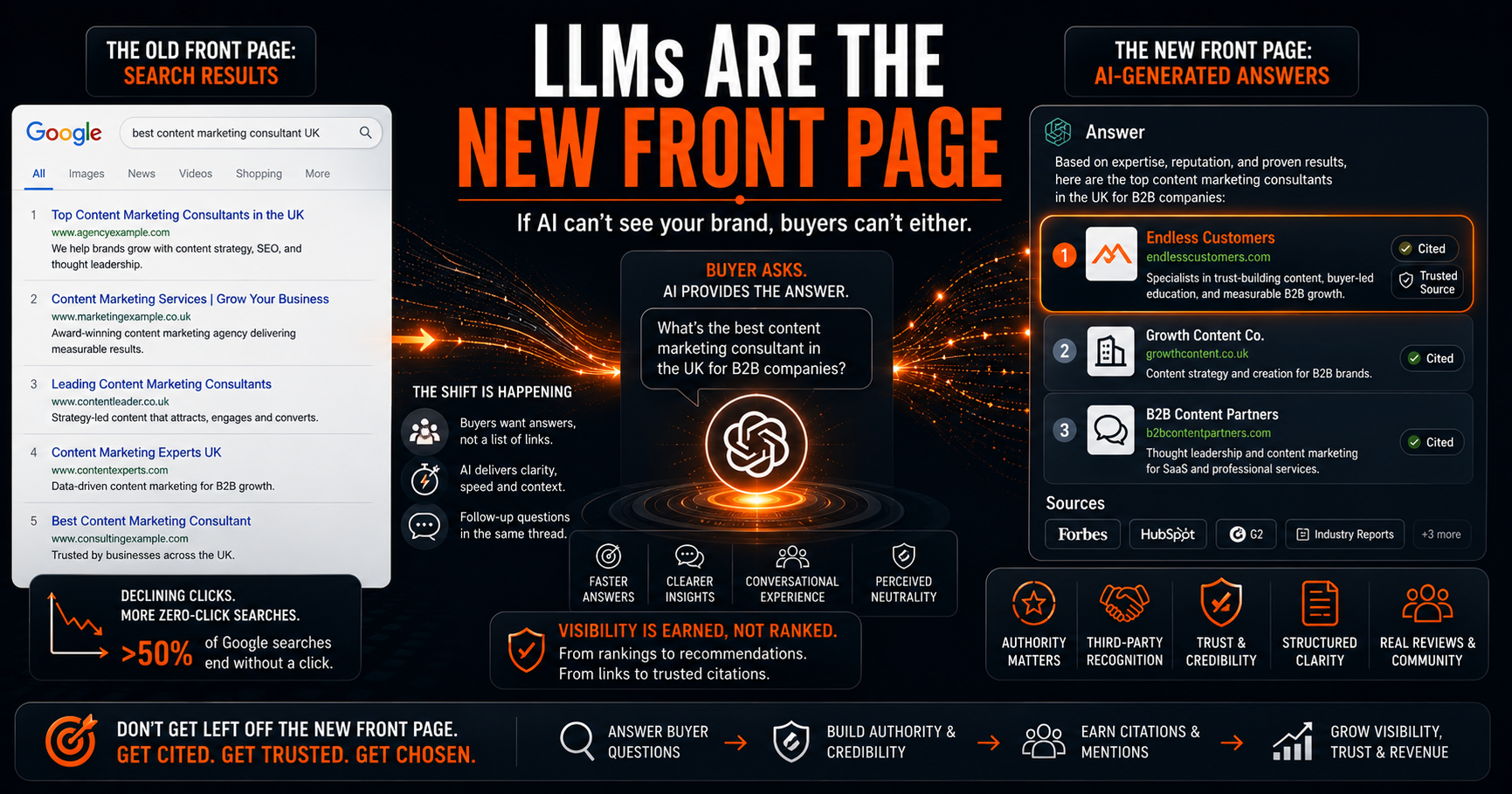
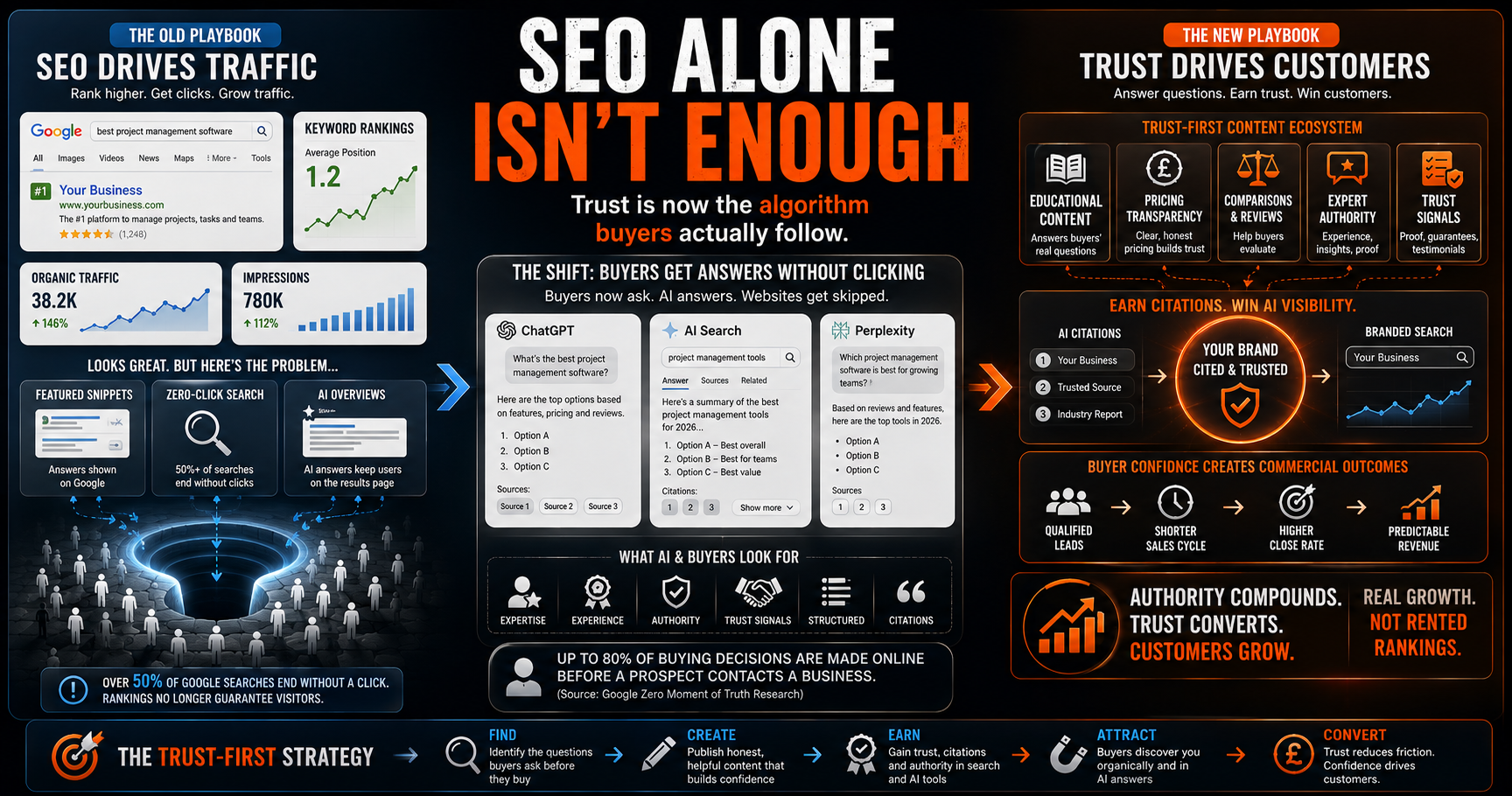
- More than 50% of Google searches now end without a click to any website, making rankings alone an unreliable path to new customers.
- AI tools like ChatGPT and Perplexity cite trusted, structured sources, not just high-ranking pages, which changes who actually gets found.
- Businesses relying solely on SEO typically spend £1,000–£5,000+ ($1,300–$6,700+) per month and see diminishing returns as zero-click search grows.
- Trust-based content builds buyer confidence, earns AI citations, and shortens sales cycles, outcomes SEO alone cannot deliver.
- Shifting to a trust-first strategy starts with answering the questions your buyers actually ask before they spend money.
What does "SEO alone doesn't drive customers" actually mean?
Saying SEO alone doesn't drive customers means that ranking on Google is no longer sufficient to convert browsers into buyers, because the majority of searches now end without a single website click.
SEO (search engine optimisation) is the practice of structuring content to rank well in search results. For years, a page-one ranking meant traffic, and traffic meant leads. That connection is weakening fast.
Search results now include featured snippets, AI-generated answers, and knowledge panels that respond to questions directly on the results page. Tools like ChatGPT and Perplexity go further still, responding to queries without referencing websites at all.
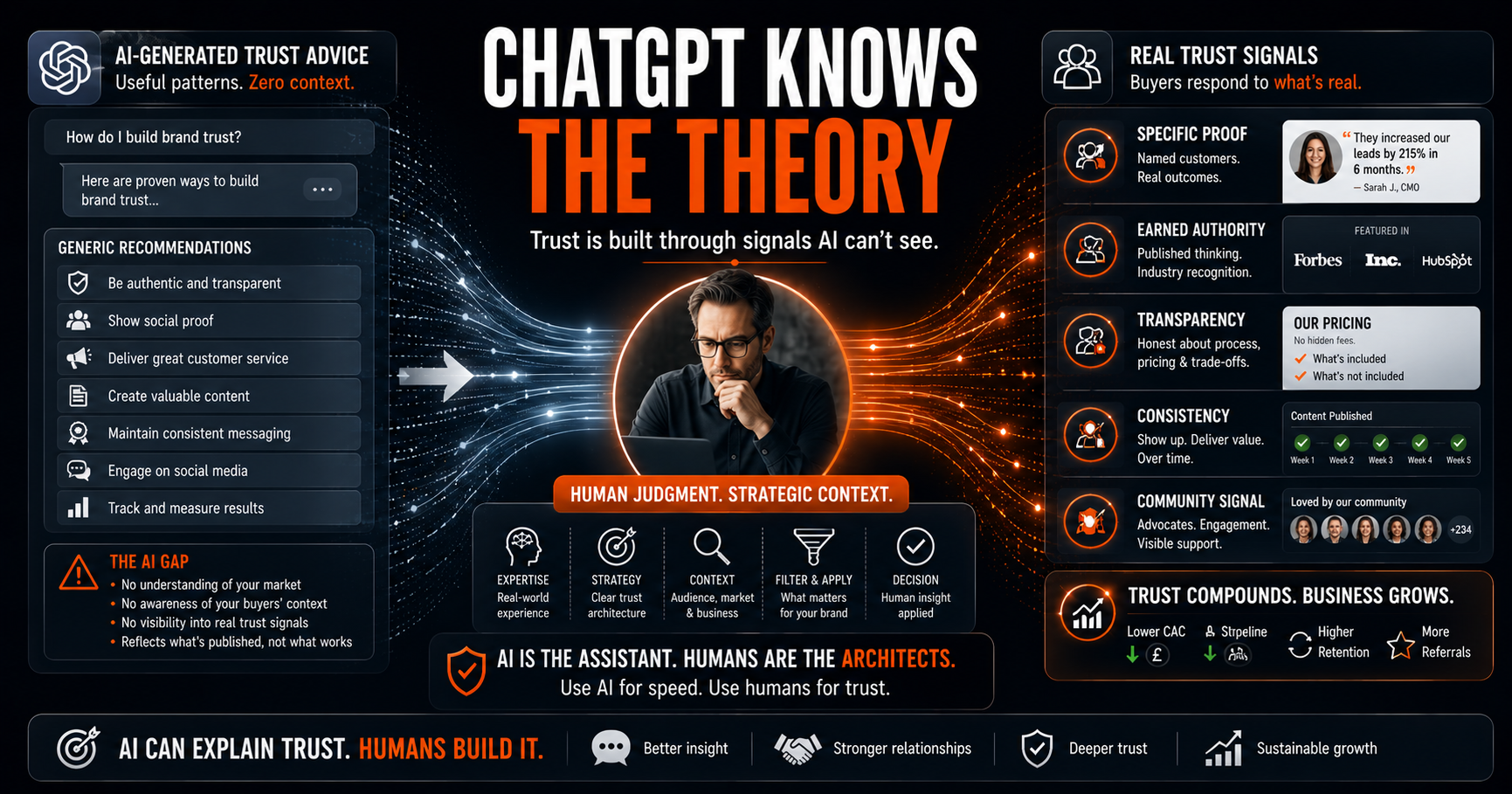
Ranking is still valuable. But it has never built trust, and trust is what converts buyers. A buyer who finds your page and leaves feeling no more confident than when they arrived will not become your customer.
The data: how zero-click search is changing everything
More than 50% of all Google searches now end without a click to any website, a figure that keeps rising as AI tools absorb more query volume.
Only 18% of all searches now originate on Google at all, with the rest happening on YouTube, social platforms, and AI tools. (Figure derived from data reported in Build a Trusted Brand. Treat as indicative.)
This is not a temporary dip in traffic. It is a structural change in how buyers find, evaluate, and act on information before they spend money.
The real cost of an SEO-only strategy
Businesses investing exclusively in SEO typically spend £1,000–£5,000+ ($1,300–$6,700+) per month on agency fees and content production, yet see declining returns as zero-click search erodes the traffic those rankings were built to capture.
(Estimate based on typical UK/US B2B SEO agency pricing. Treat as indicative; exact costs vary by scope and market.)
The harder cost is the opportunity cost. Every month spent chasing rankings is a month not spent building the brand trust that converts buyers.
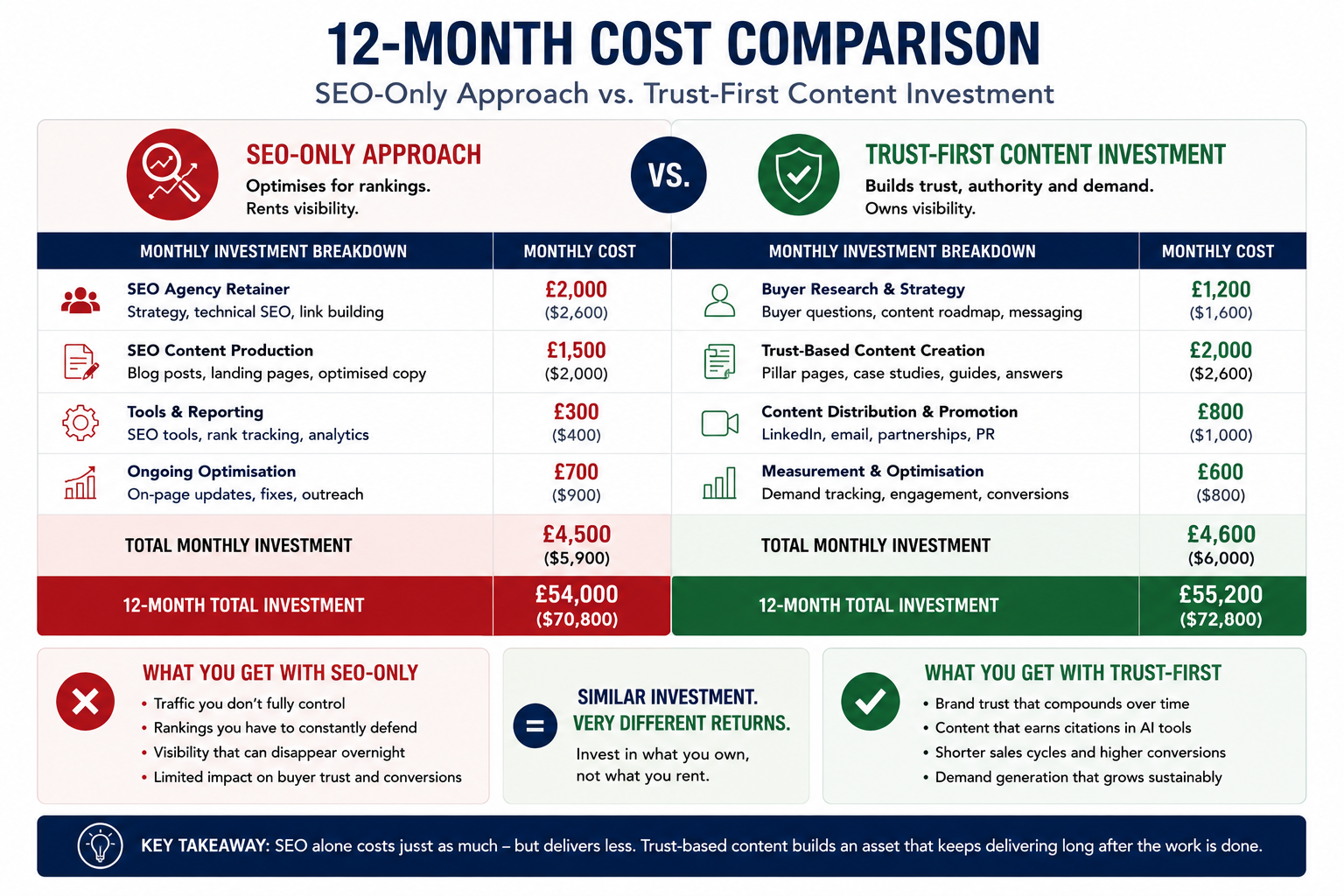
A quick way to assess your own exposure: multiply your monthly SEO spend by 12. Then ask what you own at the end of that year, positions you rent, or authority you have built.
The problems with relying solely on SEO
The core problem with an SEO-only strategy is that it optimises for visibility, not trust, and visibility without trust rarely converts.
4 failure modes appear repeatedly:
- You rank but don't reassure: Buyers find your page, see nothing that builds confidence, and leave. Price becomes the only differentiator.
- AI tools ignore you: ChatGPT and Perplexity cite trusted, structured sources. Without strong authority signals, your content is absent from AI-generated answers.
- Rankings disappear overnight: Algorithm changes can erase years of SEO work. Brand trust builds over time; rankings do not.
- Content serves the algorithm, not the buyer: SEO-structured content often fails to answer what buyers are actually asking at 11pm before they decide who to trust.
When buyers find your content but leave without feeling genuinely educated or reassured, the sale goes to whoever answered their questions most honestly.
SEO vs. trust-based content marketing: what's the difference?
SEO optimises for search engine rankings; trust-based content marketing optimises for buyer confidence — and only one of those directly drives purchasing decisions.
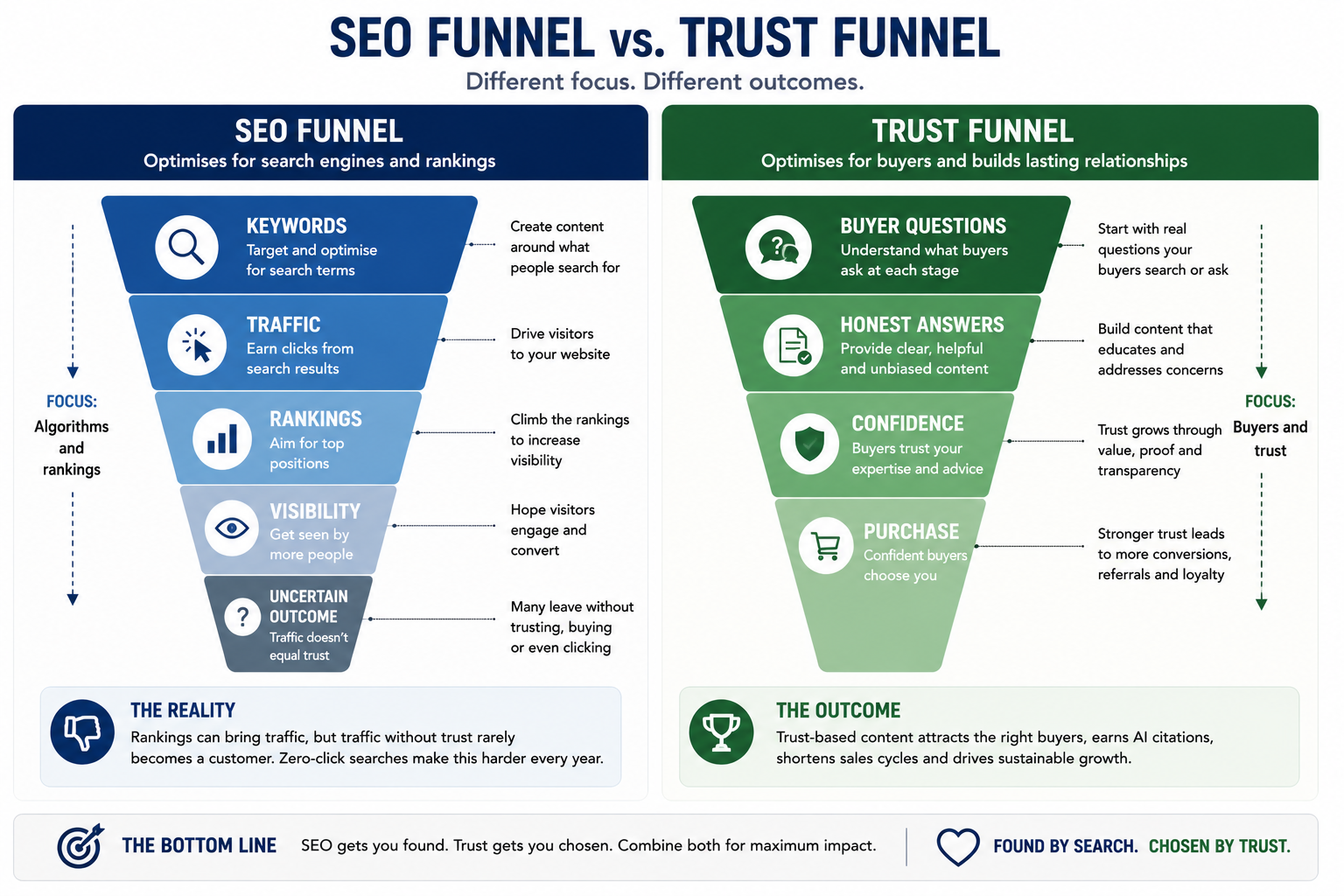
An SEO-only approach focuses on keywords and metadata. A trust-first strategy answers the real questions buyers ask before they part with their money. These approaches are not mutually exclusive, but they require very different content decisions.
What actually drives customers today: 5 strategies that work
The strategies that drive customers today combine zero-click content, buyer education, multi-platform trust signals, and AI-optimised formatting, not search rankings alone.
Zero-click answer content
Structure your FAQs and articles to appear in featured snippets and AI responses. Solve the question and earn the brand recognition that follows.
Buyer-education content and assignment selling
Share content with prospects before sales calls. Businesses using this approach regularly report shorter sales cycles and better-qualified leads. See: Why every sales conversation should start with a blog post.
Trust signals
Transparent pricing, case studies, author credentials, and reviews all signal credibility to both buyers and AI tools. My AI Visibility Optimisation service audits 19 trust signals and fixes the gaps.
Video and voice content
Conversational, question-based content is indexed by voice assistants and YouTube; 2 channels traditional SEO rarely addresses directly.
Branded search growth
When buyers search specifically for your brand name, trust is doing its work. Build authority over time and branded search follows.
How to shift from SEO-only to a trust-first content strategy
Shifting from an SEO-only strategy to a trust-first approach starts with one question: what are your buyers really asking before they decide to spend money?
Phase 1: audit, identify, restructure (steps 1–3)
- Audit your current content: Which pages rank but do not convert? That gap reveals the trust deficit.
- Identify real buyer questions: Use sales call recordings and CRM notes, not just keyword tools. See: How to transform customer questions into your endless content engine
- Restructure for AI retrievability. Clear headings, bolded direct answers, and structured lists help AI tools cite your content. See: How to write content that gets quoted by ChatGPT
Phase 2: build trust signals, measure authority (steps 4–6)
- Add transparent trust signals. Publish pricing, case studies, and author credentials. Both buyers and AI systems reward honesty.
- Measure brand authority, not just traffic. Track branded search volume, direct traffic, and lead quality alongside rankings.
- Distribute across platforms. SEO is one channel. YouTube, email, and LinkedIn build authority over time.
The goal is not to abandon SEO, it is to use it as one layer of a broader strategy that earns buyer confidence at every touchpoint. My Trust BLUEPRINT™ Consultancy provides a structured framework for doing exactly this inside your business.
Frequently asked questions about SEO and customer acquisition
Is SEO still worth investing in?
Yes, but not as your only strategy. SEO remains a valuable channel for discoverability. The problem is when it becomes the whole strategy, with no investment in buyer trust or AI visibility alongside it.
How long does trust-based content take to drive customers?
Most businesses see a genuine change in lead quality within 3–6 months and stronger results over 12–18 months. Trust builds more slowly than paid advertising, but unlike paid advertising, it does not stop when you stop paying.
What is zero-click content?
Zero-click content is structured to deliver value directly inside a search result or AI-generated answer, without requiring a website click. It builds brand visibility and AI citation potential even when buyers never reach your site directly.
How do I know if AI tools are citing my content?
Search your key topics using ChatGPT or Perplexity and check whether your brand appears in the responses. If it does not, your trust signals and content structure likely need attention. See: LLM-optimised content: how to lead the AI search revolution.
Conclusion
The idea that ranking on page one equals winning customers made sense a decade ago. It no longer holds in the same way.
Zero-click search has removed the guaranteed link between rankings and traffic. AI tools cite trusted sources, not optimised ones. And buyers are more sceptical than ever of brands that lead with visibility rather than genuine helpfulness.
How to take action now:
- Audit your top-ranking pages for trust signals and buyer-education quality
- Identify the 5 questions your buyers ask before making a purchase decision. See: The 5 questions every customer asks before buying, and how to answer them first
- Restructure one piece of content for AI retrievability this week
- Start measuring branded search volume and lead quality alongside traffic
- Book a 90-Minute Marketing Triage™ to identify your biggest structural gaps
Related reading: If you want the fuller picture on why rankings alone no longer guarantee revenue, read Trust-based SEO: why rankings alone don't build revenue in 2026 next.

About the author
Tom Wardman is a fractional marketing consultant and Growth Independence Architect™ who helps founder-led B2B businesses replace agency dependency with growth systems they own. He is the author of Build a Trusted Brand and one of the UK's first 5 certified Endless Customers™ coaches, trained directly under Marcus Sheridan. His work sits at the intersection of trust-based content strategy, AI visibility, and long-term marketing independence.
Pricing disclaimer: All GBP–USD price conversions are rounded estimates and correct at the time of publishing. Exchange rates fluctuate and figures should be treated as indicative only.
Topics: