

Key Takeaways
- Trust in marketing is the confident belief that your brand will act in customers' best interests, and 81% of consumers need to trust a brand before buying from them.
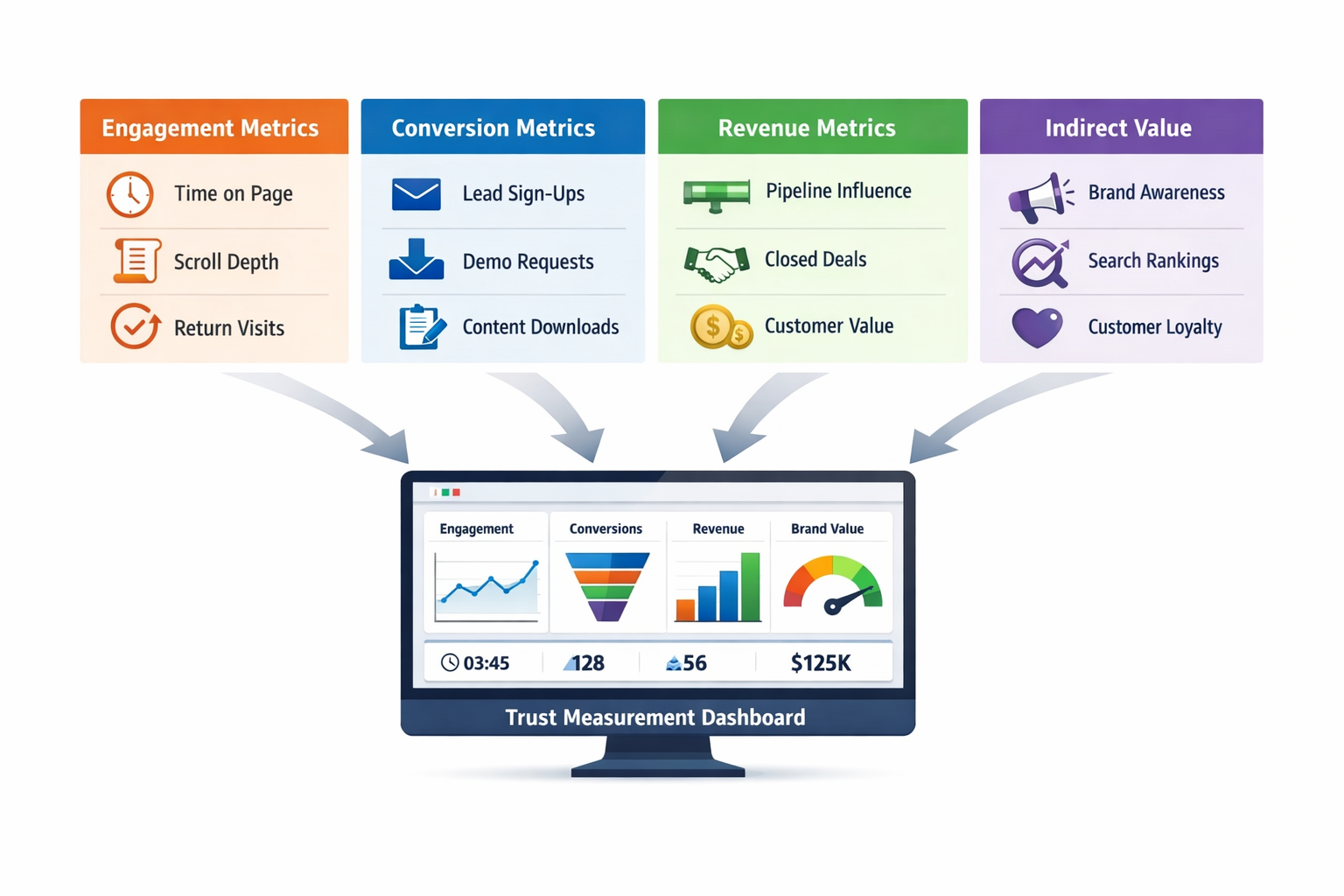
- Trust metrics fall into four categories: engagement (time on page, scroll depth), conversion (lead quality, demo requests), revenue (pipeline influence, closed deals), and indirect value (brand awareness, search rankings).
- Most businesses succeed with mid-range measurement tools costing £800–£1,200/month ($1,070–$1,600), though basic trust tracking can start free using Google Analytics.
- Multi-touch attribution modeling connects trust-building content to actual revenue by tracking every touchpoint from first blog post to final sale.
- Companies that consistently measure marketing performance are 12 times more likely to see year-over-year increases in returns compared to those flying blind.
Why does leadership keep questioning whether your marketing is working? Why do so many marketing dashboards show plenty of activity but nothing that connects to revenue or trust?
In this guide, you'll learn how to measure marketing trust using metrics that actually connect to business results. I've spent over a decade helping businesses measure and prove the revenue impact of trust-based marketing, and am one of the UK's first five certified coaches in the Endless Customers System™, a methodology built around exactly this challenge.
We'll break down four categories of trust metrics, the tools that track them, and a five-step framework for implementation, so the next time leadership asks "Is it working?", you'll have a clear, revenue-linked answer.
What is trust in marketing and why does it matter?
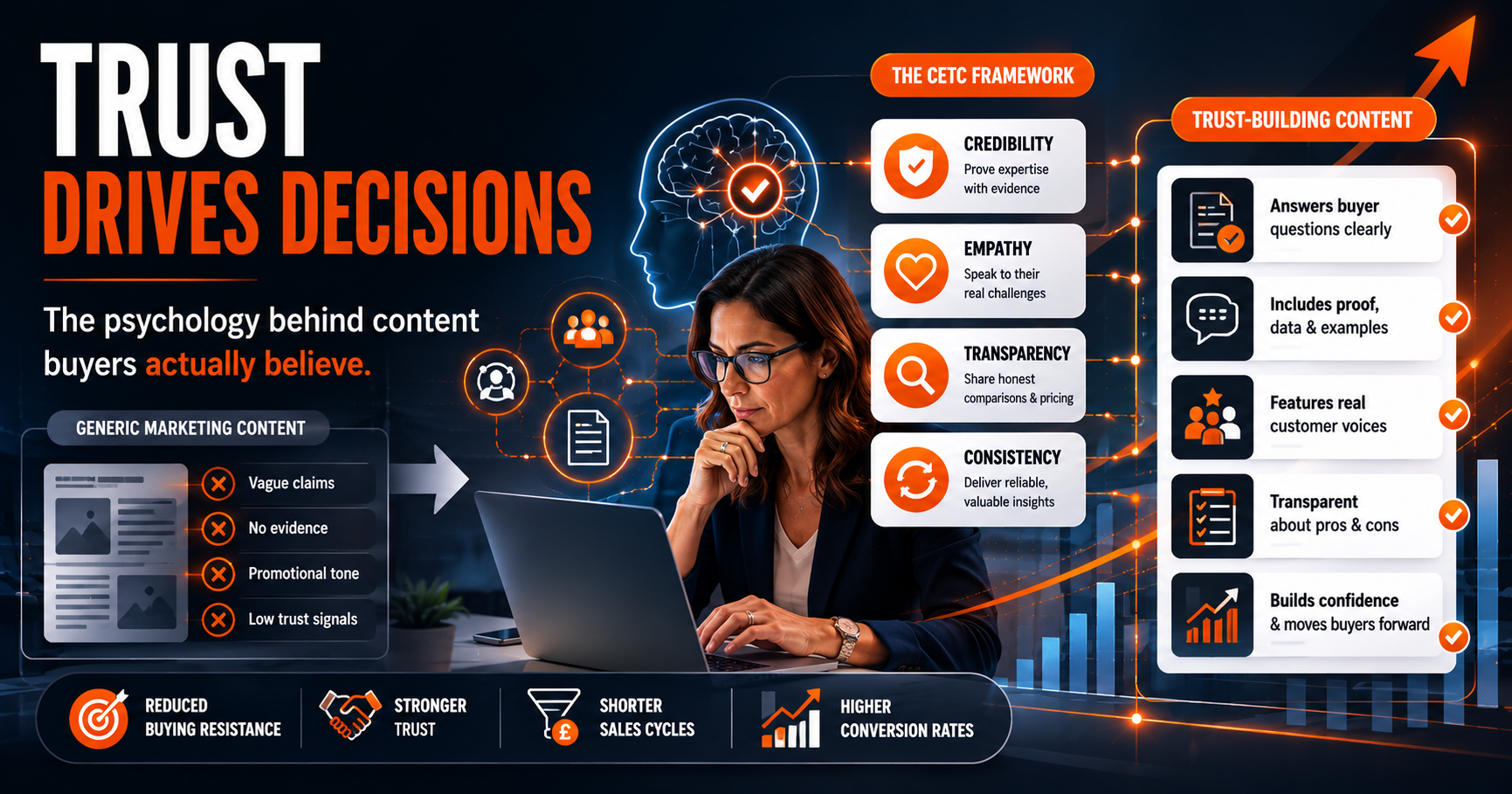
Trust in marketing is the confident belief that your brand will act in customers' best interests, deliver on promises, and prioritise their success over short-term profits. It's the difference between a prospect who reads your content and immediately contacts you versus one who bounces to a competitor.
Research from Edelman shows that 81% of consumers need to trust a brand before they'll buy from them, making trust the invisible currency that drives every successful business transaction.
Trust determines whether prospects spend three minutes reading your blog post or thirty seconds before leaving. It affects whether they share your content with colleagues, return to your website multiple times, and ultimately whether they choose you over competitors offering similar solutions.
Why Measuring Trust in Marketing Is Difficult (and How to Solve It)
Trust feels intangible because it develops through consistent actions over time rather than single transactions, making it harder to track than straightforward metrics like clicks or conversions.
The perception problem creates the first barrier. Trust exists in your customers' minds, not in your analytics dashboard. You can't directly measure what someone believes about your brand, only observe behaviours that signal trust is building or eroding.
Most businesses struggle because they're looking for a single trust metric when trust is actually reflected across multiple data points that need to be connected into a coherent story. Return visitor rates, time spent reading, scroll depth, conversion rates, sales cycle length, and referral patterns all reveal different dimensions of trust.
The attribution challenge compounds the difficulty. When someone becomes a customer after reading seven blog posts, downloading two guides, and watching three videos over four months, which piece of content deserves credit? Without proper systems, you can't answer that question, and you can't optimise what you can't measure.
The solution is a measurement framework that tracks trust across four categories, connects them to revenue, and gives leadership a clear view of how content builds customers.
The 4 Key Categories of Marketing Trust Metrics
Trust metrics fall into four main categories: engagement metrics that show content resonance, conversion metrics that demonstrate effectiveness, revenue metrics that prove business impact, and indirect value indicators that capture long-term brand equity.
| Category | What It Measures | Example Metrics | Trust Signal |
|---|---|---|---|
| Engagement | Content resonance and quality | Time on page (3+ min), scroll depth (70%+), return visits (40%+), comments/shares | People invest attention in your content |
| Conversion | Content effectiveness | Email sign-ups, content downloads, demo requests, free trial starts | People take action based on your content |
| Revenue | Business impact | Pipeline influence, closed deals, customer acquisition cost, content ROI | People spend money after engaging with your content |
| Indirect Value | Long-term brand equity | Brand awareness, search rankings, social engagement, customer lifetime value | People remember and recommend your brand |
The key to measuring trust isn't choosing one perfect metric — it's connecting multiple data points across the customer journey to create a clear story of how trust drives business results.
How much does trust measurement cost?
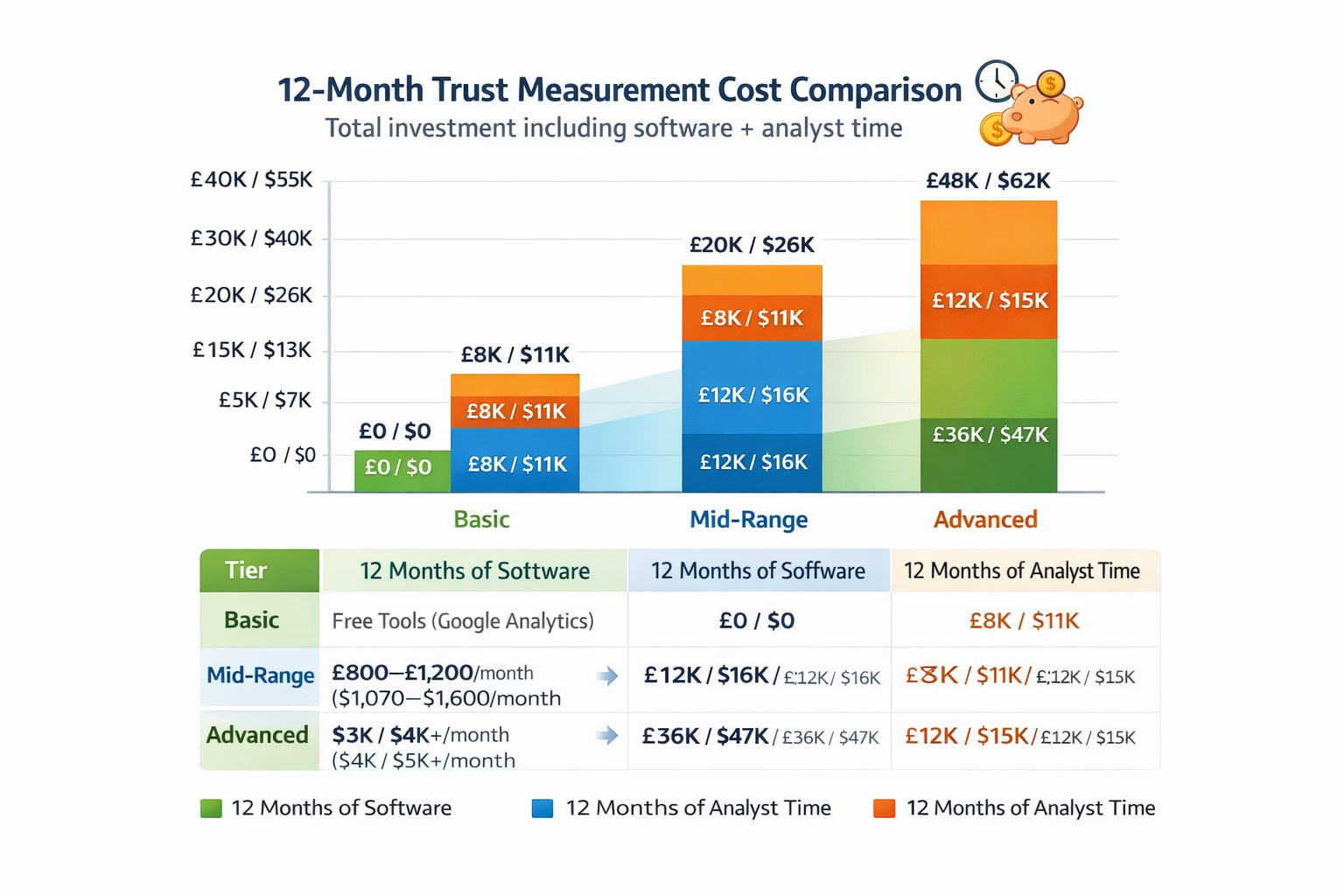
Trust measurement can range from free tools like Google Analytics (£0 / $0) to sophisticated platforms like HubSpot Enterprise (£3,600+ / $4,820+ annually), with most businesses finding success in the mid-range tier using platforms like HubSpot Professional at £800–£1,200/month ($1,070–$1,600).
| Tier | Monthly Cost | Tools Included | Best For |
|---|---|---|---|
| Basic | £0 ($0) | Google Analytics, social media insights, email platform metrics | Small businesses starting trust measurement |
| Mid-Range | £800–£1,200/month ($1,070–$1,600) | HubSpot Professional, Marketo, Pardot | Growing businesses needing attribution modeling |
| Advanced | £3,000+/month ($4,000+) | HubSpot Enterprise, custom analytics, data warehouses | Enterprises with complex customer journeys |
The real cost isn't just software; it's the time investment: expect 5–10 hours weekly for a dedicated analyst to properly track, analyse, and optimise trust-building efforts. Someone needs to review dashboards, identify patterns, test improvements, and translate data into actionable insights.
How do you track trust through engagement metrics?
Engagement metrics reveal how deeply your content resonates with audiences through measurable behaviours like time on page (3+ minutes suggests high trust), scroll depth (70%+ completion rates), and return visitor rates (40%+ indicates trust is building).
Time on page benchmarks tell you whether people actually read your content or skim and leave. Articles averaging under 90 seconds suggest content isn't connecting. Content holding attention for 3+ minutes indicates readers trust your expertise enough to invest their time.
Return visitor patterns reveal whether people come back for more. A first-time visitor might stumble onto your site by accident. Someone returning four times in two weeks? That signals growing trust. Track the percentage of returning visitors and watch for upward trends as your content library grows.
Social engagement signals extend beyond your website. When people share your content with colleagues, comment with thoughtful questions, or tag your brand in discussions, they're publicly vouching for you, one of the strongest trust indicators available.
Companies like HubSpot increased organic traffic by 50% by analysing engagement patterns and discovering that comprehensive pillar pages significantly outperformed standard blog posts. They measured, learned, and adapted based on what the data revealed about how people engaged with different content formats.
Key engagement trust metrics to track:
- Time on page
- Scroll depth
- Return visitor rate
- Content shares
- Comment activity
How do you connect content to conversion and revenue?
Attribution modelling connects trust-building content to actual revenue by tracking every touchpoint in the customer journey, from the first blog post that attracted a lead to the case study that sealed the deal.
The simplest models give all credit to either first-touch (the initial blog post) or last-touch (the final case study). But these approaches ignore all the content between — the guide they downloaded, the videos they watched, and the comparison article they read three times.
Multi-touch attribution gives partial credit to each piece of content based on its role in the conversion path. Five common models work for different situations:
- First-touch attribution: Credits the initial content piece (useful for understanding acquisition)
- Last-touch attribution: Credits the final content before purchase (shows closing effectiveness)
- Linear attribution: Spreads credit equally across all touchpoints
- Time-decay attribution: Gives more credit to recent interactions
- U-shaped attribution: Gives 40% credit each to first and last touch, 20% to middle interactions
Tools like HubSpot, GA4 integrated with your CRM, and most modern marketing automation platforms allow you to trace revenue directly back to specific content pieces, showing exactly which blog posts, videos, or downloadable resources contributed to a £50,000 ($67,000) customer deal.
Best Tools for Measuring Trust in Marketing (Google Analytics vs HubSpot)
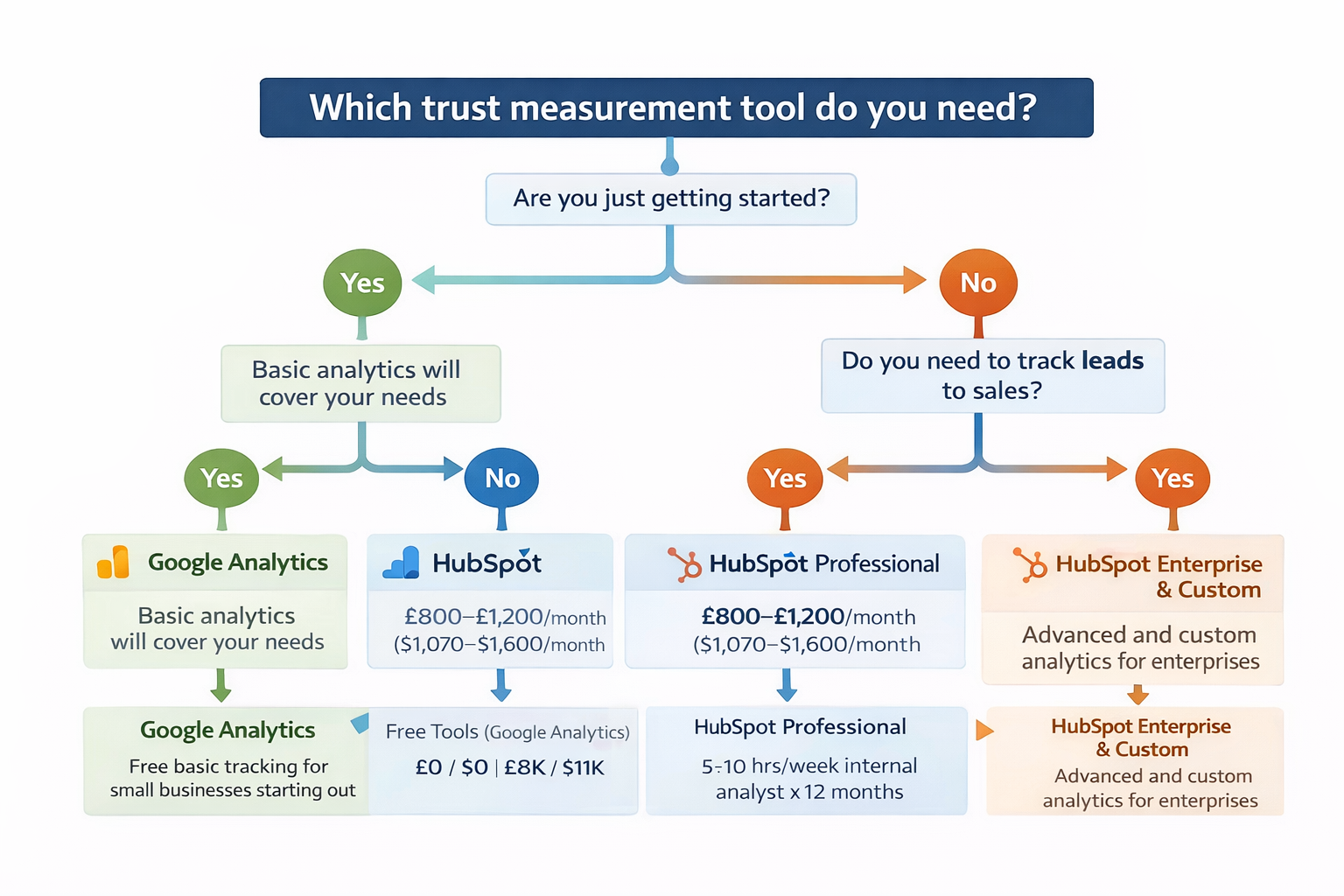
While Google Analytics provides free basic tracking, platforms like HubSpot offer sophisticated attribution modelling that automatically ties customer information to content pieces they interacted with, creating a direct line from specific content to actual revenue.
Google Analytics tracks page views, time on site, and traffic sources — enough to start measuring engagement metrics. But it struggles with attribution because it can't easily connect content consumption to specific deals or revenue.
HubSpot and similar CRM-integrated platforms track individual visitors across multiple sessions, connecting their content consumption to form submissions, sales conversations, and closed deals. You see exactly which content pieces each customer engaged with before buying.
| Feature | Google Analytics | HubSpot | Custom Solutions |
|---|---|---|---|
| Cost | Free | £800–£3,600+/month ($1,070–$4,820+) | £5,000+/month ($6,700+) |
| Engagement tracking | Strong | Strong | Customisable |
| Revenue attribution | Limited | Strong | Very strong |
| Setup complexity | Low | Medium | High |
| Best for | Basic trust monitoring | Growing businesses | Large enterprises |
The choice between tools depends on your needs: basic analytics work for early-stage trust monitoring, while growing businesses benefit from all-in-one platforms that connect marketing activities directly to sales outcomes.
What is the step-by-step process for measuring trust?
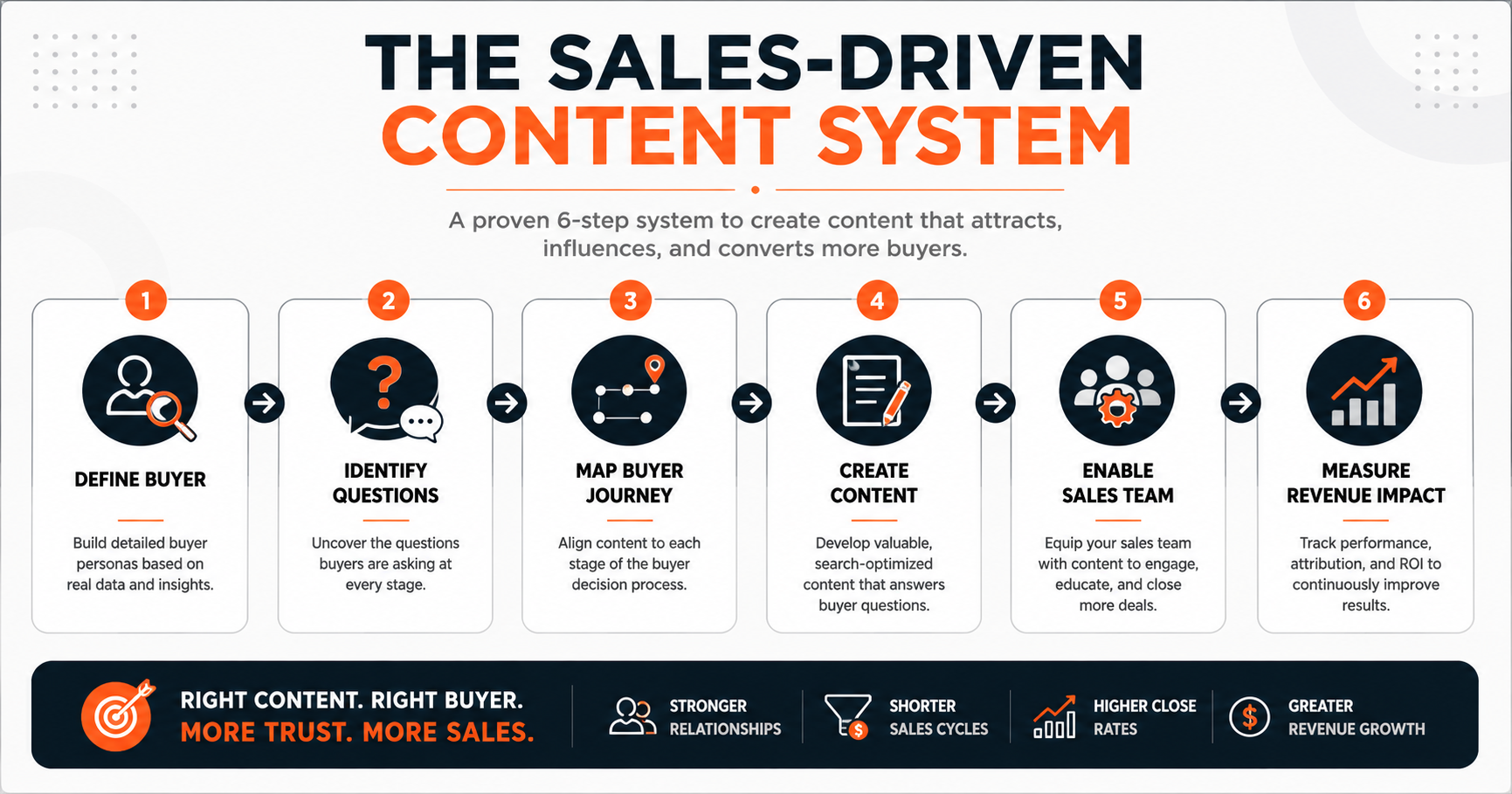
Start by defining what trust success looks like for your business through specific, measurable outcomes like lead quality improvements, shorter sales cycles, higher close rates, and increased customer lifetime value.
Follow this five-step framework:
- Define success metrics tied to business goals: Identify which trust indicators matter most for your business model (B2B services track sales cycle length; e-commerce tracks repeat purchase rates)
- Implement tracking systems for costs and results: Set up your analytics platform to capture engagement, conversion, and revenue data with proper attribution
- Develop an attribution model for your customer journey: Choose the model that reflects how your customers actually buy (longer sales cycles benefit from multi-touch attribution)
- Build dashboards that translate data into insights: Create visual reports showing how trust metrics trend over time and connect to revenue
- Establish regular performance review cycles: Schedule weekly or monthly reviews to identify what's working, what isn't, and where to focus optimisation efforts
This approach transforms trust measurement from an abstract concept into a systematic discipline. Start simple with engagement metrics, add conversion tracking as you gain confidence, then implement full attribution as your systems mature.
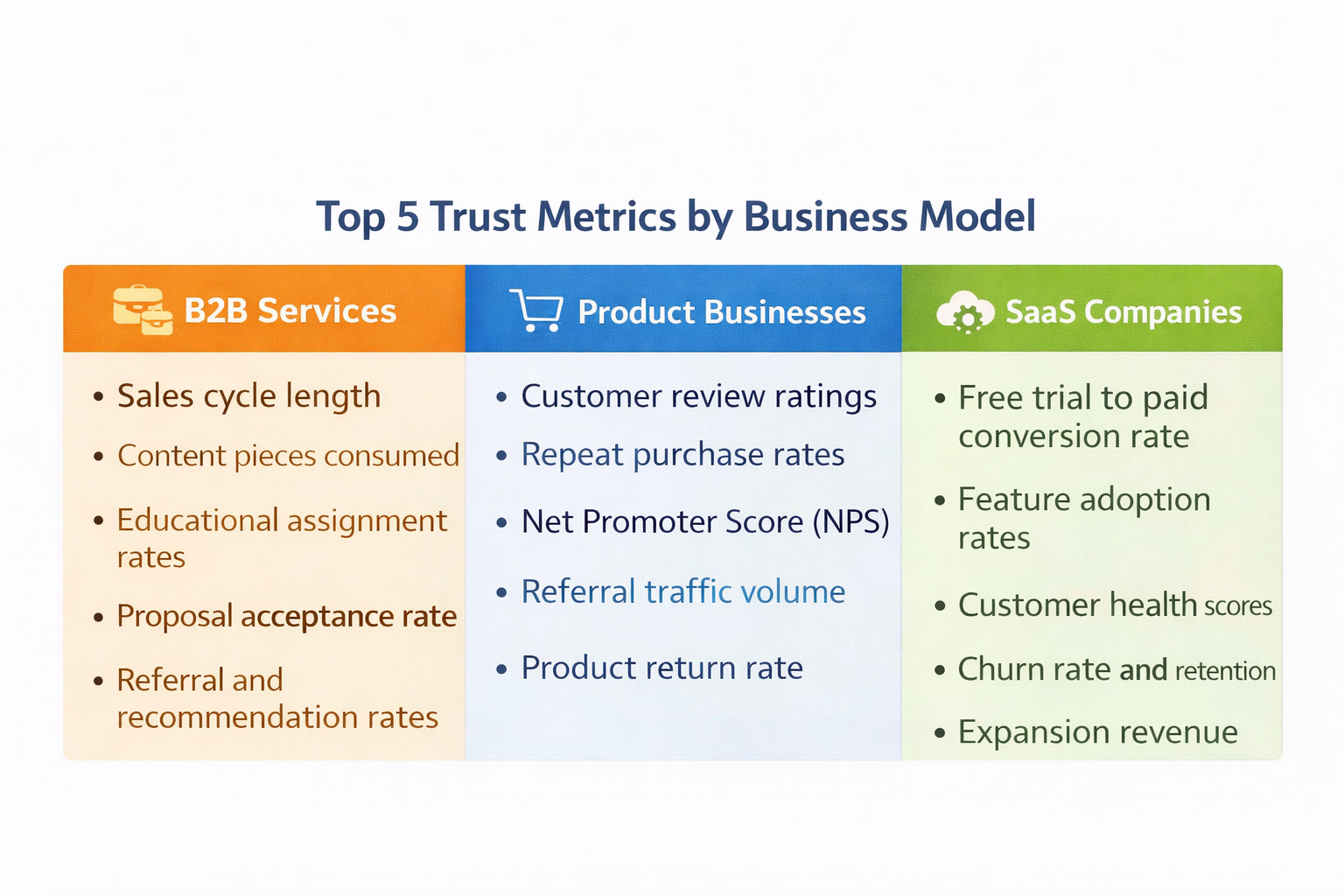
What are the best trust indicators for different business models?
Trust Metrics for B2B Services
B2B service businesses should track metrics like sales cycle length (30–50% reduction indicates growing trust), content engagement during evaluation, and assignment completion rates when using educational selling approaches.
For B2B services with longer sales cycles, focus on:
- Average time from first contact to closed deal
- Number of content pieces consumed before conversion
- Percentage of prospects completing educational assignments
- Proposal acceptance rates
- Referral and recommendation rates
Trust Metrics for Product Businesses
Product-based businesses benefit from monitoring review ratings, repeat purchase rates, net promoter scores, referral traffic patterns, and 'problems' content performance as trust indicators.
E-commerce and product companies should watch:
- Customer review ratings and volume
- Repeat purchase rate within 6 months
- Net Promoter Score (NPS)
- Cart abandonment rates
- Product return rates
Trust Metrics for SaaS Companies
SaaS and subscription businesses need different indicators:
- Free trial to paid conversion rate
- Feature adoption rates
- Customer health scores
- Churn rate and retention metrics
- Expansion revenue from existing customers
What Happens When You Don't Measure Marketing Trust?
Companies that fail to measure trust metrics fly blind, making decisions based on vanity metrics like page views while missing critical signals like declining time-on-page or dropping conversion rates that indicate eroding trust.
Without measurement, you can't spot problems until they become disasters. Time on page drops from 4 minutes to 90 seconds? You won't notice until leads dry up. Return visitor rates falling from 45% to 20%? You'll wonder why sales suddenly stalled, not realising the warning signs appeared months earlier.
Research from Aberdeen Group shows companies that consistently measure marketing performance are 12 times more likely to see year-over-year increases in returns, proving measurement isn't optional; it's the difference between growth and stagnation.
Marketing teams struggle to secure budgets, optimise content strategy, or prove ROI when they can't demonstrate results. Leadership questions whether marketing delivers value. Sales teams complain about poor lead quality. Budget reviews become defensive exercises rather than productive planning sessions.
FAQ: Common questions about measuring trust
What metrics actually prove marketing builds trust?
The strongest proof comes from combining engagement depth (time on page, scroll depth, return visits) with downstream revenue data. When you can show that prospects who engaged heavily with your content had shorter sales cycles, higher close rates, and better retention; that's the evidence leadership actually needs.
Can small businesses measure trust without expensive tools?
Yes. Start with Google Analytics for engagement metrics, email platform analytics for conversion tracking, and basic CRM reporting for revenue attribution. You won't get sophisticated attribution, but you'll capture the indicators that matter most.
How long before I see trust metrics improve?
Engagement metrics improve within 4–8 weeks of publishing quality content. Conversion metrics follow in 8–12 weeks. Revenue metrics typically show movement in 3–6 months as trust compounds across the buyer journey.
What's the single most important trust metric?
Return visitor rate tells you whether people trust you enough to come back. If this number grows consistently, other trust indicators typically follow.
How do I prove trust measurement ROI to leadership?
Connect metrics to revenue. Show how improvements in engagement correlate with better lead quality, shorter sales cycles, and higher close rates. Speak in terms of pounds saved and earned, not abstract trust scores.
Can trust metrics predict customer behaviour?
Yes. Patterns in engagement and conversion metrics often predict future buying behaviour 30–90 days ahead, giving you early warning of problems or opportunities.
Conclusion
Trust isn't a vague brand concept; it's measurable through engagement, conversion, revenue, and long-term brand signals, and each category tells a different part of the story your leadership needs to hear.
If you started reading this struggling to prove that your marketing works, you now have the framework to show exactly how it does — in revenue terms that leadership actually care about. The gap between where you are now and where you could be isn't about more effort. It's about connecting the right data into a clear story.
Your next step is to implement the five-step framework above and begin tracking at least three trust indicators tied to revenue. Start with engagement metrics this week, layer in conversion data over the next month, and build toward full attribution across the quarter.
If you need help building these systems, my Fractional Marketing Director service helps businesses connect trust-building content directly to revenue, with the measurement frameworks to prove it.

About the Author
Tom Wardman is a marketing strategist who helps businesses build trust that brings endless customers. As one of the UK's first five certified coaches in the Endless Customers System™, Tom has spent over a decade transforming marketing capabilities across industries including accountancy, construction, FinTech, and SaaS. His approach focuses on proven systems that create lasting change rather than quick fixes, helping businesses develop the confidence to manage marketing sustainably.
Pricing Disclaimer: All GBP–USD price conversions are rounded estimates and correct at the time of publishing. Exchange rates fluctuate and figures should be treated as indicative only.
Topics: