
Most founder-led businesses do not have a content problem. They have a structural one.
The symptom is always the same: one or two people carrying the whole marketing function, publishing when they can, watching competitors with bigger teams appear everywhere. The assumption that follows is that output requires headcount. So nothing changes, because the second hire never gets approved.
That assumption is expensive. The businesses with the widest content footprint are rarely the ones with the largest marketing departments. They are the ones who treat content as a company-wide input and marketing as the system that organises it. I set out that architecture in my book Build a Trusted Brand.
This article is for owners and marketing leads running a team of one to three people, with no realistic prospect of doubling it. It covers how to widen the footprint with the people you already have, and when an agency is the better answer instead.
Key takeaways
- A lean marketing team is a one-to-three-person function that publishes across multiple formats by organising expertise that already exists inside the business, rather than by hiring more marketers.
- Content footprint, not headcount, is what earns search visibility and AI recommendations.
- If you can fund one dedicated role, make it a Content Manager, because content is the raw material every other channel depends on.
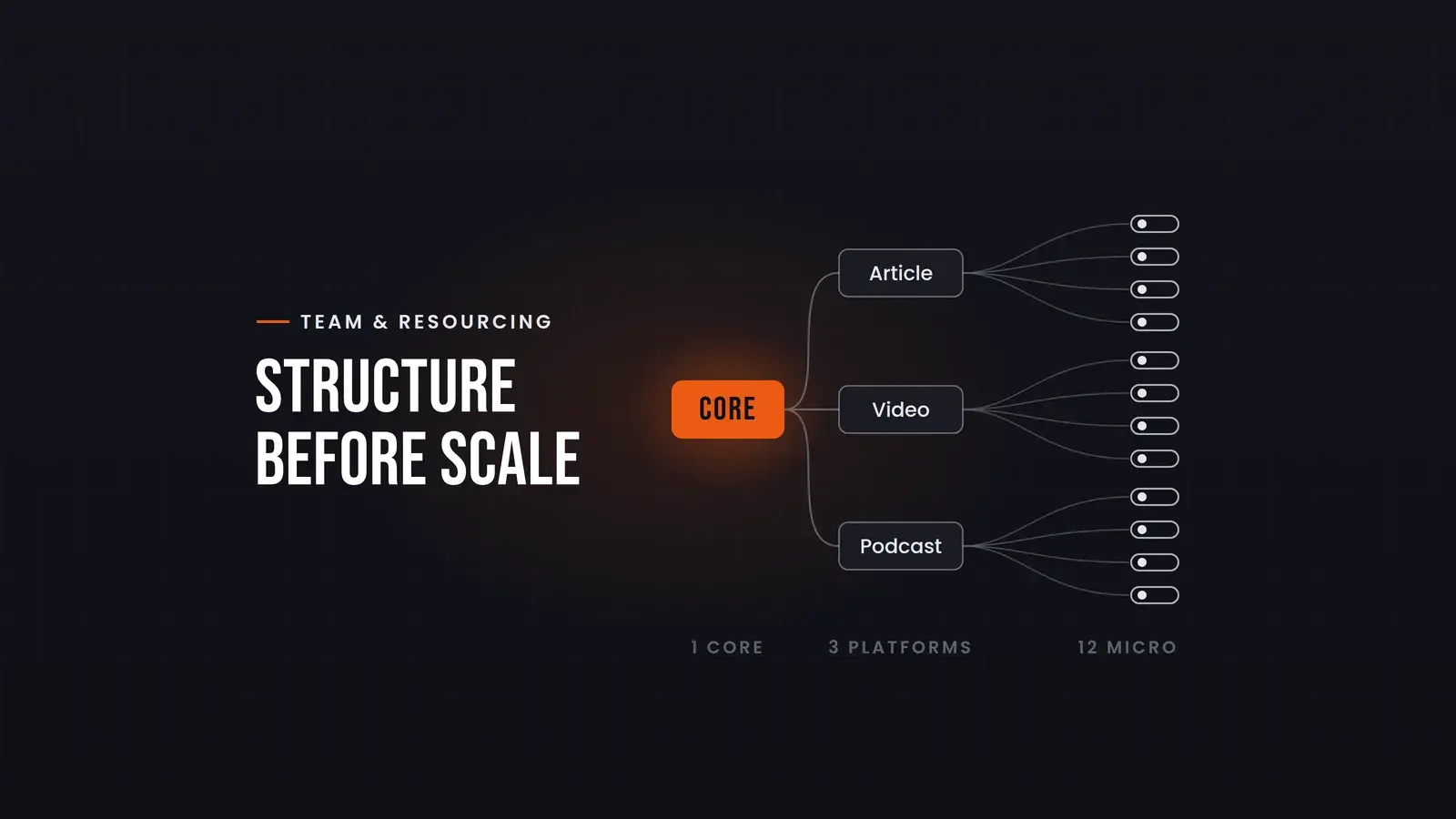
- One core content piece per week, adapted for 3 platforms, with 4 micro-pieces pulled from each adaptation, produces 16 assets from a single effort.
- Expect around 30 months of consistent publishing before you are genuinely known in your space. Most lean teams fail by stopping, not by lacking talent.
What is a lean marketing team with a wide content footprint?
A lean marketing team with a wide content footprint is a one-to-three-person marketing function that publishes consistently across multiple formats by organising the expertise already inside the business, rather than by employing more marketers.
The footprint is the total body of useful, findable material you own: articles, videos, guides, podcast episodes, and the answers to the questions your buyers actually ask.
The size of that footprint is only loosely connected to the size of your marketing department. A team of two publishing 8 useful assets a week will out-perform a team of six publishing 4, because the two-person team is not the only source of the material. They are the editors and the architects.
The business is the author.
A lean team that writes everything itself is capped by its own capacity. A lean team that runs a system is not.
Search rankings and AI answer engines both reward the breadth and depth of what you have published. Results come from building a significant content footprint on your own website, building an audience who share that material, and earning links back from elsewhere. That takes sustained effort rather than sustained budget.
Most businesses give up long before the footprint exists. In my own experience, the podcasters who succeed are well past their 300th episode, while most stop in the first dozen. A new website and a handful of articles is a starting point, not a strategy.
Data and benchmarks
- 63% of B2B marketers use content audits to find gaps in what they publish. (Source: Content Marketing Institute)
- Bloggers who update existing content are 74% more likely to report strong results. (Source: Orbit Media)
- As of Wyzowl's 2023 survey, 91% of businesses used video as a marketing tool and 94% of marketers said video improved how well buyers understood their product or service. (Source: Wyzowl)
If search visibility is why you are reading this, the mechanics have shifted and the footprint argument now matters more, not less.
Related Reading: Why SEO Alone No Longer Drives Customers in 2026 (And What Does)

How do you get a wide footprint from a small team?
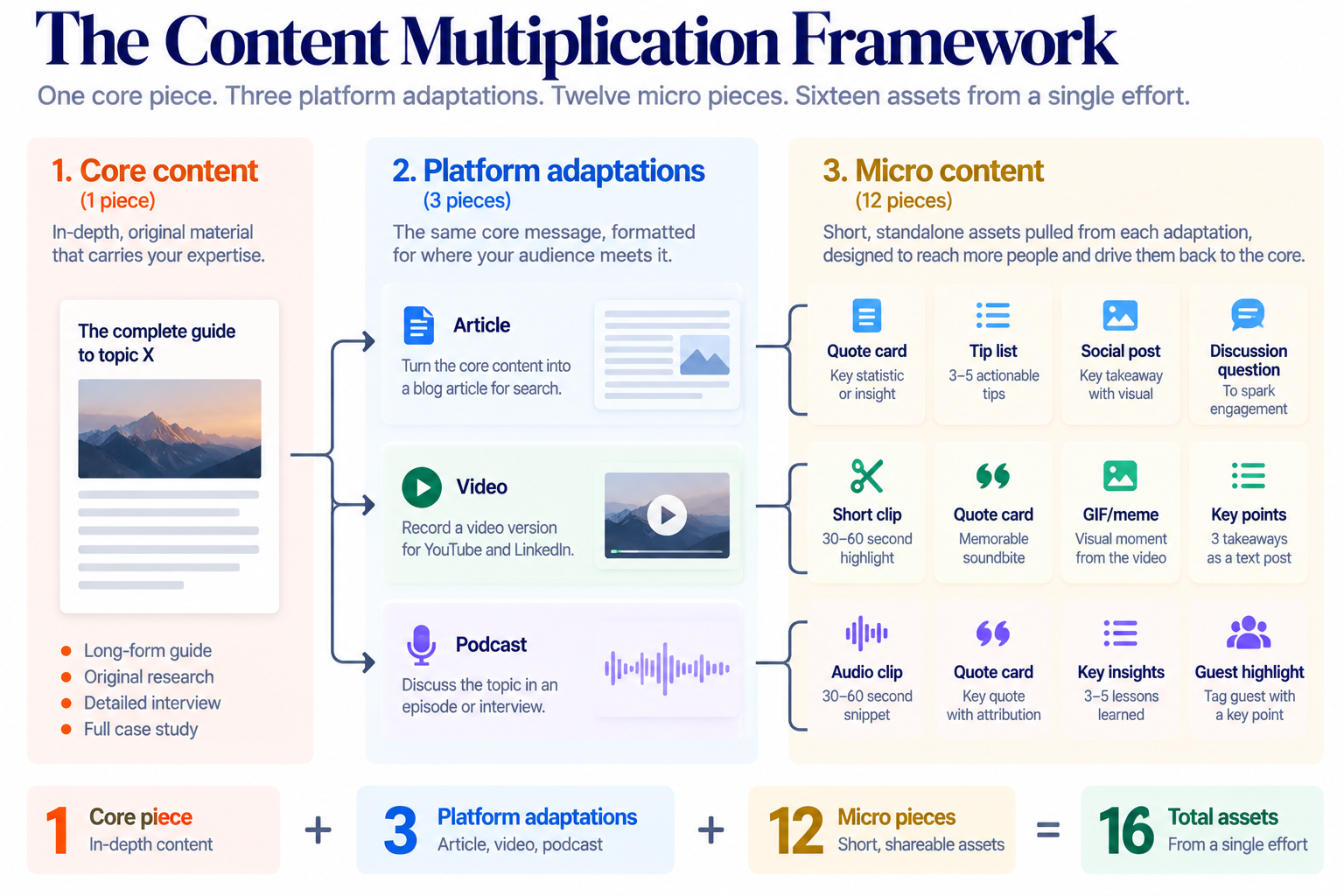
You widen the footprint by treating every piece of work as a source rather than a finished item, using what I call the Content Multiplication Framework.
Everything you produce sits in one of 3 buckets:
- Core content: The in-depth material that carries your expertise: long-form guides, original research, detailed interviews, full case studies.
- Platform adaptations: The same core message formatted for where people meet it: articles, video, podcast episodes, email sequences.
- Micro content: Small pieces that stand alone but point back to the core: quote cards, statistical highlights, quick wins, short clips.
The arithmetic is what makes this viable for a team of two. Produce 1 core piece a week, adapt it for 3 platforms, and pull 4 micro-pieces from each adaptation. The sum is 1 + 3 + 12 = 16 assets from a single effort, and each one reinforces the same argument rather than diluting it across unrelated topics.
The Diary of a CEO runs this model visibly. One 60 to 90-minute recording becomes full-length YouTube episodes, audio versions on Spotify and Apple Podcasts, short vertical clips for TikTok, medium-length Instagram segments, and quote graphics. Guests then share their appearance on their own channels, extending the reach again.
The four Rs of content repurposing
- Reformatting: Change the medium, keep the message. An article becomes a video, a podcast becomes an article, a presentation becomes an infographic.
- Repackaging: Bundle related pieces into something new. Six articles on one theme become an ebook. Case studies become a whitepaper.
- Refreshing: Update what already works with new statistics, examples and visuals. The cheapest win available to a lean team, and Orbit Media found that bloggers who update old content are 74% more likely to report strong results.
- Reimagining: Take a different angle. Same information, different audience segment, different stage of the buying journey.
Repurposing is not about doing less work. It is about getting more value from the work you are already doing. The hard part, developing the original insight and crafting the core message, only has to happen once.
How do you turn the rest of the company into your content engine?
The fastest way to multiply output without multiplying headcount is to make contributing a company-wide expectation, because your colleagues already hold the answers your buyers are searching for.
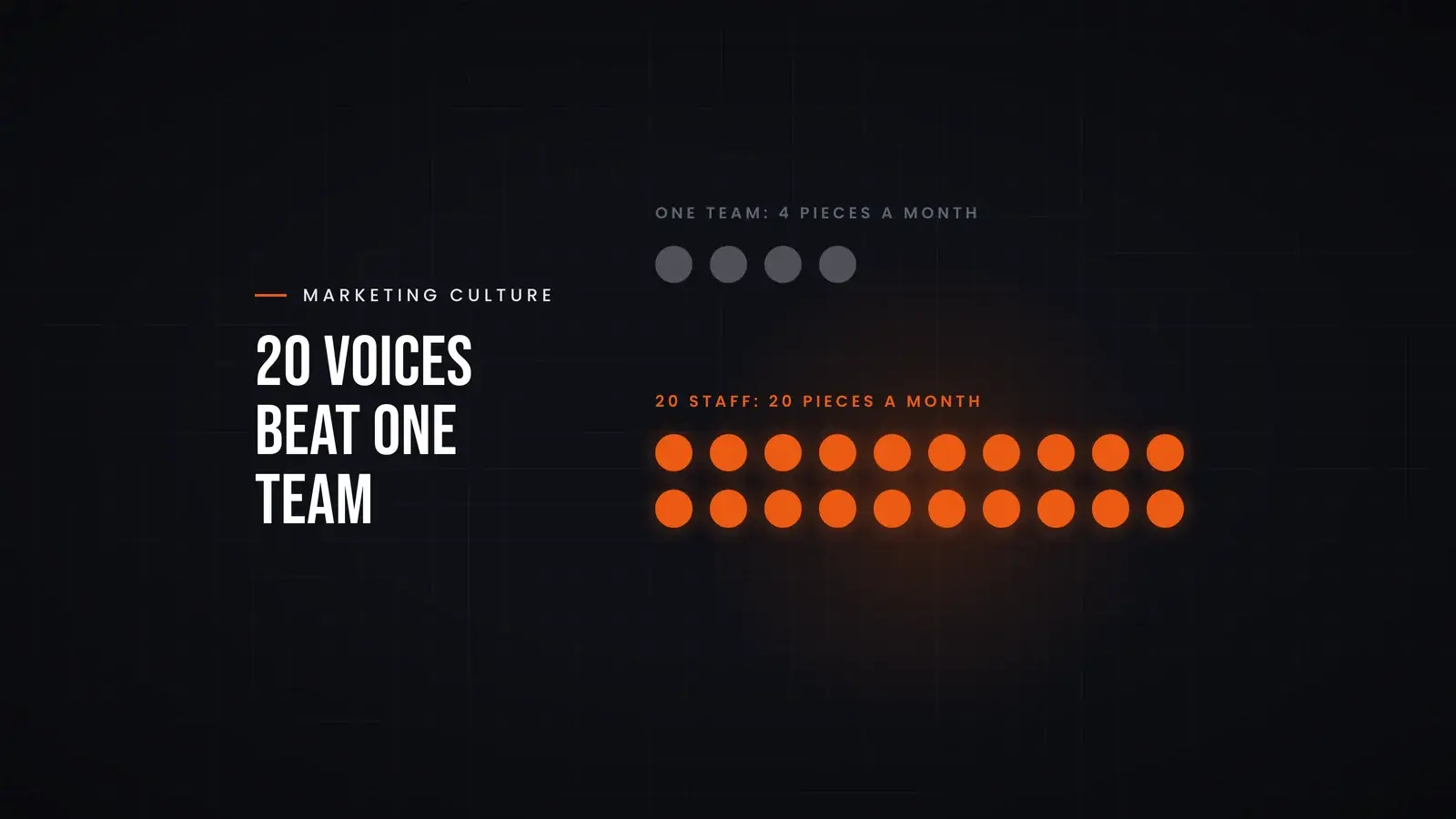
Compare two scenarios. Your marketing team produces 4 articles a month: limited perspectives, a bottleneck at the point of creation, a marketing-centric view. Or 20 colleagues each contribute one piece a month: varied perspectives, real operational insight, and a volume no small team could manufacture alone.
|
Department |
The content only they can create |
|---|---|
|
Sales |
Objections, how you compare to competitors, why deals are won and lost, the questions asked most often |
|
Customer service |
Recurring problems, troubleshooting that works, how to explain features plainly |
|
Technical or delivery |
Product updates, technical guides, integration stories, best practice |
|
Leadership |
Industry perspective, strategy, company direction |
Yale Appliance is the clearest example of what happens when this lands. CEO Steve Sheinkopf's first attempt at content marketing failed: articles went unpublished, videos were never filmed, growth was flat.
It changed when he made content creation company policy rather than a suggestion, requiring every department from sales to service technicians to contribute. Revenue grew from $37 million to more than $180 million (roughly £28m–£140m), with around $700,000 a year less spent on advertising. Treat that as a multi-year outcome across a sustained publishing programme, not a 12-month turnaround.
The reason it worked is specific: the service technicians who fixed appliances daily had insight no marketing writer could replicate. When everyone contributed, the material became genuinely useful and impossible for competitors to copy.
The highest-value use of that material is not traffic. It is handing your sales team something to send before, during and after a conversation, which is a different job from attracting strangers Getting the buy-in to produce it in the first place is a leadership exercise, not a marketing one
Why the orchestrator role is the one you cannot outsource
Even a company full of willing contributors still needs one person whose primary job is running the content operation, or the output becomes a collection of disconnected pieces rather than one coherent argument.
Every band needs a leader. Every film needs a director.
Microsoft made this explicit in 2014, creating a role most people had never heard of: Chief Storyteller. Steve Clayton took the job, and what he did is the useful part. He coordinated how the whole company told its story, helping engineers and executives find their voice while keeping every story inside one narrative.
The orchestrator function grows where the writing function does not. One person can edit and shape the output of 20 contributors. One person cannot write it.
In practice, that person works like an internal reporter, and their output divides roughly into three types:
- Around 80%: articles built on expert input, where they interview a colleague and write it up.
- Around 10%: Q&A pieces, published close to how the conversation actually ran.
- The remainder: ghostwritten leadership content, where the ideas are the executive's and the drafting is not.
What to look for in a Content Manager
If you can fund one dedicated marketing role, make it a Content Manager, not a generalist marketer and not a social media specialist, because content is the raw material every other channel depends on. Look for 5 capabilities:
- Strong writing across multiple formats, not only long-form articles.
- The ability to understand your customer's questions and problems without being told what they are.
- A planning mindset that connects content to business objectives.
- Working SEO knowledge, enough to structure a page properly.
- Project management capability, because they will be chasing busy colleagues for input.
Why a videographer is the second hire, not an SEO specialist
Video earns the second slot because it is the format buyers use to decide whether they trust you, and the hardest thing for a non-specialist to fake. An SEO specialist or a designer improves material that already exists. A videographer creates a category of material a lean team otherwise never produces at all.
How should a small team grow from there?
Build in phases based on business stage, rather than assembling your ideal structure at once. For a lean team, only the first phase is a live decision. The rest is a map of what comes later.
|
Phase |
Headcount |
Roles |
|---|---|---|
|
1. Foundation |
1–3 |
Content Manager, videographer (part-time or freelance to start), marketing coordinator (optional) |
|
2. Growth |
4–7 |
Head of Marketing, full-time videographer, SEO specialist, designer, digital marketing specialist |
|
3. Scale |
8+ |
Marketing operations, social media, marketing technologist, content specialists by product line, analytics |
If you are reading this as a lean team, Phase 1 is the only row that should affect a decision this year.
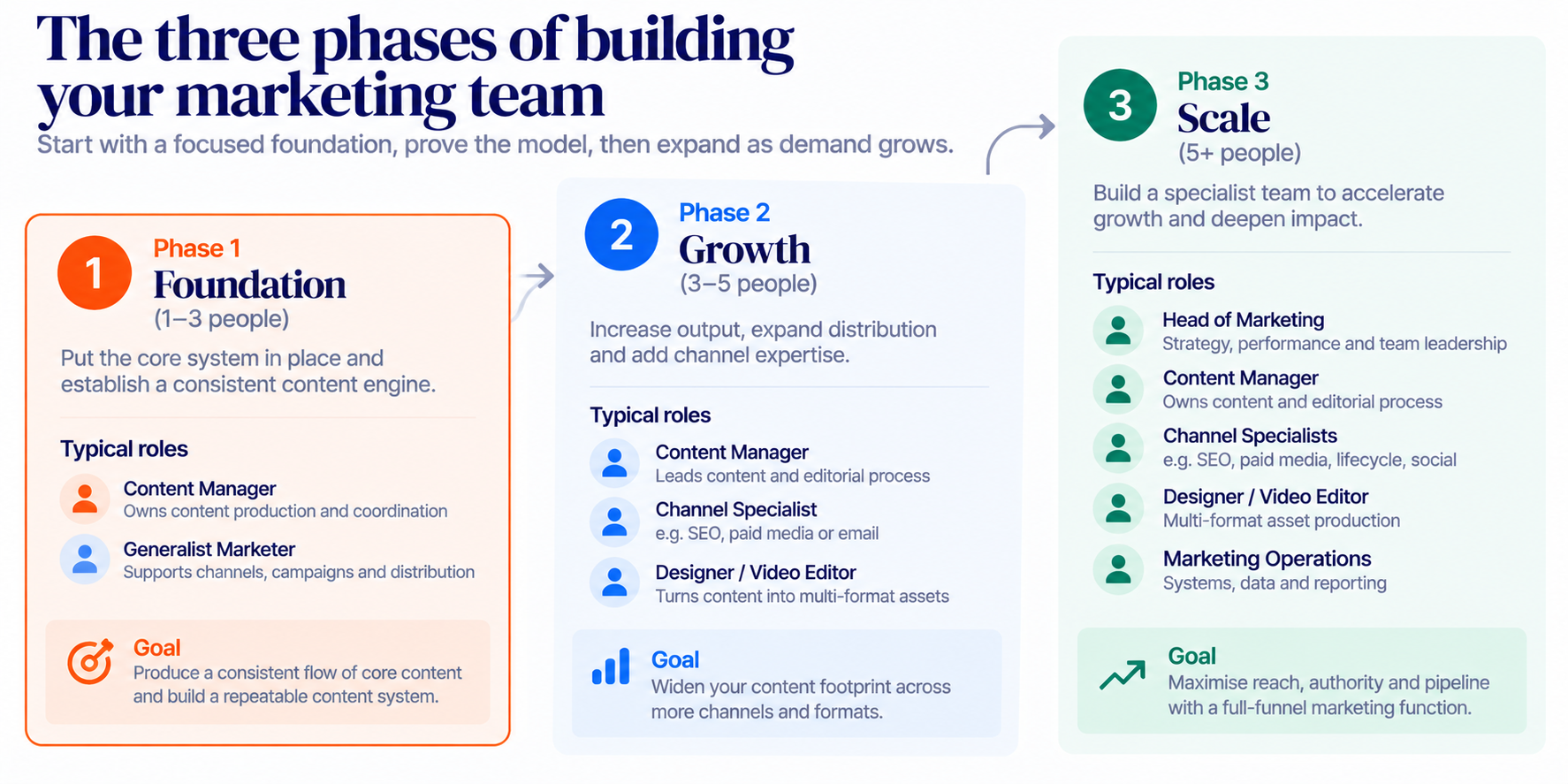
Each phase assumes the one before it is working. Hiring specialists before a content foundation exists reliably wastes money, because they arrive to find no quality material to work with.
Before hiring anyone, audit the journey a prospect takes through your business. Can they find answers to their questions on your website? Does your material educate buyers or only promote your products? Where do people drop out? Those answers set hiring priorities better than a job-description template
Related Reading: 5 Silent Website Trust Killers (and How to Audit Yours in an Hour)
What does a lean marketing team cost compared with outsourcing?
A lean in-house function costs less than a mid-range agency retainer over three years, and the comparison is closer in year one than most owners expect.
Video makes the point cleanly. Many businesses pay an agency £10,000 or more ($13,500 or more) for a handful of videos that date within a year. An in-house videographer at around £35,000 a year ($47,000) can produce dozens of videos a month that keep pace with the business.
|
Model |
Typical cost |
Strongest at |
Weakest at |
|---|---|---|---|
|
In-house lean team |
£35,000–£70,000/year ($47,000–$95,000) for 1–2 roles |
Volume, institutional knowledge, owned capability |
Slow to start, single points of failure, narrow skill range |
|
Traditional agency retainer |
£3,000–£10,000+/month ($4,000–$13,500+) |
Speed to first output, specialist skills you cannot hire at one salary, cover during absence |
Capability stays with the agency, output fixed to the scope you bought |
|
Hybrid: in-house plus fractional leadership |
From £2,000/month ($2,700) alongside internal roles |
Senior direction without a senior salary, capability transfer |
Needs at least one internal person to carry delivery |
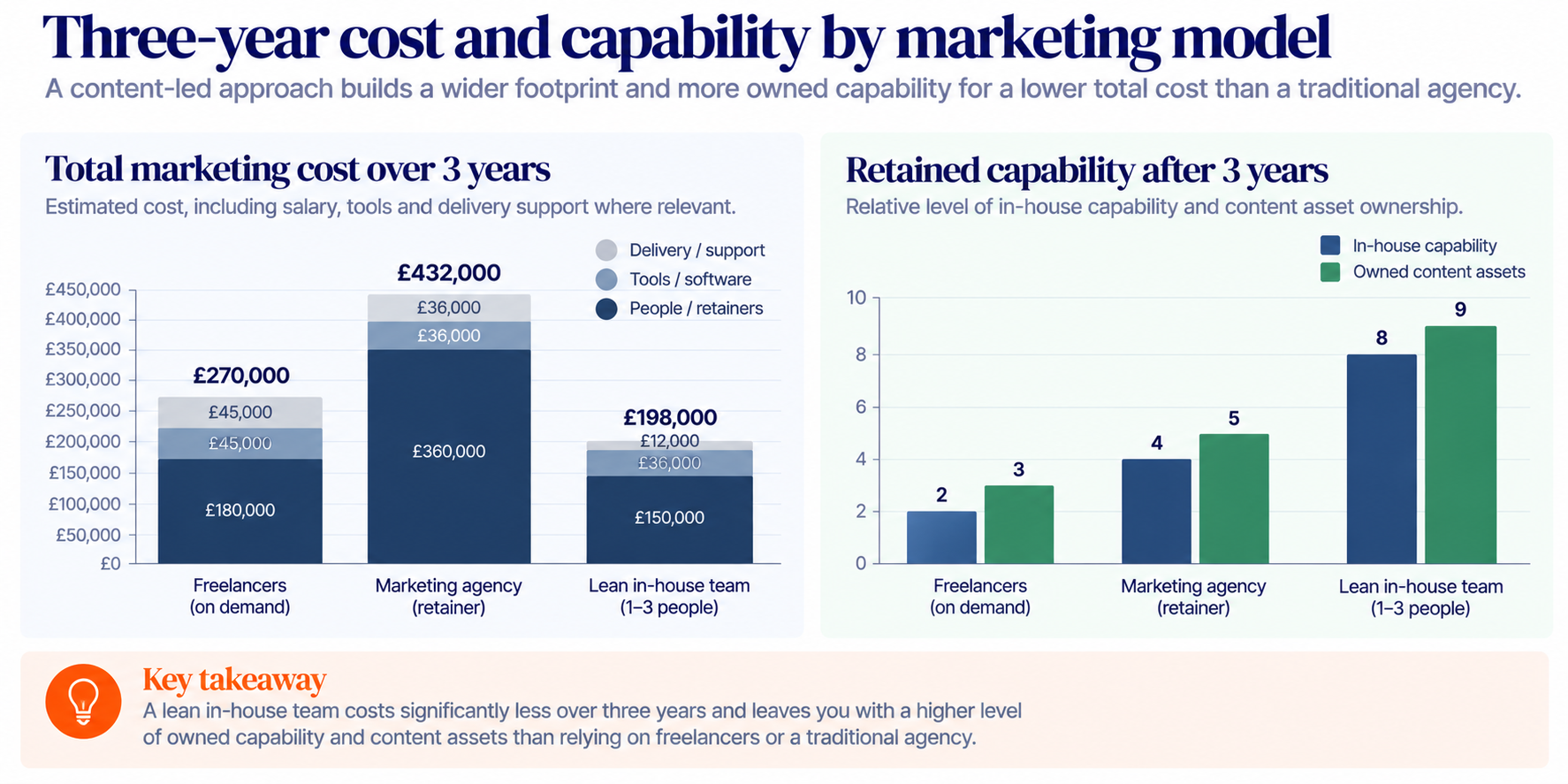
Work it out with one calculation: monthly cost x 36, then ask what you own at the end. An agency at £5,000 a month costs £180,000 ($243,000) over three years, and the capability leaves when the invoices stop. The same budget spent internally leaves you with a team, a documented system, and a content library that keeps working.
When hiring in-house is the wrong answer
In-house is not automatically the better option, and claiming otherwise is the kind of overclaiming I would challenge in anyone else's marketing. Outsource, or stay outsourced, when any of the following is true:
- You need output within weeks, not months: Recruiting and getting a first competent piece out of a new hire realistically takes a quarter. An agency can be producing in a fortnight.
- The skill is genuinely specialist and occasional: Technical SEO migrations, paid media and high-end video direction are hard to justify as a salary and easy to buy by the project.
- You cannot hire the standard you need locally, and will not hire remotely: A compromise hire costs more than a good supplier.
- There is nobody internally to manage the role: An unmanaged content hire produces activity, not results.
- The business is too volatile to carry fixed cost: A retainer you can end in 30 days is less risky than a salary you cannot.
The honest position is that the model matters less than who owns the system at the end of it. An agency that documents its work and trains your team is better than an in-house hire nobody directs.
What goes wrong when businesses try to run lean?
The most common failure is adding content creation to the job description of someone already fully occupied, which almost always produces nothing publishable. Useful content requires dedicated focus, not goodwill in the margins of another role.
Five operating traps follow close behind
- Hiring specialists too early: Without a content foundation, they have no quality material to work with.
- Choosing volume over depth: Ten mediocre articles will never out-perform three excellent ones. Volume compounds only when each piece is genuinely useful, which is why the 16-asset model multiplies one good idea rather than generating sixteen weak ones.
- Separating content from sales: Your creators should sit with the sales team regularly to hear the real questions.
- Neglecting team culture: Content work needs collaboration, not only capacity.
- Underinvesting in training: One-time training does not create lasting change. Skills need reinforcement to become habits.
Three mindsets kill the company-wide model before it starts:
- "Only marketers can create content." Everyone in the business holds knowledge worth sharing, even if they need help expressing it.
- "Everything must be perfect." When the bar is impossibly high, people stop trying to clear it, and the pursuit of flawless material produces no material at all.
- "More process means better content." Added process creates friction and discourages the participation you are trying to build.
Start with the colleagues who volunteer, align contributing with their own goals, and make their wins visible. Mandating participation in a business with no content habit yet produces compliance rather than insight.
Frequently asked questions
Can one person really run marketing for a growing business?
Yes, if that person organises contributions rather than producing everything alone. One Content Manager can realistically coordinate 15 to 20 internal contributors and run a weekly publishing rhythm. What they cannot do is write all of it and also plan, distribute and measure it.
Do we need video if the team is small, and can we start freelance?
Yes, and yes. Start with a freelance videographer for one or two days a month, filming several pieces per session so the cost per asset falls. Move the role in-house once you are using everything they produce and scheduling has become the bottleneck.
Should a lean team use AI to increase output?
Use it for the mechanical parts of repurposing: transcription, format conversion, first-draft adaptations of material you have already created. Do not use it to generate the original insight, because that insight is what buyers are trusting you for.
What should the marketing lead report on, and to whom?
To the leadership team directly, on a connected view of traffic, engagement, conversion and revenue rather than activity volume. Reporting on output alone is how marketing gets treated as a cost centre.
When is it time to hire the second person?
When the Content Manager is publishing to plan and the constraint has moved to format or distribution rather than production. If articles are still slipping, another hire will not fix it.
Build a trusted brand with the team you already have
A wide content footprint is not a resourcing problem. It is an architecture problem, and architecture costs less to fix than headcount costs to add.
You started reading this with a small team and an output expectation that looked impossible to meet. The structure is now clear: open the business up as a source of material, put one person in charge of orchestrating it, multiply every core piece through the four Rs, be honest about when an agency is the better buy, and hold the line long enough for the footprint to compound. Structure before scale.
How to take action now
- Audit your buyer journey against the 4 questions in the hiring section.
- Pick your best-performing piece and list 5 ways to repurpose it using the four Rs.
- Name one owner of content production, even if it is part of a wider job for now.
The full system behind this article, including the Trust BLUEPRINT™ and the nine steps inside it, is laid out in my book.

About the author
Tom Wardman installs in-house growth systems inside founder-led businesses, replacing agency dependency with marketing their own teams can run. He is the author of Build a Trusted Brand and works with SMEs across the UK as a Fractional Marketing Director and Endless Customers System™ implementer. His approach is built on one principle: predictable growth, fully owned.
Pricing disclaimer: All GBP–USD price conversions are rounded estimates and correct at the time of publishing. Exchange rates fluctuate and figures should be treated as indicative only.