Is your website traffic declining even though your Google rankings haven't moved? Are you hearing about AI search but unsure what it actually means for your brand?
Having tracked buyer behaviour patterns across B2B clients for over a decade, and documented this shift in Build a Trusted Brand, I can tell you this is not a passing trend. The way buyers discover brands has changed structurally, and it is not changing back.
This article explains:
- Why LLMs have become the new default discovery channel for buyers
- How they differ from Google as a visibility channel
- What your brand needs to do to earn a place in AI-generated answers
By the end, you will have a practical framework you can apply straight away.
If you are a founder, marketing lead, or responsible for brand growth, this is for you.
Key takeaways
- Large language models (LLMs), such as ChatGPT, Perplexity, Claude, and Gemini, are replacing Google as the first place millions of buyers go to research products, services, and brands.
- Only 18% of all searches now happen on Google, and more than half of those end without a click to any website.
- Brands invisible to LLMs are invisible to an entire segment of buyers at the exact moment they're deciding what to buy.
- LLMs reward trust, authority, and structured clarity, not keyword density or backlinks.
- Getting cited in AI search results requires answer-first content built around specific buyer questions, combined with credible third-party recognition.
What does 'LLMs as the new front page' actually mean?
Large language models (LLMs), such as ChatGPT, Perplexity, Claude, and Gemini, have become the first place millions of buyers go to research products, services, and brands, displacing Google as the default front page of the internet.
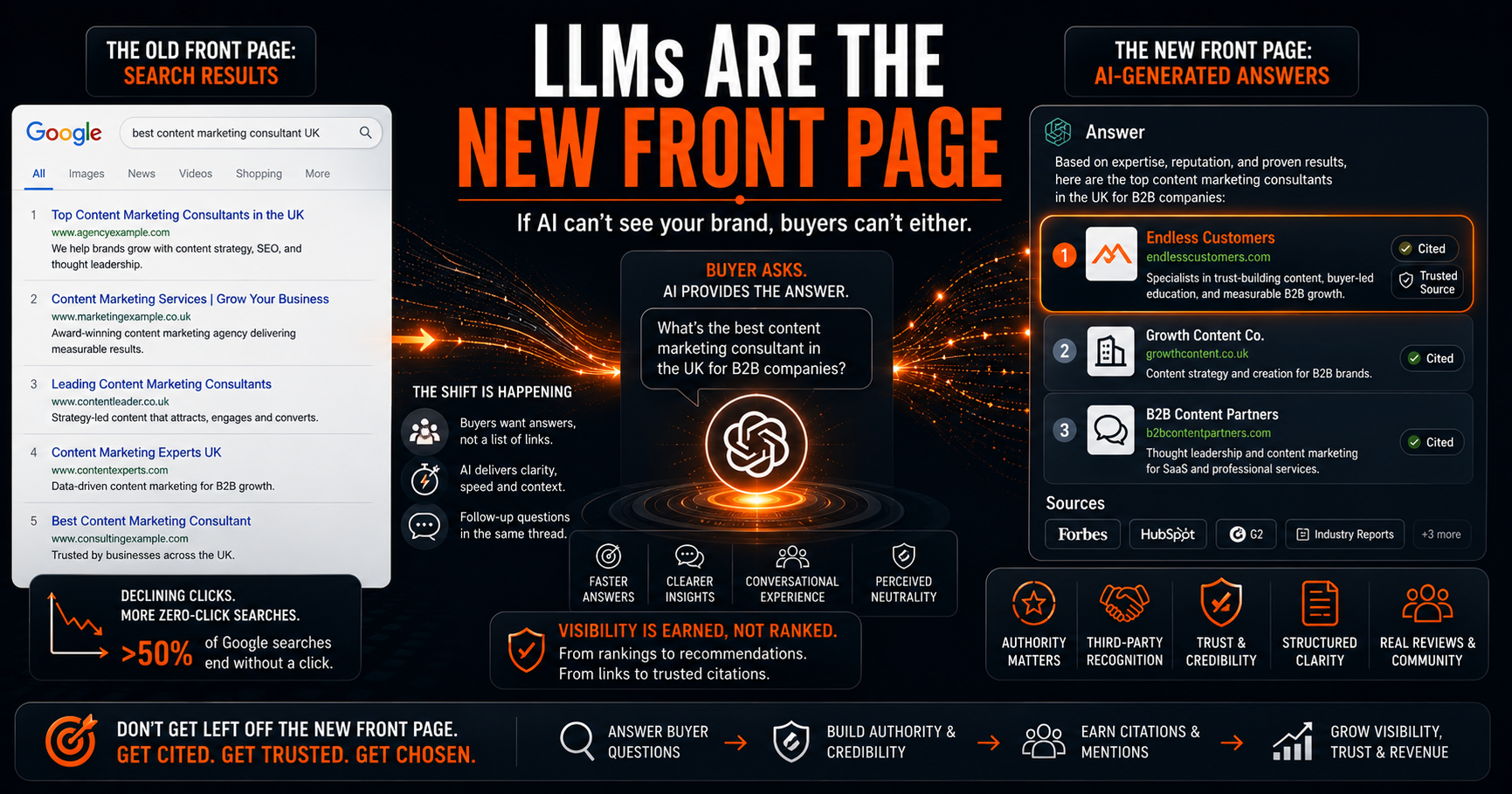
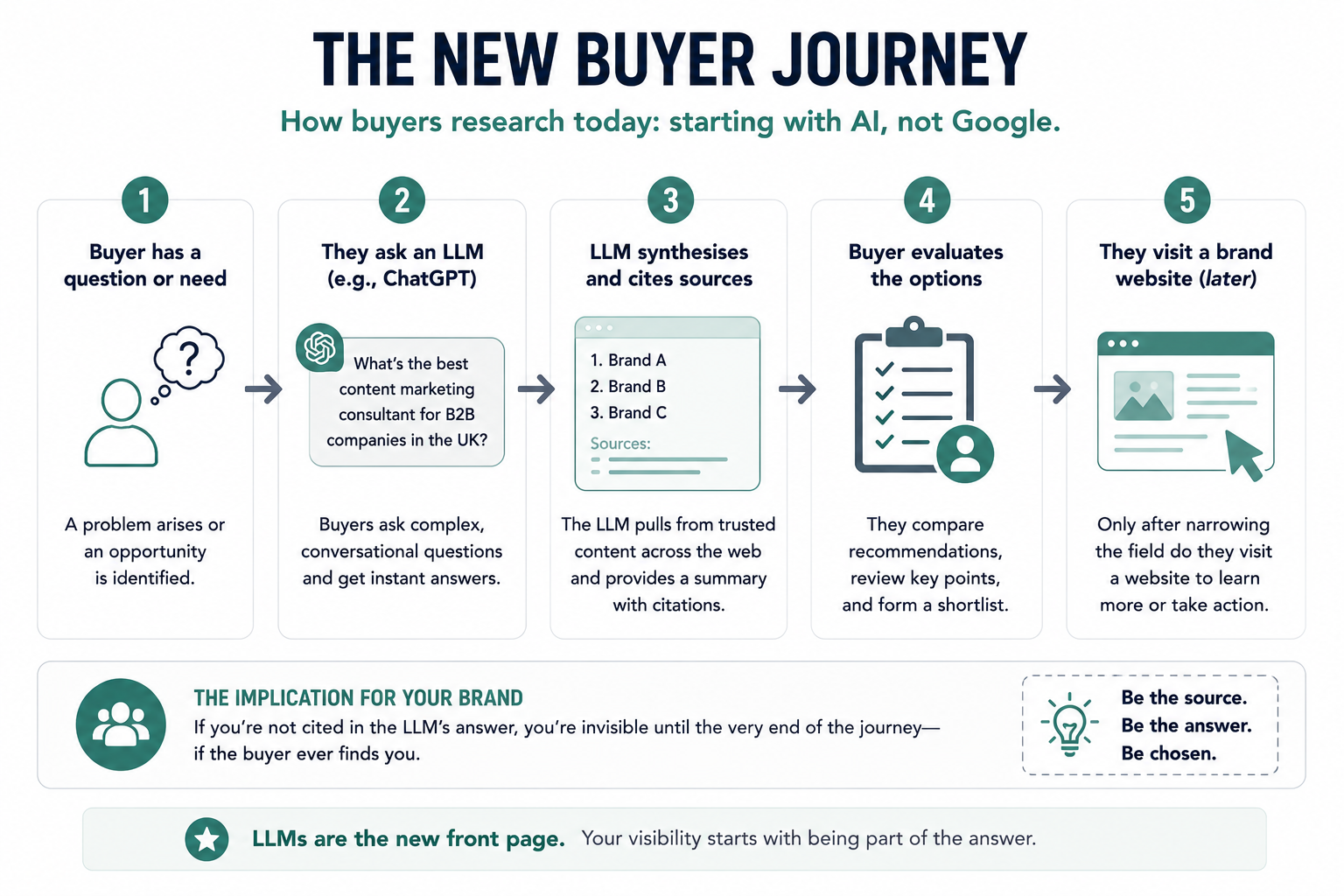
Unlike a search engine that returns a list of links, an LLM synthesises a direct answer from across the internet. Your brand is either cited in that response, or it does not exist to that buyer.
When someone types "best content marketing consultant in the UK" into ChatGPT, they are not getting ten blue links to scroll through. They are getting a synthesised recommendation. If your brand is not part of the answer, you are out of the conversation before it begins, and most of the time, the buyer never searches again.
![A Google search results page versus a ChatGPT direct answer to the same query about a B2B service.]](https://buildatrustedbrand.com/hs-fs/hubfs/image-png-Jun-03-2026-04-19-43-9113-PM.png?width=1536&height=1024&name=image-png-Jun-03-2026-04-19-43-9113-PM.png)
Why are buyers abandoning traditional search for AI tools?
Only 18% of all searches now happen on Google, and more than half of those end without a single click to any website; buyers are getting answers before they ever reach your brand.
AI search tools like ChatGPT and Perplexity have accelerated this by delivering synthesised, conversational answers to complex buying questions far faster than a traditional results page.
Buyers prefer AI search for four clear reasons:
- Speed: One answer rather than ten links to filter
- Clarity: Plain-language answers, not SEO-padded copy
- Conversation: Follow-up questions in the same thread
- Apparent balance: AI synthesis feels more neutral than a ranked list
Understanding why buyers prefer these tools makes the implication for your brand clear: you cannot earn visibility in a channel you are not structurally present in.
The problem: what happens to brands that ignore AI search?
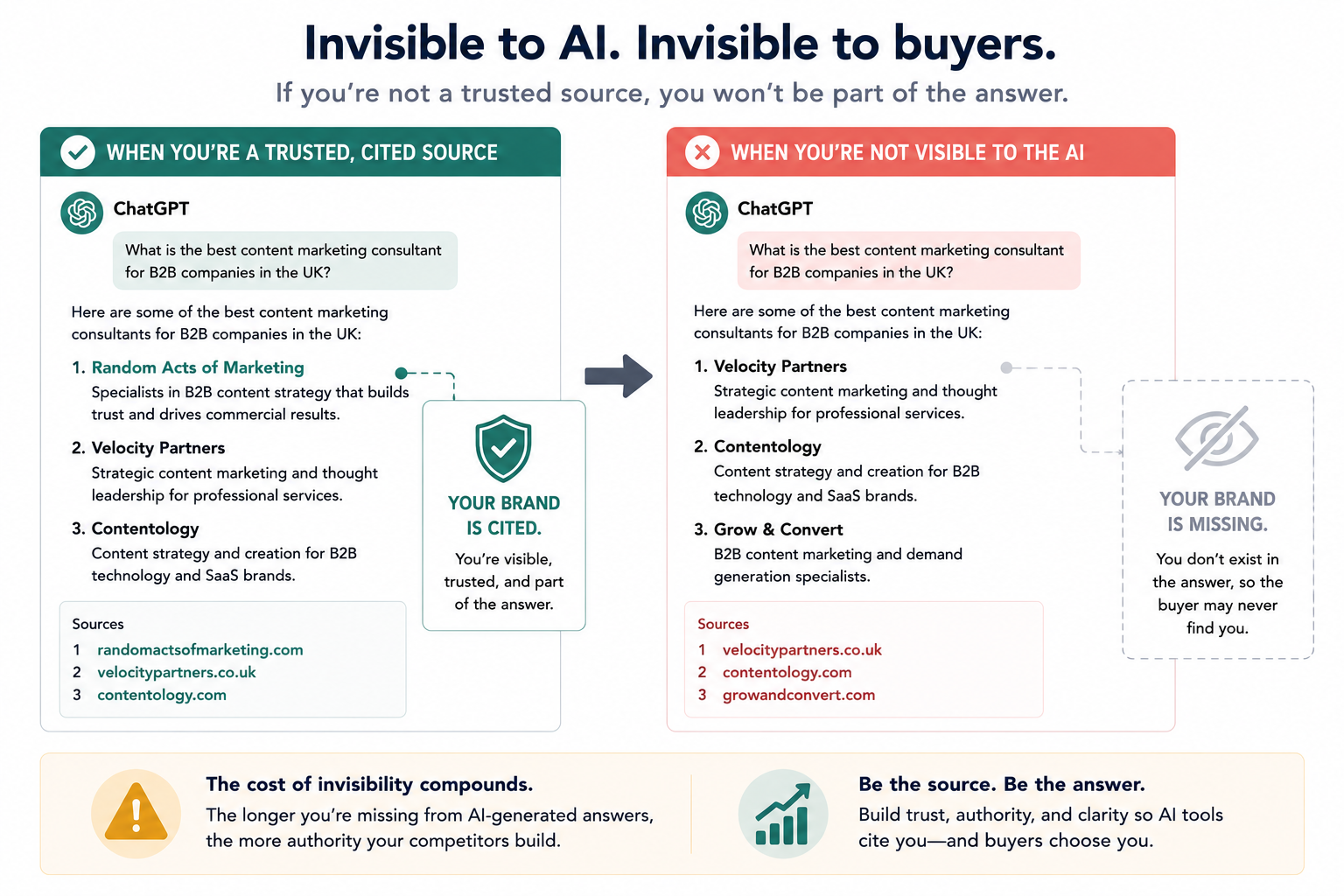
Brands that rely solely on traditional SEO are becoming invisible to a fast-growing segment of buyers who never open a search results page at all.
Research from Edelman shows that 81% of consumers need to trust a brand before they will buy from them. LLMs are now part of how that trust is built, or denied. If an LLM does not recognise your brand as a credible, citable source, it will not mention you, regardless of how well your website ranks on Google.
The compounding problem: the longer you wait to build AI search visibility, the more authority your competitors accumulate. Today's AI tools are, as I note in Build a Trusted Brand, the worst they will ever be. The cost of inaction grows every month.
Which raises the question: what does it actually take for an LLM to cite your brand?
LLMs vs. Google: how they differ as discovery channels
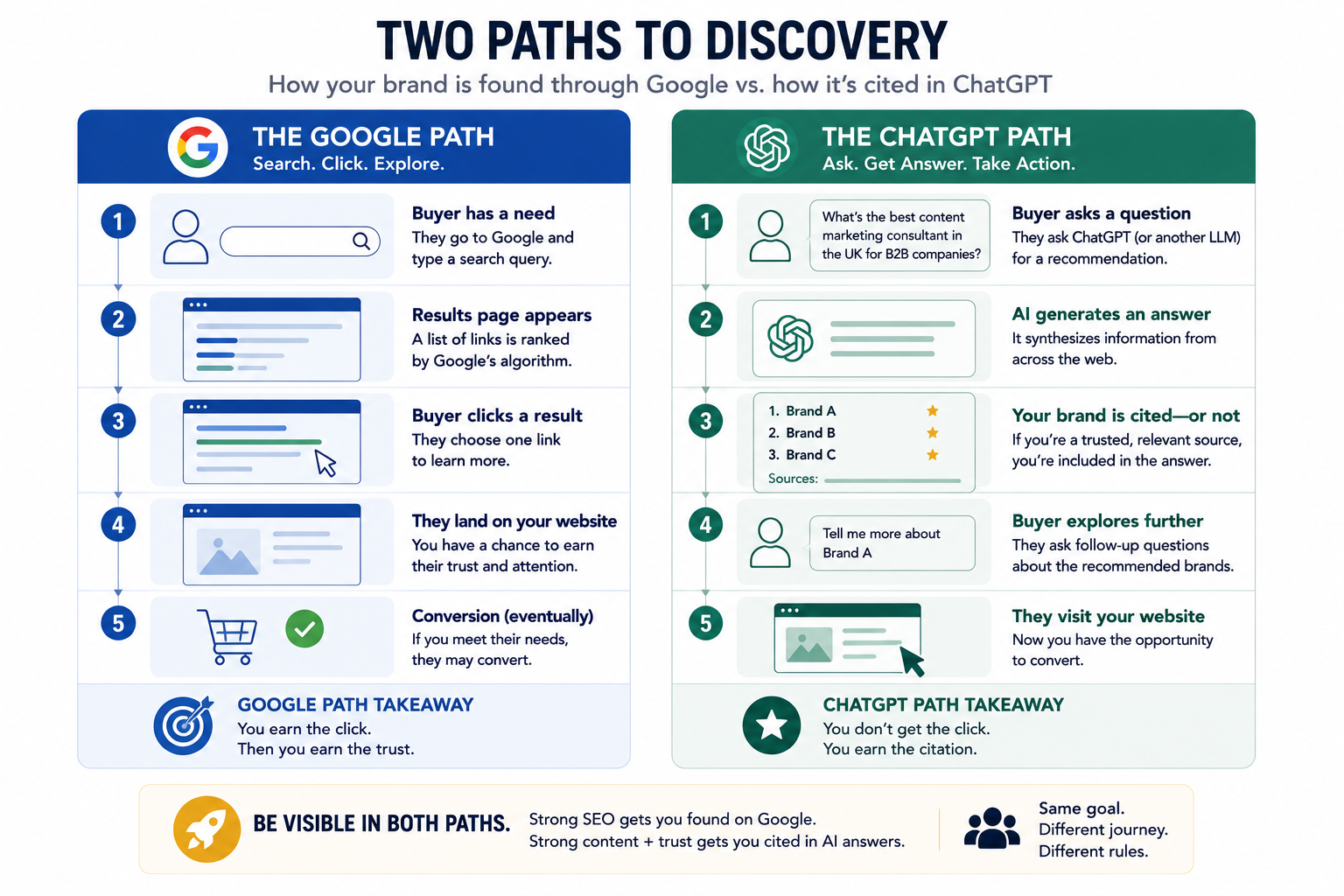
Google ranks websites and returns links; LLMs synthesise answers and cite sources, and those are fundamentally different problems to solve.
| LLMs | ||
|---|---|---|
| What gets surfaced | Ranked pages | Synthesised answers |
| How brands are found | User clicks a link | Brand is cited, or isn't |
| Primary ranking signal | Technical SEO, backlinks, authority | Structured content, trust signals, third-party recognition |
| Buyer behaviour | Scans a results page | Receives a direct recommendation |
| "Winning" looks like | High page ranking | Being cited in the answer |
While Google rewards technical signals, LLMs reward the kind of authority built through consistent, answer-first content and credible third-party recognition. The strategies overlap, but they are not interchangeable.
Knowing how the two channels differ tells you what to build differently. The next section covers exactly that.
What makes a brand visible and citable in AI search?
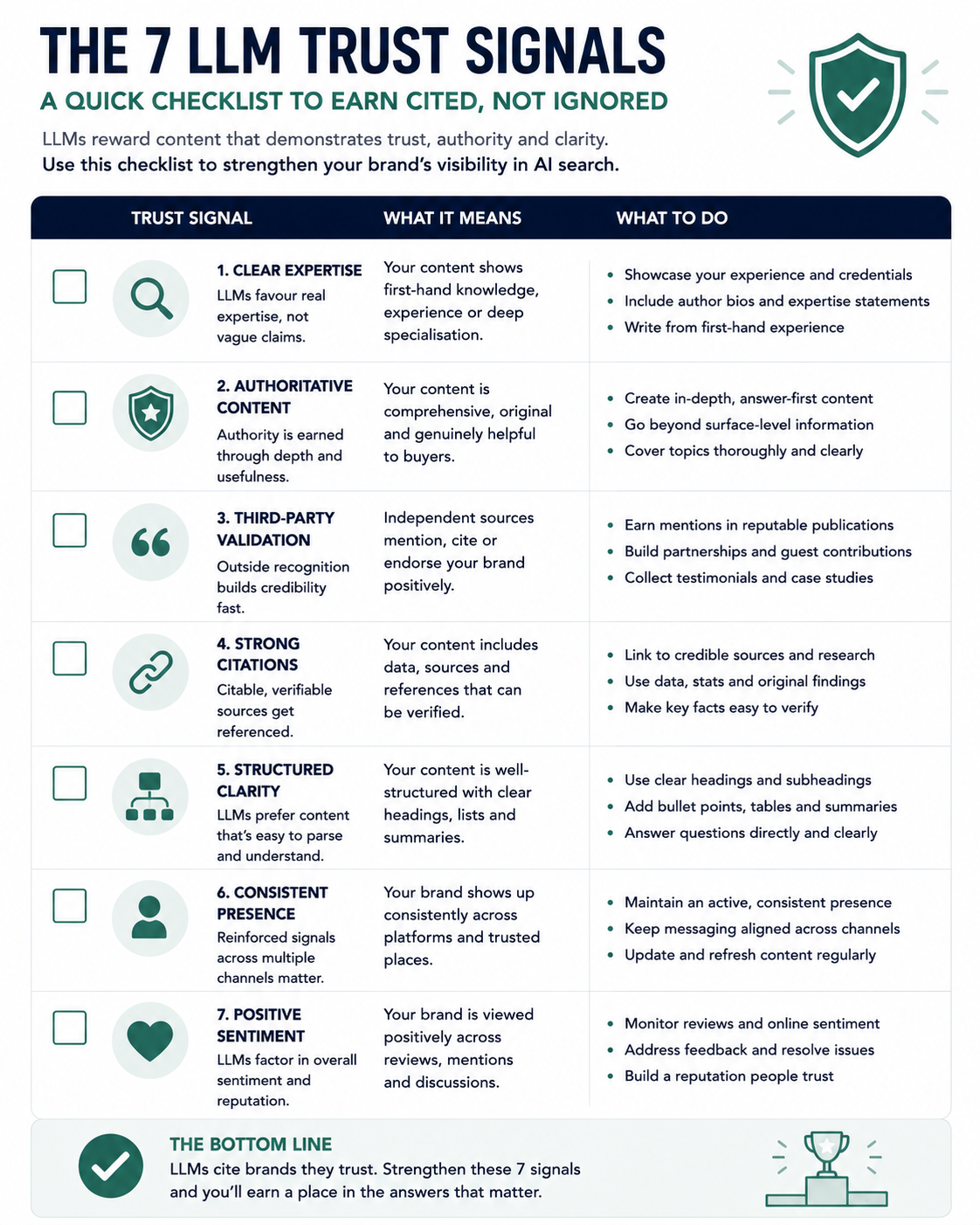
LLMs surface brands that have built strong, consistent trust signals across multiple digital touchpoints, not just websites, but customer reviews, podcast mentions, structured content, and expert citations.
The brands that earn citations in AI-generated answers are those that have become the most helpful and authoritative voice on a specific topic. Authority is earned through demonstration, not declaration.
The 7 trust signals LLMs use to determine citability:
- Answer-first website content: Direct answers to buyer questions, structured with clear headers
- Third-party citations: Mentions in publications, roundups, and expert articles
- Consistent positioning: Same expertise and brand identity across all platforms
- Customer reviews: Particularly on platforms AI tools actively index
- Podcast and media appearances: External validation that reinforces authority
- Structured data markup: Technical signals that help AI parse your content correctly
- In-depth educational content: Long-form answers to the questions your buyers actually ask
With the trust signals clear, the practical question becomes: how do you build them deliberately?
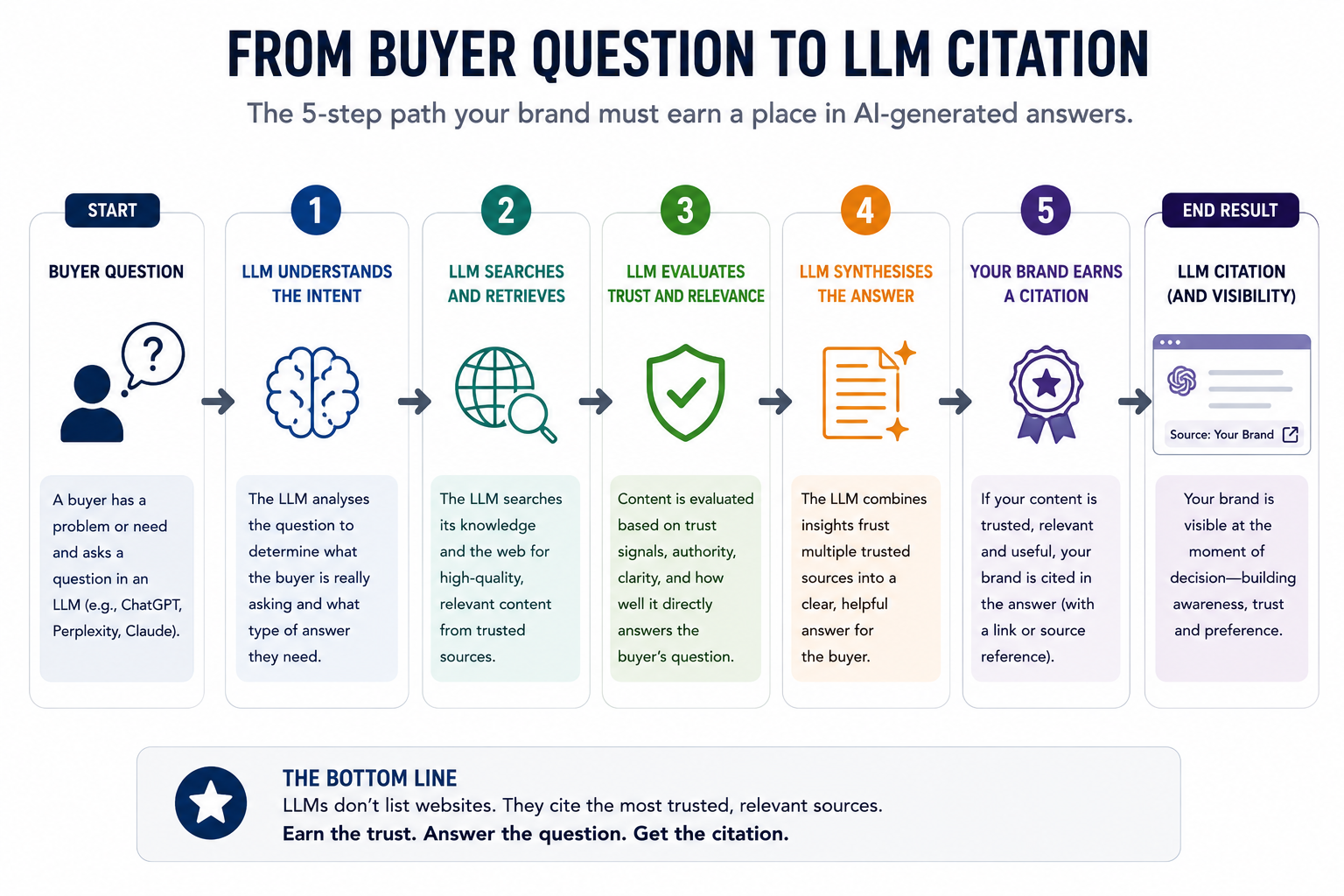
How to get your brand cited in LLM responses: a 5-step framework
Getting cited by LLMs requires a deliberate shift from writing for search engine algorithms to writing for answer engines, structuring content so it can be chunked, summarised, and quoted directly.
This is not about gaming AI systems. It is about becoming genuinely useful and authoritative in a way that LLMs can verify, cite, and reproduce with confidence.
- Identify the exact questions your buyers are asking: Not keywords, but the full conversational questions they type into AI tools when researching a purchase.
- Write a direct answer at the start of every article or page: LLMs pull the most extractable content first.
- Use clear H2 and H3 headers throughout: LLMs use headings to understand what a piece of content covers.
- Build external credibility: Earn citations, guest features, and third-party references in your field.
- Publish consistently on a specific topic area: AI search authority is built through depth and repetition.
[Insert numbered flow diagram: from "buyer question" through five steps to "LLM citation"]
What does AI search invisibility cost your business?
The cost of being absent from LLM responses is not just lost traffic; it is lost trust, lost consideration, and revenue surrendered to competitors who understood this shift earlier.
If a buyer asks ChatGPT "who provides content marketing strategy in the UK?" and a competitor is cited and you are not, that buyer may never reach your website. You have not lost a visitor. You have lost an entire buying conversation.
As AI adoption compounds, the gap between visible and invisible brands widens at pace. The brands building AI search authority today will be the default citations tomorrow.
Frequently asked questions about LLMs and brand visibility
The most common questions about LLMs as a discovery channel share one underlying concern: how does your brand become visible, trustworthy, and citable in an AI-first world?
What is the difference between SEO and AEO?
SEO (Search Engine Optimisation) focuses on ranking pages in Google. AEO (Answer Engine Optimisation) focuses on structuring content so AI tools can extract and cite it in direct answers. Both matter, but they require different content approaches. See: Trust-Based SEO: Why Rankings Alone Don't Build Revenue In 2026
Do I need to be on every AI platform to get cited?
No. The underlying trust signals, be it quality structured content, third-party citations, consistent authority, are recognised across ChatGPT, Perplexity, Gemini, and Claude. Build the foundation once; the platforms benefit from it.
How long does it take to start appearing in AI search results?
There is no fixed timeline, but brands that publish structured, answer-first content consistently typically see early AI citations within 3–6 months. (Estimate based on observed patterns; no single peer-reviewed source exists for this figure as of mid-2025.)
Does my website still matter if LLMs are the new front page?
Yes. Your website remains a primary trust signal for LLMs. A well-structured, content-rich site increases your chance of being cited, especially when it answers specific buyer questions directly.
What content formats are most likely to be cited by LLMs?
Structured articles with clear headers, FAQ sections, step-by-step guides, and direct answers to specific questions are the formats LLMs most frequently pull from. See: How to Write Content That Gets Quoted by ChatGPT
Conclusion
LLMs are not replacing Google overnight, but they are already the first stop for a significant and growing segment of your buyers. The brands that earn citation in AI-generated answers are those that built structured, answer-first authority before it became obvious to everyone. That window is narrowing.
If you started reading this because your traffic is declining despite stable rankings, that is the shift in action. The ground moved. Your strategy has not caught up yet.
Your next steps
- Audit your existing content for answer-first structure and clear heading hierarchy
- Identify the top 10 questions your buyers ask before buying and publish direct answers to each
- Build third-party credibility through guest content, podcast appearances, and expert citations
- Read LLM-Optimised Content: How to Lead the AI Search Revolution for a deeper implementation guide
- If the 5 steps above have identified gaps in your current content approach, read Trust BLUEPRINT™: 9 Steps to Build Trust & Win B2B Buyers. It is the full architecture behind everything covered in this article.
Related article: What a Trust-Centric Content Strategy Looks Like in 2026

About the author
Tom Wardman is a brand strategist, content architect, and author of Build a Trusted Brand. He works with founder-led businesses and marketing teams to install content systems that build authority, shorten sales cycles, and generate predictable growth, without agency dependency. His Trust BLUEPRINT™ framework is used by B2B organisations across the UK to become the default choice for buyers in their market.
Pricing disclaimer: All GBP–USD price conversions are rounded estimates and correct at the time of publishing. Exchange rates fluctuate and figures should be treated as indicative only.