

Key Takeaways
-
Random acts of marketing are sporadic, disconnected marketing efforts that lack consistency and strategic direction, costing businesses an estimated 60–80% of their marketing resources.
-
The true cost extends beyond wasted advertising spend to create five devastating ripple effects: eroded authority, audience confusion, wasted resources, reporting nightmares, and internal friction that often leads to marketing teams facing budget cuts or redundancies.
-
Companies that consistently measure content marketing ROI are 12 times more likely to see year-over-year increases in returns compared to those practising sporadic marketing.
-
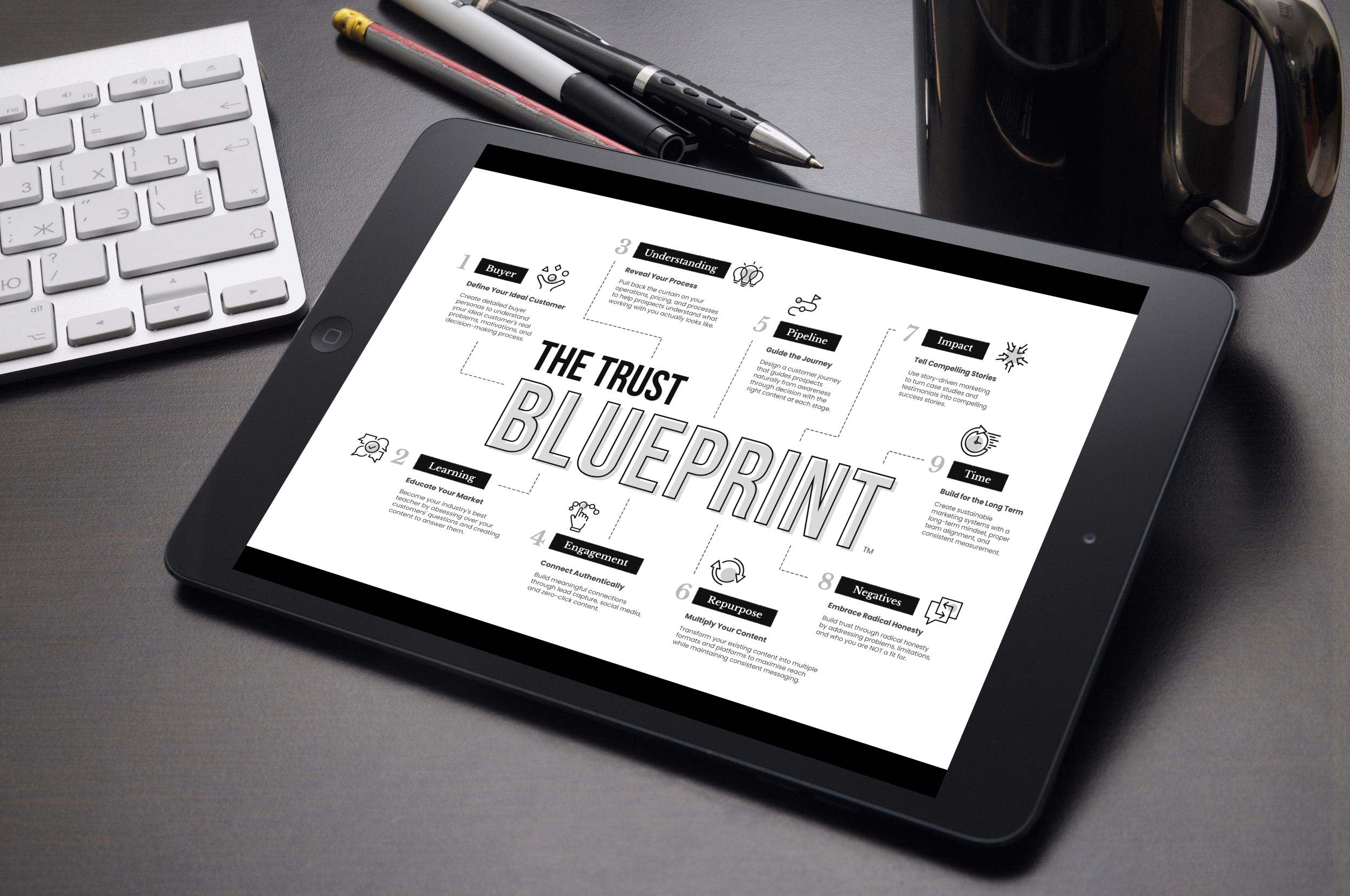
The Trust BLUEPRINT framework provides a nine-step strategic system that transforms marketing from disconnected tactics into a cohesive, trust-building approach.
-
Breaking free from random acts starts with committing to a realistic schedule—it's better to post one high-quality blog post monthly with consistency than aim for weekly posts and burn out.
Your marketing isn't bringing in the customers your business needs, and it's costing you more than you think. You've published blog posts sporadically, gone silent on social media for months, then launched a sudden campaign wondering why leads have dried up. Revenue is flat, the board is asking questions, and internally the finger-pointing has started. Sound familiar?
This is a cost problem. And in my experience, businesses stuck in this cycle waste 60–80% of their marketing resources.
I've spent the past decade helping businesses break free from exactly this cycle: inconsistent, stop-start marketing that drains budgets without delivering results. I've also seen first-hand how random acts of marketing quietly destroy brand credibility and bleed cash.
This article is for business owners and marketing leaders who recognise their marketing has become too sporadic and want to understand the true financial impact, and more importantly, what to do about it. Here's what we'll cover:
- The five hidden costs of random acts of marketing
- The real financial impact of inconsistent effort
- What results you can realistically expect from making the change
- How to transition from sporadic tactics to strategic marketing
What Are Random Acts of Marketing?
Random acts of marketing are sporadic, disconnected marketing efforts that lack consistency and strategic direction, essentially the business equivalent of publishing a blog post once every blue moon, going silent on social media for months, then wondering why lead generation has dried up.
Random acts of marketing are inconsistent, disconnected tactics that prevent trust and ROI from compounding, and they're far more common than most businesses realise.
Random marketing means hopping from one tactic to the next, such as content marketing one month, social media the next, never giving any approach enough time to bear fruit. It's like joining a gym, going daily for a week, then disappearing for two months. Just like that fitness strategy, haphazard marketing yields haphazard results.
What Are the Actual Costs of Inconsistent Marketing?
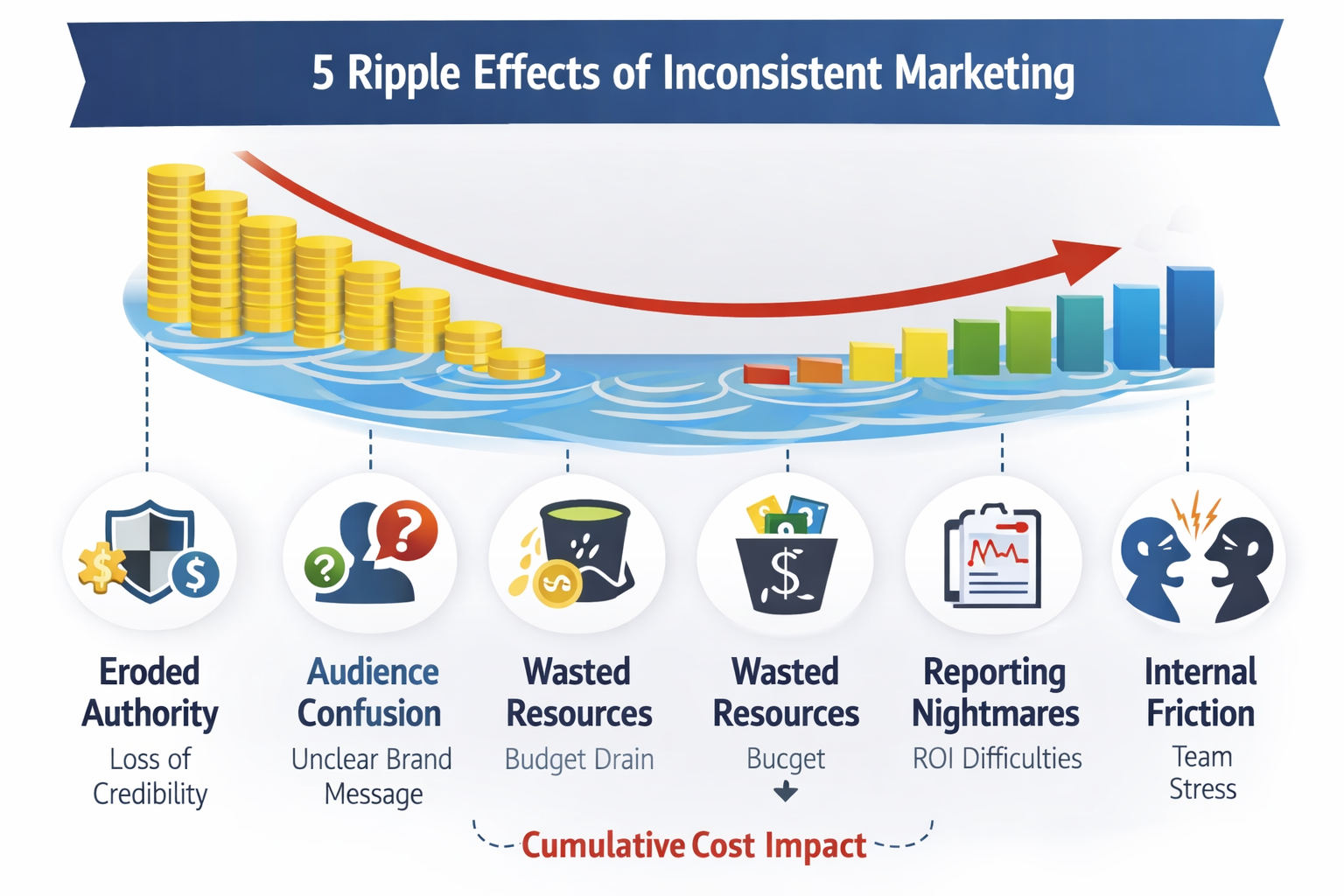
The true cost of random acts of marketing extends far beyond wasted advertising spend; it creates five devastating ripple effects: eroded authority, audience confusion, wasted resources, reporting nightmares, and internal friction that often leads to marketing teams facing budget cuts or redundancies.
Every time you start and stop marketing efforts, you're resetting to zero, and paying full price to rebuild what you already had.
These costs compound over time because every time you stop and start again, you're essentially telling your audience "We're here! ...Never mind, we're gone. Wait, we're back again!" which chips away at whatever authority you might have built.
Direct Financial Costs of Random Acts of Marketing
Money literally disappears when campaigns stop and start. You pay for advertising that builds momentum, then kill that momentum by going silent. Each pause forces you to rebuild awareness from scratch rather than compounding your results.
Every pause in your marketing forces you to pay again for awareness you'd already earned.
Opportunity Costs and Lost Revenue from Sporadic Efforts
While you're silent, potential customers are researching solutions. When buyers make 80% of their purchasing decision before even contacting you, your outdated website and sporadic content send a clear message: "We're not really interested in earning your trust," driving potential customers straight to your more consistent competitors.
When you're absent during the buyer's research phase, your competitors capture demand you've already paid to generate.
Brand Damage and Trust Erosion from Inconsistent Marketing
Each time you disappear, you chip away at what little authority you might have built. Your audience starts to question your commitment and expertise. Confusion rarely converts to sales.
Trust takes months to build and days to lose, and every gap in your marketing accelerates that erosion.
Team Morale and Internal Friction Caused by Random Marketing
When results don't materialise (and they won't with inconsistent efforts), tensions rise. Marketing teams face increased scrutiny, often leading to budget cuts or worse, redundancies. The cruel irony is that the marketing department most capable of transforming your business often faces the chopping block first when leads dry up from inconsistent efforts.
The team best positioned to fix the problem is usually the first to be cut when random marketing fails to deliver.
| Cost Category | Specific Impact | Approximate Waste |
|---|---|---|
| Eroded Authority | Lost credibility each time you disappear | 30–40% of trust-building effort |
| Audience Confusion | Unclear brand positioning | 20–25% of messaging effectiveness |
| Wasted Resources | Efforts trickle away without consistency | 60–80% of marketing budget |
| Reporting Nightmares | Impossible to prove ROI on disconnected activities | Cannot measure effectively |
| Internal Friction | Team redundancies and budget cuts | Loss of institutional knowledge |
How Much Does Unfocused Marketing Really Cost Businesses?
While exact figures vary by industry, in our experience businesses practising sporadic marketing typically waste 60–80% of their marketing resources. That estimate comes from tracking where the waste actually occurs: paid campaigns that lose momentum when paused, SEO rankings that drop during content gaps, sales teams left without up-to-date material, and the repeated cost of rebuilding audience awareness from scratch each time activity restarts.
Most businesses practising random acts of marketing are losing the majority of their investment before it has a chance to deliver returns.
Think of it this way: you invest £10,000 ($12,500) in a content marketing push. For two months, you publish regularly, build some traffic, start ranking for keywords. Then you stop. Traffic declines, rankings drop, momentum dies. When you restart six months later, you're essentially starting from zero, that £10,000 ($12,500) created temporary visibility, not lasting value.
The real cost isn't just the wasted budget—it's the opportunity cost of what consistent effort could have achieved. Companies that measure content marketing ROI consistently are 12 times more likely to see year-over-year increases in returns.
What Problems Does Random Marketing Create That Consistent Strategies Avoid?
The fundamental problem with random acts of marketing is that trust isn't built overnight; it's cultivated through consistent, valuable interactions over time, yet sporadic efforts actively undermine trust-building by creating confusion about what you stand for and whether customers can rely on you.
Random marketing doesn't just fail to build trust; it actively destroys it by signalling unreliability to your audience.
Customer Journey Disruption from Sporadic Marketing
Buyers research solutions over weeks or months, not days. When your content appears sporadically, you're absent during most of their decision-making journey. They find you once, then can't find updated information when they're ready to buy.
Inability to Track Marketing ROI Without Consistency
Try proving the return on investment from a series of disconnected marketing activities. Without consistent data over time, you can't identify what works, can't optimise, and can't justify continued investment.
SEO and Content Visibility Issues from Inconsistent Publishing
Search engines reward consistent publishing. Sporadic content tells Google your site isn't a reliable, authoritative source. Rankings suffer, organic traffic stagnates, and competitors who publish consistently overtake you.
Team Burnout from Campaign-Based Marketing Thinking
Random marketing creates a boom-and-bust cycle. Teams work frantically during campaign pushes, then face pressure when results inevitably fade. This creates exhaustion, turnover, and lost expertise.
Random Marketing vs. Strategic Marketing: What's the Real Difference?
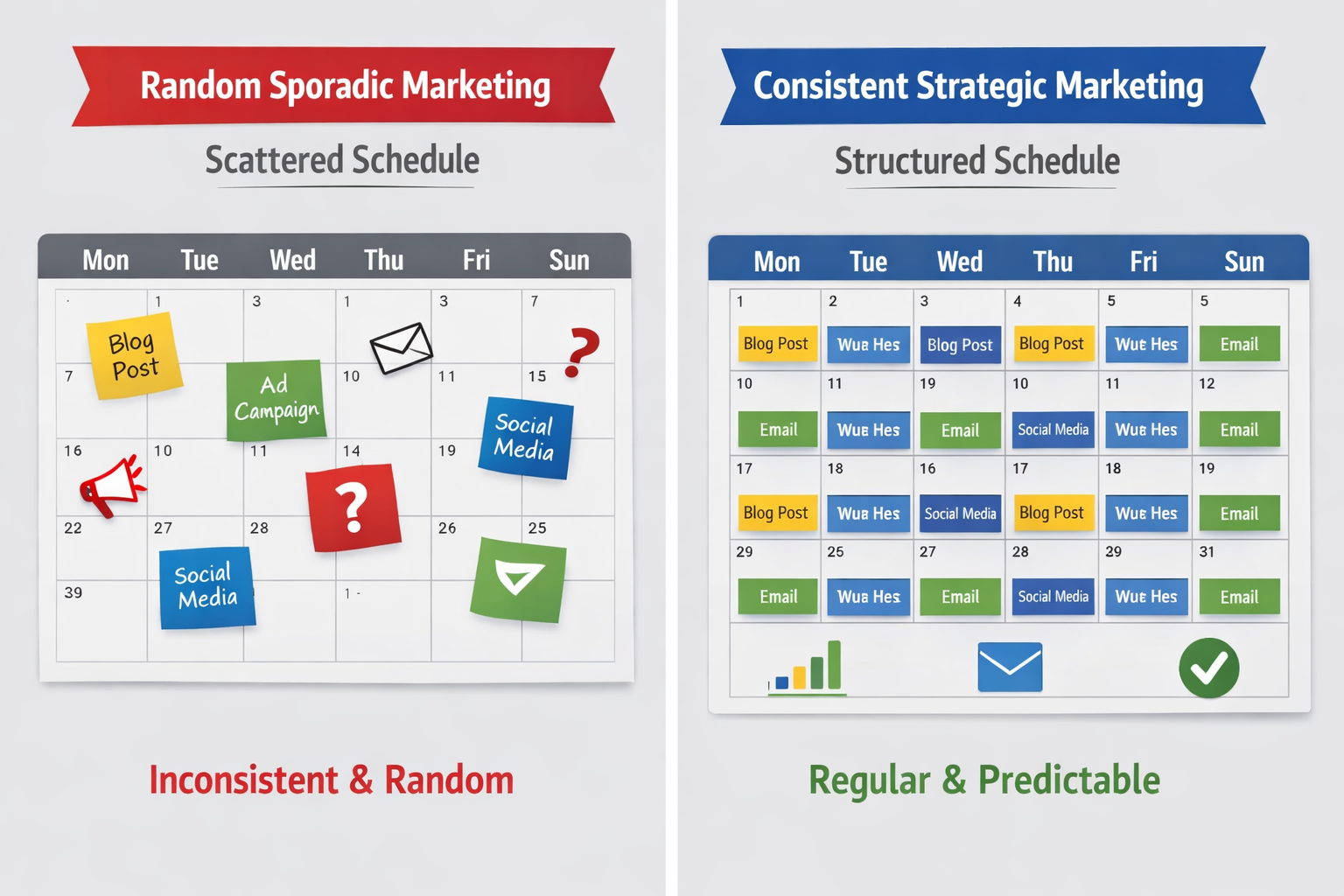
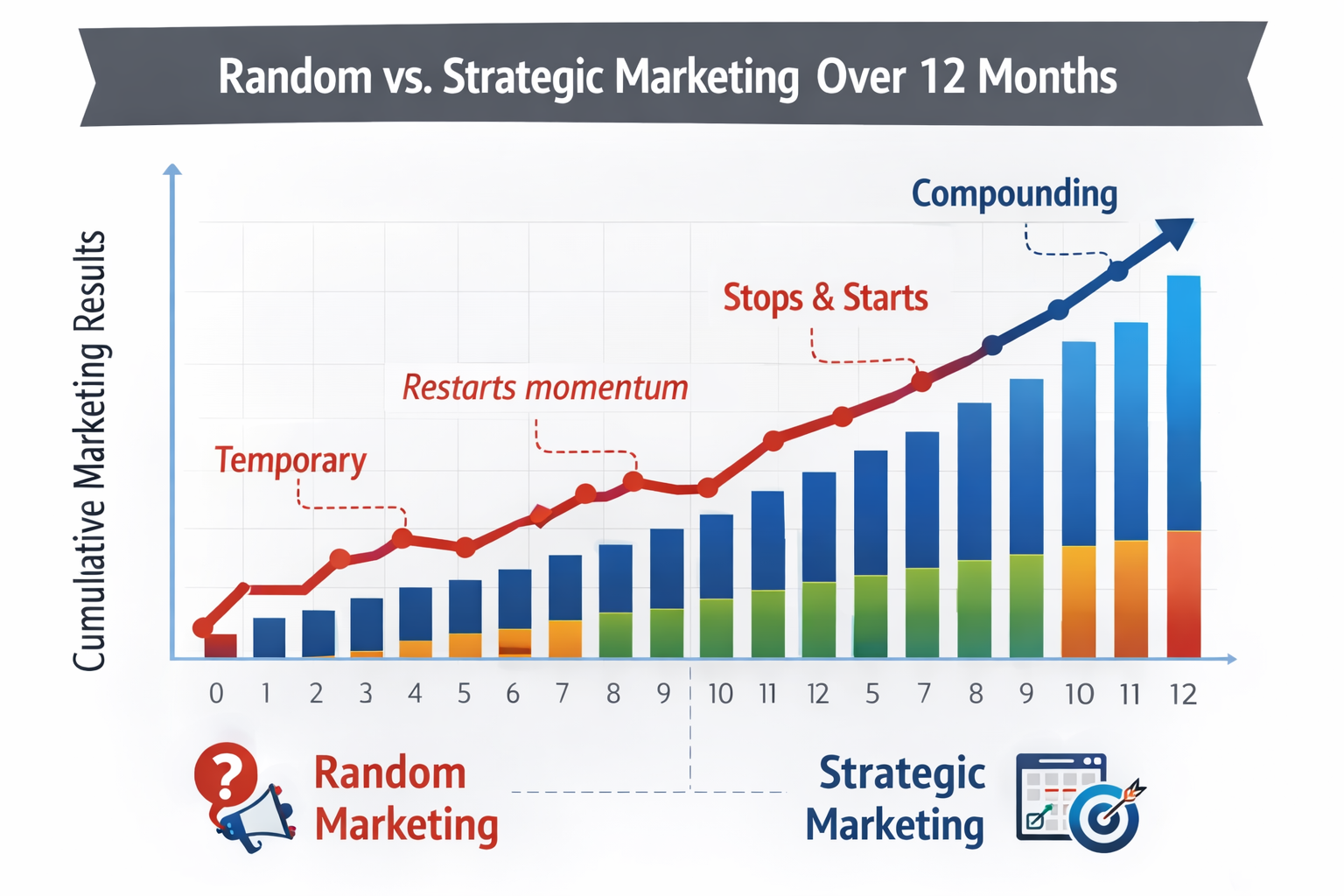
Random acts of marketing are reactive, disconnected tactics jumping from content marketing one month to social media the next without giving any approach time to bear fruit. Strategic marketing follows a consistent framework where small, regular actions compound over time.
The difference between random and strategic marketing isn't effort; it's consistency. One compounds, the other evaporates.
| Dimension | Random Marketing | Strategic Marketing |
|---|---|---|
| Consistency | Sporadic bursts followed by silence | Regular, predictable cadence |
| Measurement | Impossible to track disconnected efforts | Clear metrics tracked over time |
| Timeline | Expects immediate results | Committed to 12–24 month horizon |
| Trust-building | Undermines credibility | Compounds trust gradually |
| Resource efficiency | Wastes 60–80% of budget | Maximises ROI through consistency |
| Results | Temporary spikes that fade | Sustainable growth that compounds |
When Campaign-Based Marketing Does Make Sense
It's worth acknowledging that not all campaign-based marketing is wasteful. Product launches, seasonal promotions, and event-driven marketing all have legitimate roles to play. The problem isn't campaigns themselves; it's when campaigns are the only marketing you do, with nothing connecting them. The most effective approach uses campaigns as spikes on top of a consistent baseline of trust-building content, not as a replacement for it.
What Results Can You Expect from Consistent vs. Random Marketing?
Businesses that embrace long-term consistent marketing strategies see measurably different outcomes across four key areas.
Businesses that switch from sporadic to consistent marketing typically see cost per lead drop by 30–50% within the first 12 months as organic channels start compounding.
-
Brand Authority: Your website becomes a regularly updated hub of valuable information where customers research before buying.
-
Customer Loyalty: Consistent communication creates repeat business and referrals as customers trust your reliability.
-
Reduced Marketing Costs: Organic reach grows as search rankings improve and social following builds naturally.
-
Competitive Advantage: While competitors chase trends, your steady approach creates lasting differentiation.
Companies that consistently measure content marketing ROI are 12 times more likely to see year-over-year increases in returns compared to those practising sporadic marketing, proving that patience and consistency compound into significant competitive advantages.
How Do You Transition from Random Acts to Strategic Marketing?
Breaking free from random acts of marketing starts with committing to a realistic schedule—it's better to post one high-quality blog post monthly with consistency than aim for weekly posts and burn out after a month.
The goal isn't to do more marketing; it's to do less, more consistently, for longer.
Step 1: Audit Your Current Marketing Chaos
Review the past 12 months. List every marketing activity: blog posts published, social posts created, campaigns launched, emails sent. Look for the gaps—those silent periods reveal where your random acts are costing you.
Step 2: Set Realistic Consistency Benchmarks
Start small. If you've been sporadic, don't suddenly commit to daily content. Choose one channel and one frequency you can genuinely maintain for 12 months. One weekly email or one monthly blog post beats ambitious plans you'll abandon.
Step 3: Build Your Content Calendar
Plan 90 days ahead. This bird's-eye view helps maintain consistency and aligns your efforts with business goals. Batch-create content, set aside dedicated time to create multiple pieces at once, ensuring you always have a backlog ready.
A 90-day content calendar is the single most effective tool for preventing the stop-start cycle that kills marketing momentum.
Step 4: Implement Measurement Systems
Use scheduling tools for social media posts and email newsletters. Track what you publish, when, and what results you see. Consistency doesn't mean manually posting every day—automate where possible to maintain your cadence without burnout.
Step 5: Commit to the Long Game (12–24 Months)
Regularly review your efforts—what's working, what isn't—but use these insights to refine your strategy, not abandon it entirely. Give your marketing team the time, resources, and trust they need to implement a steady, long-term strategy.
Frequently Asked Questions About Random Acts of Marketing
These are the most common questions businesses ask when recognising their marketing has become too sporadic and unfocused.
How long does it take to see results from consistent marketing?
Expect 3–6 months before you see measurable improvements in traffic and lead quality, with significant ROI appearing around the 12-month mark. Early months build the foundation; later months deliver the returns.
What if we've already tried marketing and it didn't work?
This is one of the most common things I hear, and in almost every case, the marketing didn't fail because it was the wrong approach. It failed because it was inconsistent. If you stopped before 12 months, you didn't give it enough time. But timing isn't the only factor. Most "failed" marketing also suffers from topics that weren't aligned to what buyers actually search for, no measurement framework to know what was working, and no alignment between marketing content and what the sales team needed. The fix isn't to try something new—it's to commit to the fundamentals with consistency and proper tracking.
How much should we budget for strategic marketing vs. random campaigns?
In our experience, consistent marketing typically costs 20–30% less than campaign-based approaches over 12 months because you eliminate the waste of constantly rebuilding momentum. Budget £2,000–£5,000 ($2,500–$6,250) monthly for small businesses, £5,000–£15,000 ($6,250–$18,750) for mid-market companies.
Can a small team really maintain marketing consistency?
Yes, but start small. One person can maintain one weekly blog post, one weekly email, and daily social scheduling using automation tools. The secret isn't doing more—it's doing less, consistently.
What's the minimum viable consistency for marketing success?
One high-quality piece of content monthly (blog post, video, or podcast), repurposed into social posts and email content, maintained for 12 months minimum. This baseline gives you enough data to measure, enough consistency to build trust, and enough sustainability to avoid burnout.
Conclusion
You came to this article because your marketing wasn't delivering—sporadic blog posts, months of silence on social media, sudden campaigns born from panic rather than strategy. Now you can see the real cost: 60–80% of your marketing budget wasted, trust eroded with every gap, teams under pressure, and competitors pulling ahead while you reset to zero.
Random acts of marketing aren't just inefficient; they're one of the most expensive mistakes a growing business can make. They cost you in wasted budget, lost opportunities, eroded authority, confused audiences, and teams who face redundancy when results inevitably fail to materialise.
But here's what changes when you commit to consistency: small, regular actions start compounding. Authority builds. Trust grows. Leads become more qualified, sales cycles shorten, and your marketing starts working for you instead of draining you. When businesses make this shift, they don't just see better marketing—they see a fundamentally different relationship with their pipeline.
The choice is yours: continue the cycle of random acts, or commit to the consistency that builds trusted brands.
If you're ready to take the first step, start with an honest audit of your last 12 months. Identify the gaps. Then read [The Trust BLUEPRINT: A 9-Step Framework for Strategic Marketing] to see how a structured approach replaces the guesswork.
How to Take Action Now
- Audit your past 12 months of marketing to identify gaps and sporadic patterns
- Choose one marketing channel and commit to a realistic, sustainable publishing schedule
- Create a 90-day content calendar to maintain consistency and reduce decision fatigue
- Implement measurement systems to track what works over time, not just campaign-by-campaign
- Give yourself permission to start small—one monthly blog post beats ambitious plans you'll abandon
Ready to transform your marketing from random acts to a strategic system? I work with businesses as a Fractional Marketing Director, handling day-to-day execution, or as a Fractional CMO, providing strategic guidance to existing teams. My services are built on the Trust BLUEPRINT framework, designed to build consistent, trust-based marketing that generates reliable results. Full disclosure: I developed this framework, so I'm naturally biased toward it—but the principles of consistency and buyer-first content apply regardless of which system you use.

About the Author
I'm Tom Wardman, and I've spent the past decade helping businesses transform scattered marketing efforts into reliable systems for growth. My approach has generated over £3m ($3.75m) in new business opportunities and a 45% increase in qualified leads for clients. I developed the Trust BLUEPRINT framework after seeing too many businesses waste resources on random acts of marketing when what they needed was a consistent, trust-building strategy. Whether working as a Fractional Marketing Director handling execution or as a Fractional CMO providing strategic guidance, I focus on what really matters: building trust with customers and turning that trust into revenue.
Pricing Disclaimer: All GBP–USD price conversions are rounded estimates and correct at the time of publishing. Exchange rates fluctuate and figures should be treated as indicative only.
Topics: