

Are your potential customers finding the answers they need on your website, or are they finding them on a competitor's?
Are you publishing content regularly but not seeing it convert into qualified leads?
If so, there is a good chance your content is missing the specific topics buyers are actually searching for. This article gives you the Big 5 buyer questions framework, five content categories that influence almost every major buying decision, and shows you exactly how to use it to shorten your sales cycle and build trust that compounds over time.
This is for founders, marketing leads, and sales teams in B2B businesses who want their content to do real commercial work. You will leave with a clear audit framework and a practical starting point.
Key takeaways
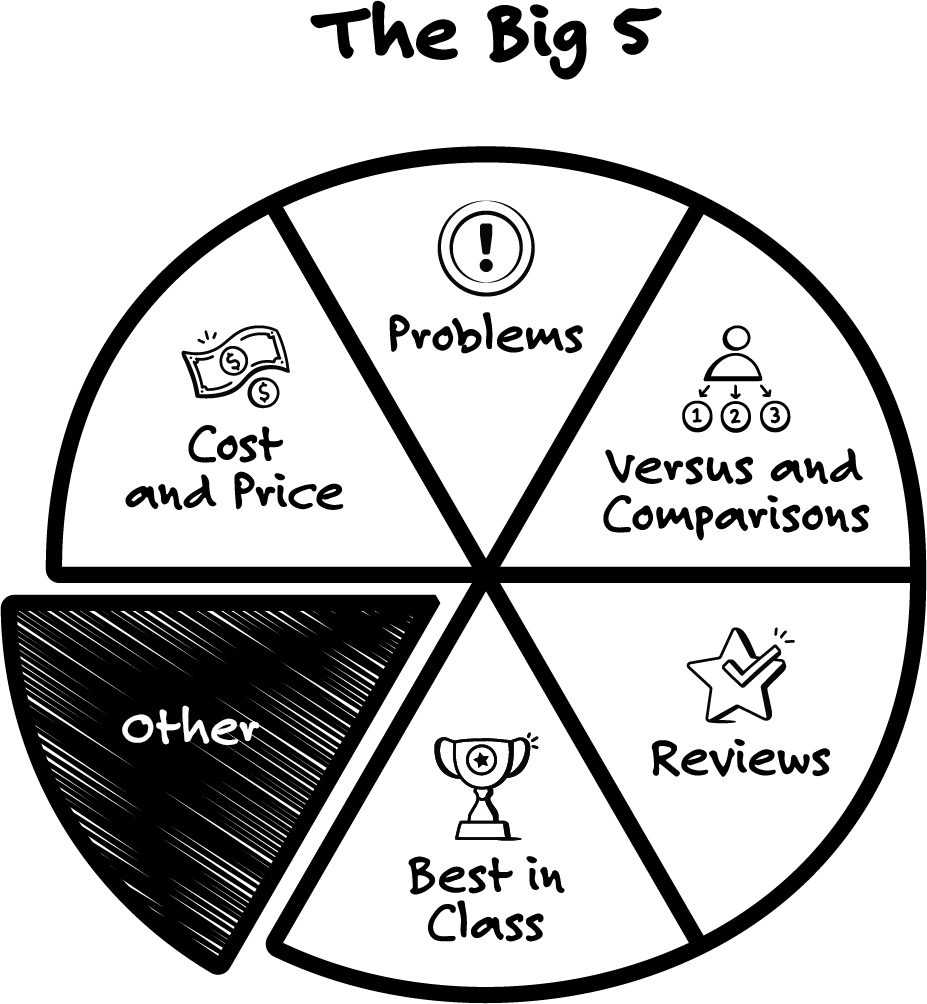
- The Big 5 are Cost & Price, Problems, Versus & Comparisons, Reviews, and Best in Class, the five content categories buyers research before most significant purchases.
- Fewer than 10% of businesses address pricing on their website; those that do immediately stand out as transparent and trustworthy. (Estimate based on Marcus Sheridan's cross-industry research, see Endless Customers System™)
- Buyers who discover problems with your product themselves lose trust. Buyers you told about those problems gain it.
- Criteria-based Best in Class content, ranking yourself alongside competitors using transparent evaluation criteria, is among the strongest-performing formats in AI-generated search on platforms like ChatGPT and Perplexity.
- Implementing the Big 5 starts with a simple audit: search your own business across all five categories and identify which questions you are not yet answering.
What are the Big 5 buyer questions?
The Big 5 are five content categories; Cost & Price, Problems, Versus & Comparisons, Reviews, and Best in Class, that buyers search for before making almost every significant purchase.
The framework was developed by Marcus Sheridan and sits at the core of the Endless Customers System™.
I should be upfront: I'm a certified Endless Customers coach and I use this framework as the operational engine inside my Endless Customers™ Implementation programme. I'm referencing it here because the underlying buyer psychology is well documented — and the results I've seen with clients are real. It is not a content trend.
It is a philosophy built on one premise: buyers are already researching your product or service. The only question is whether your business is part of that conversation.
Every business I work with starts with an audit of which Big 5 topics they are currently answering, and which they are quietly avoiding.
Why buyers research before they contact you
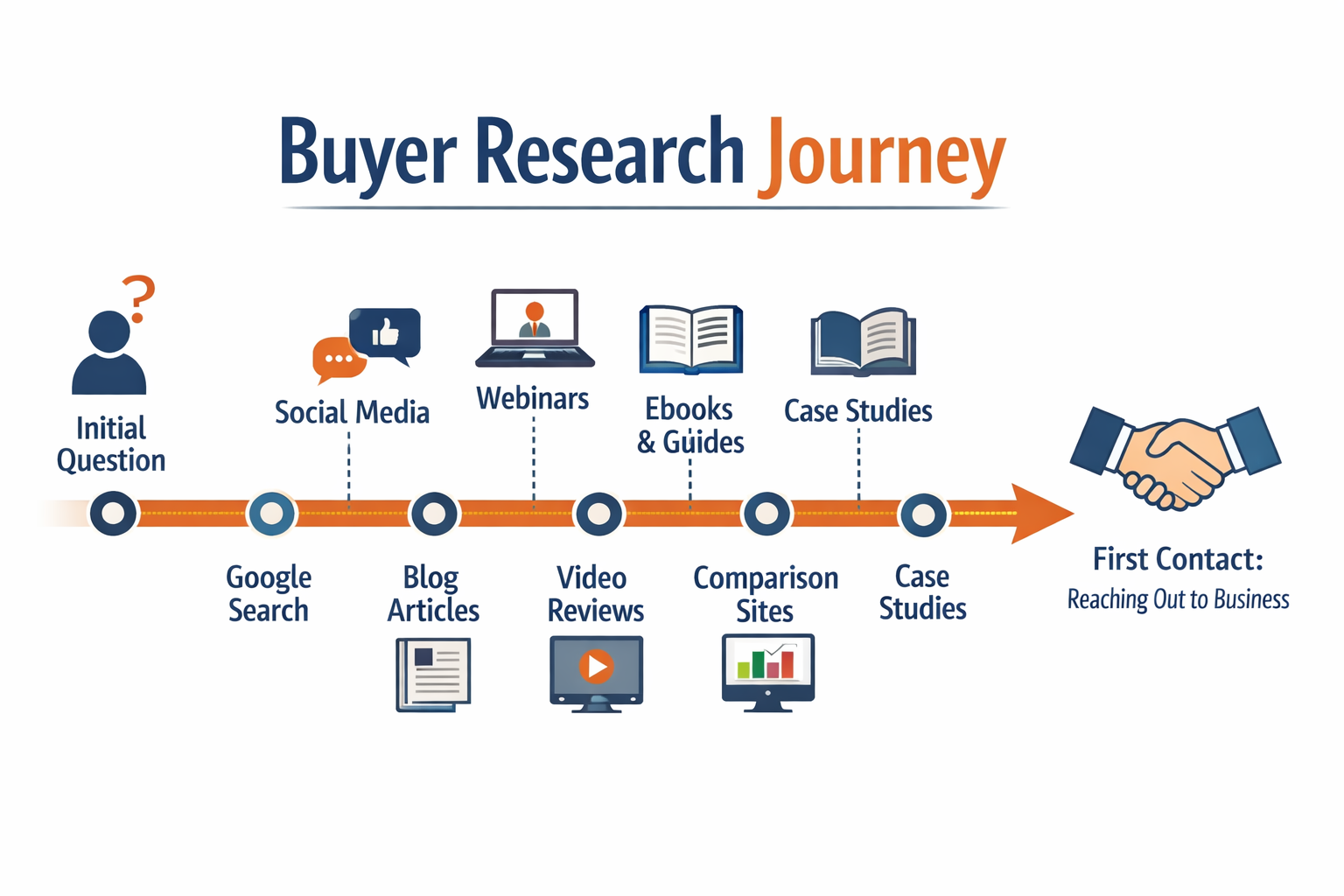
On average, 80% of the buying decision is made online before a prospect contacts a business, a phenomenon Google calls the Zero Moment of Truth
Research from Forrester suggests B2B buyers typically consume between three and five pieces of content before engaging with a sales rep. By the time someone fills out your contact form, they have already formed a strong view about who they want to buy from. Your content either shaped that opinion, or a competitor's did.
Businesses that avoid the uncomfortable topics, price, problems, comparisons, are not protecting themselves. They are handing those conversations to someone else.
Big 5 #1: Cost & Price - why hiding your prices is losing you customers
Fewer than 10% of businesses address pricing on their website, making price transparency one of the most accessible trust-building moves available to any brand. (Estimate: Marcus Sheridan's research across industries, cited in Build a Trusted Brand)
When buyers cannot find pricing, most do not call to ask. They leave, and go to a competitor willing to be upfront.
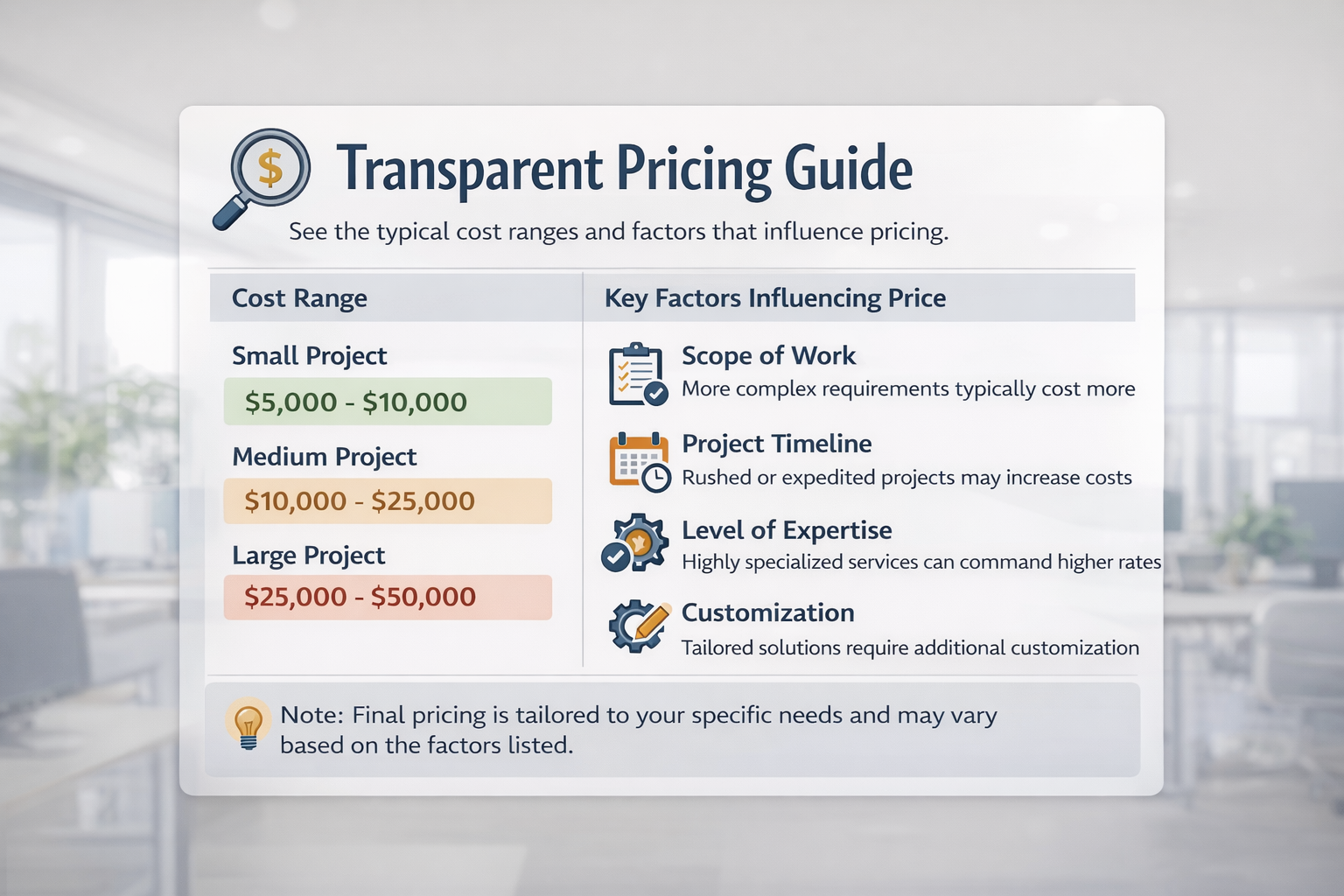
You do not need a fixed price list. Ranges, explanatory guides, and calculators all count. The goal is enough context for buyers to self-qualify.
A straightforward approach: if your typical project runs between £15,000–£40,000 ($19,000–$51,000), publish that range and explain what drives costs up or down. Buyers who arrive already knowing your price range are serious prospects, not tyre-kickers.
Note: I address pricing for my own services on my Endless Customers™ Implementation page. If you are evaluating whether to work with me, that is the right place to start.
For more on structuring content that qualifies leads before the first call, see Why Your Blog Isn't Getting Leads (And How to Change That).
Big 5 #2: Problems - why talking about drawbacks builds more trust than hiding them
Businesses that honestly address the problems and limitations of their products consistently outperform those that don't, in both search rankings and buyer trust.
Most businesses avoid this topic for fear of putting buyers off. In practice, the opposite tends to be true, both in terms of search performance and conversion.
Marcus Sheridan's article "Top 5 Fiberglass Pool Problems and Solutions" is attributed to at least $2 million (£1.6 million) in revenue. He did not claim fiberglass pools were perfect. He put the honest answer front and centre, and buyers trusted him for it. In my own experience working with clients, addressing problems openly has consistently improved lead quality rather than reducing it.
A buyer who discovers a limitation themselves loses trust. A buyer you told about it gains it.
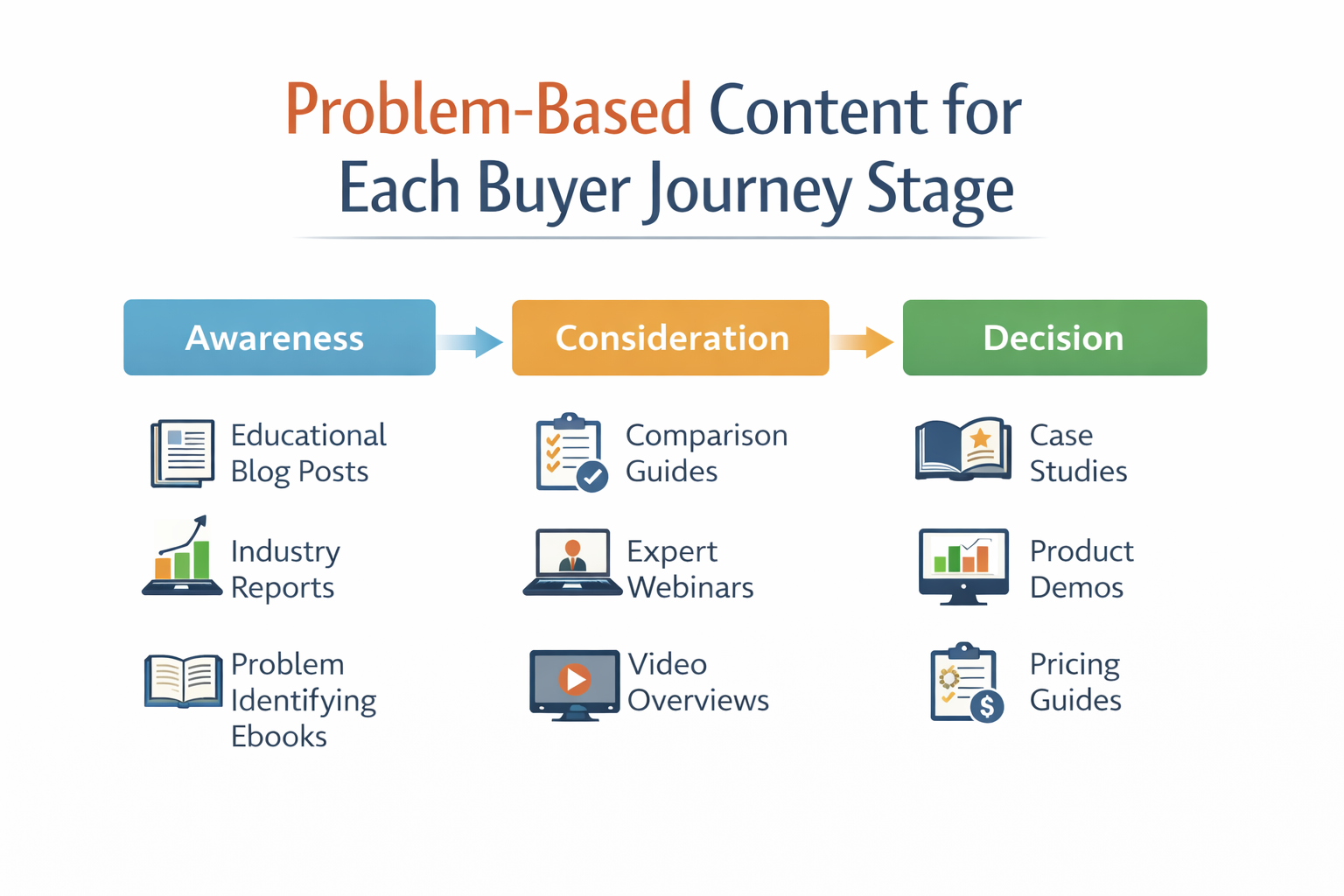
Problem-based content mapped to the buyer journey:
| Buyer stage | Type of problem content to publish | Example article angle |
|---|---|---|
| Awareness | General limitations, ideal use cases, common misconceptions | "Is [your service] right for every business?" |
| Consideration | Detailed comparisons with alternatives, honest trade-offs | "[Your service] vs [Alternative]: honest pros and cons" |
| Decision | Specific risk factors, support requirements, mitigation strategies | "What could go wrong with [your service] — and how we handle it" |
For a detailed look at this approach, see Why Talking About Your Weaknesses Builds More Trust Than Bragging.
Big 5 #3: Versus & Comparisons - your buyers are already comparing you
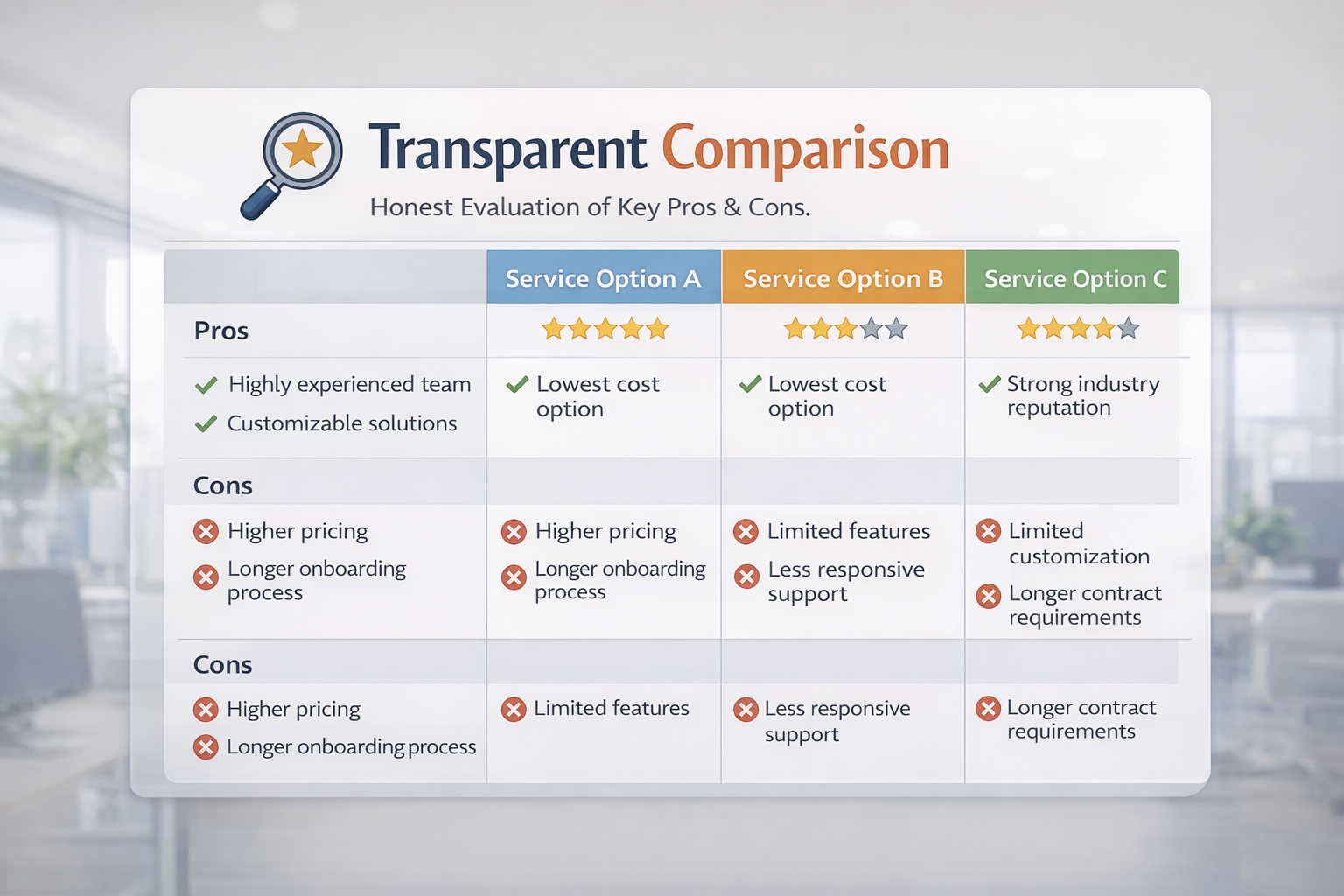
When buyers are evaluating a purchase, they are almost always comparing two or three options, and if you do not guide that comparison, a competitor or a third-party review site will.
Marcus Sheridan published a post comparing fiberglass, vinyl liner, and concrete pools. He was selling fiberglass. At no point did he claim it was the best option for everyone. After publishing, he ranked first for over a dozen comparison-related search phrases, and he credited honest, criteria-based comparisons as the reason.
The rule with comparison content is radical honesty. Claiming to be the best fit for everyone destroys the credibility that makes the content worth reading. Be genuinely transparent about where a competitor is a better choice, buyers will trust everything else you say because of it.
Big 5 #4 & #5: Reviews and Best in Class - how to turn competitors into traffic
Publishing honest, criteria-based reviews, including reviews of competitors, positions your business as an objective industry educator and captures high-intent traffic from buyers already in research mode.
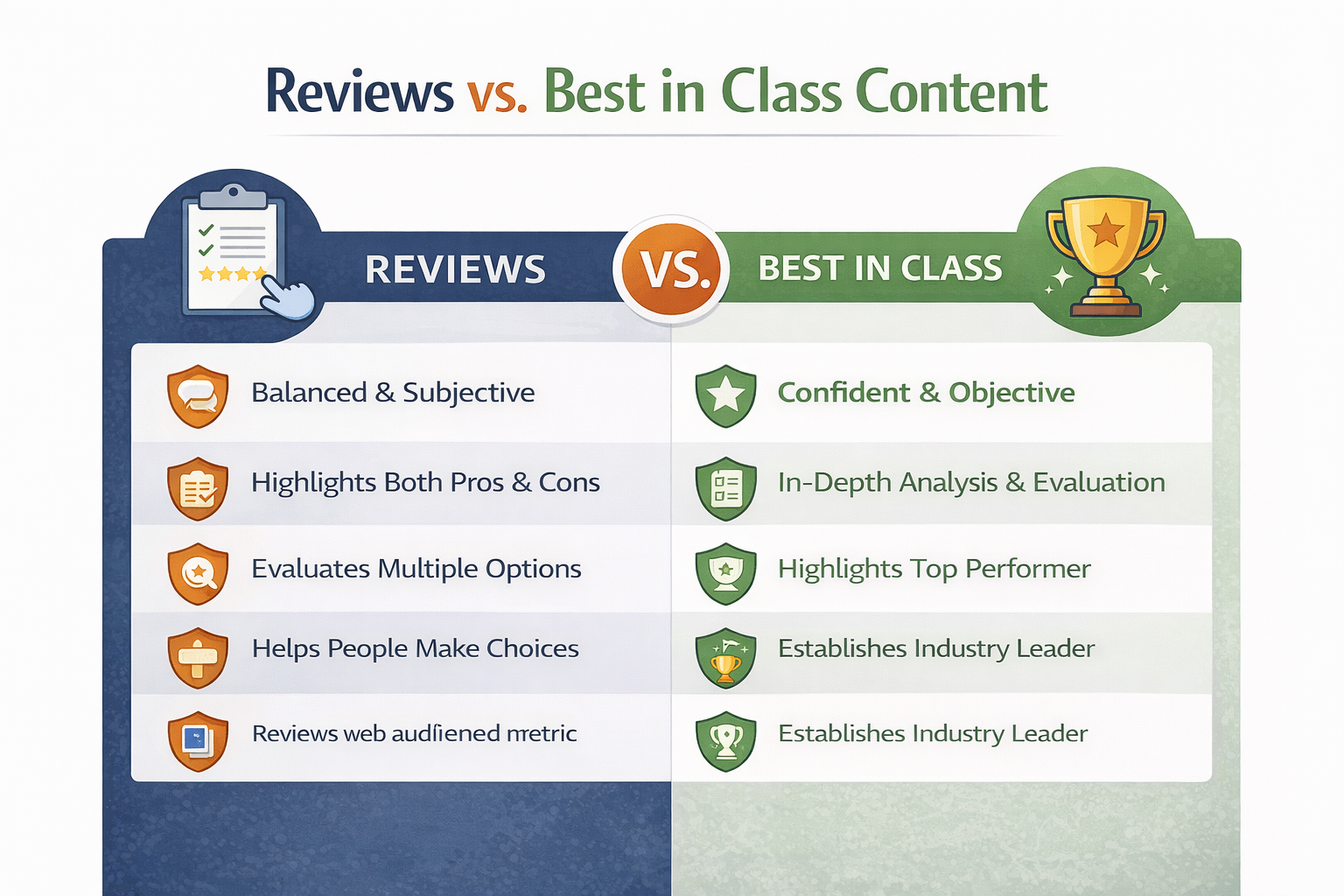
These two formats are related but distinct. A competitor review evaluates a single product or service honestly, helping buyers understand whether it is the right fit for their needs. A Best in Class list ranks multiple providers, including yourself, against published criteria, giving buyers a structured way to compare the field. Both formats work because they serve the buyer rather than the seller.
Reviews vs Best in Class; a quick comparison:
| Format | Purpose | Buyer stage | AI retrievability |
|---|---|---|---|
| Competitor reviews | Capture research traffic | Consideration | High |
| Criteria-based Best in Class list | Establish authority; rank alongside competitors | Consideration / Decision | Very high |
The criteria-based Best in Class list is particularly powerful for AI search. Shasta Pools published "The Top 6 Pool Builders in Arizona in 2025," listing themselves alongside competitors with a transparent evaluation framework. Within a short time, they were being recommended by ChatGPT when users searched "who are the best pool builders in Arizona?"
This format works because AI platforms surface structured, factual, specific answers, which is exactly what a well-constructed criteria list delivers.
See How to Write Content That Gets Quoted by ChatGPT for the technical detail behind this.
How to implement the Big 5
Implementing the Big 5 buyer questions starts with a simple audit: search your own business across all five categories and identify which questions you are not yet answering.
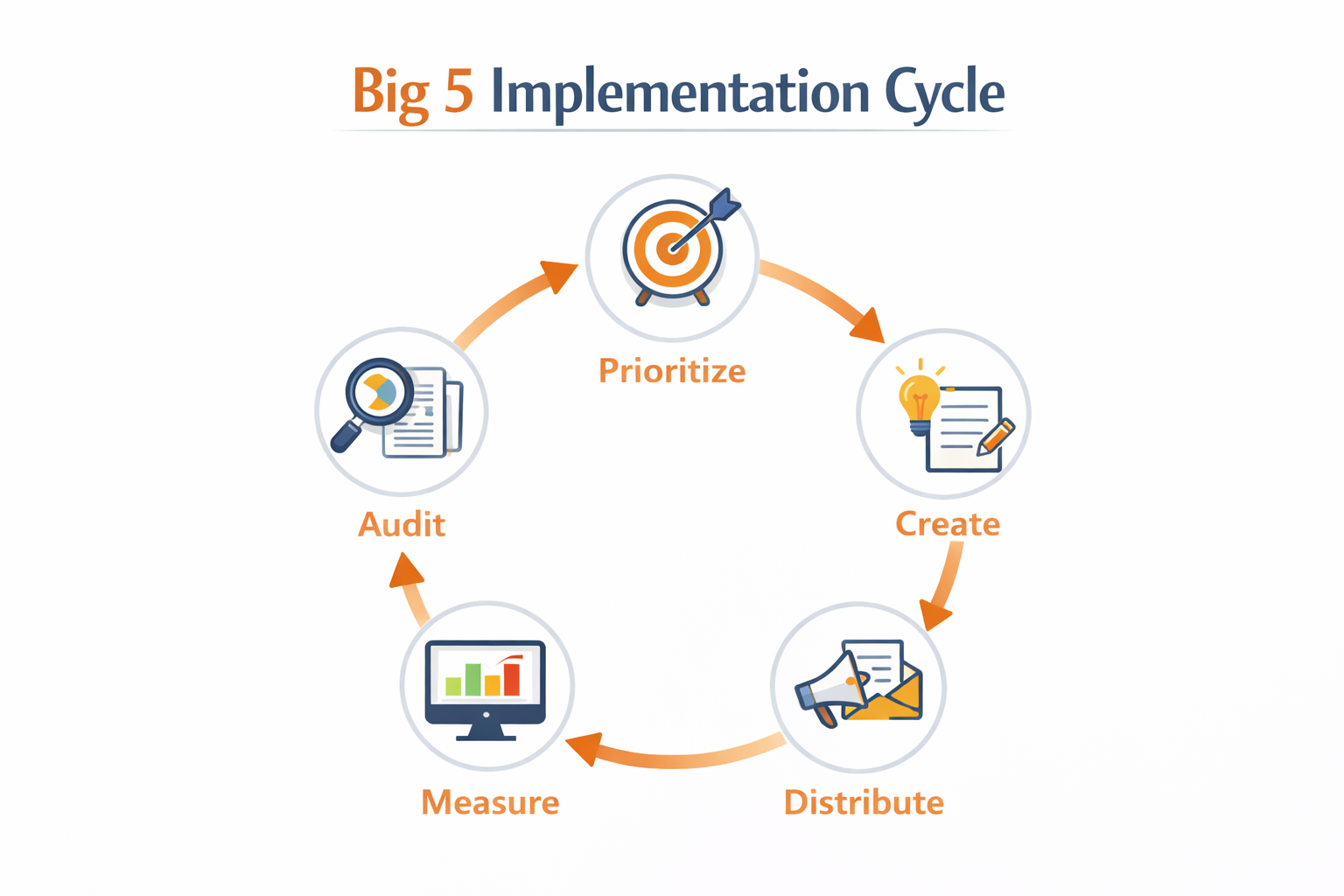
From there, follow this sequence:
- Audit: Search "[your service] price," "[your service] problems," and "[your service] vs [alternative]." Note which results exist and whether any are yours.
- Prioritise: Start with Cost & Price and Problems. These are the topics competitors avoid most and where buyer anxiety is highest.
- Create: Write one honest, specific piece of content per category. Not marketing copy.
- Distribute: Share content with your sales team to use before and during prospect conversations. This is the fastest route to commercial impact.
- Measure: Track organic traffic, lead quality, and sales cycle length against your pre-Big-5 baseline.
In my experience, clients who commit to this approach typically report improved lead quality within 90 days. The compounding effect, as each piece of content builds authority, continues for years.
Common mistakes businesses make with the Big 5
The most common mistake is avoiding the uncomfortable topics: price, problems, and competitor comparisons, under the belief that honesty will cost sales, when silence is what actually drives buyers away.
Other patterns to watch for:
- Publishing surface-level content that acknowledges the question but avoids the real answer
- Treating the Big 5 as a one-off campaign rather than an ongoing content philosophy
- Failing to update pricing and comparison pages as your market or offer evolves
- Keeping sales and marketing separate; Big 5 content only works when your sales team uses it
- Writing for search rankings rather than genuine buyer questions (both suffer as a result)
See The Trust BLUEPRINT™ Explained: A 9-Step Guide for B2B Teams for the broader framework that connects Big 5 content to measurable trust-building across your business.
Conclusion
Six months ago, your buyers were researching your product online and finding someone else's answers. Today, you have a framework that tells you exactly which questions they are asking, and what honest, structured answers look like.
You now know which five topics drive almost every buying decision, where most businesses fail to show up, and how to use that gap to build trust at scale.
The next step is to act on it.
How to take action now
- Run a Big 5 audit this week: search your business across all five categories and note the gaps
- Choose one starting point, Cost & Price or Problems, and draft a single honest piece of content
- Share that content with your sales team before it goes live and ask them to use it in their next prospect conversation
If you want to move faster, or want a clearer picture of where your wider marketing system stands before you start:
- Use my Marketing Debt Scorecard to assess the broader structural gaps in your content and marketing system
- If you want support building this systematically, rather than working through it alone, book a call to discuss how Endless Customers™ Implementation can help.
Suggested related article: Don't Be Mysterious: Answer the Questions Your Competitors Avoid

About the author
Tom Wardman is a fractional marketing consultant, Growth Independence Architect™, and one of the UK's first five certified coaches in the Endless Customers System™, trained directly under Marcus Sheridan. He works with founder-led B2B businesses to replace agency dependency with documented, self-sufficient growth systems. His book, Build a Trusted Brand, introduces the Trust BLUEPRINT™, a 9-step framework for turning trust into measurable revenue. Learn more about how he works.
Pricing disclaimer: All GBP–USD price conversions are rounded estimates and correct at the time of publishing. Exchange rates fluctuate and figures should be treated as indicative only.
Topics: