
Is your marketing team producing content that genuinely earns buyer trust, or content that looks the same as every other business in your space? Are you spending time and budget on articles, videos, and posts that prospects quietly ignore?
If those questions sting a little, you are not alone. Most marketing teams are busy without being distinctive.
Having coached founder-led B2B businesses through the Endless Customers System™, the single most common problem I encounter isn't a lack of content effort. It's a lack of content architecture.
This article introduces the four content pillars of the Endless Customers System™: Say, Show, Sell Differently, and Be Human. It explains how each one works in practice. You will leave with a clear framework for building a content strategy that differentiates your business, shortens your sales cycle, and builds trust that compounds over time.
This is written for marketing leaders, founders, and B2B marketing teams ready to move beyond random content creation and build something that drives measurable revenue.
Key takeaways
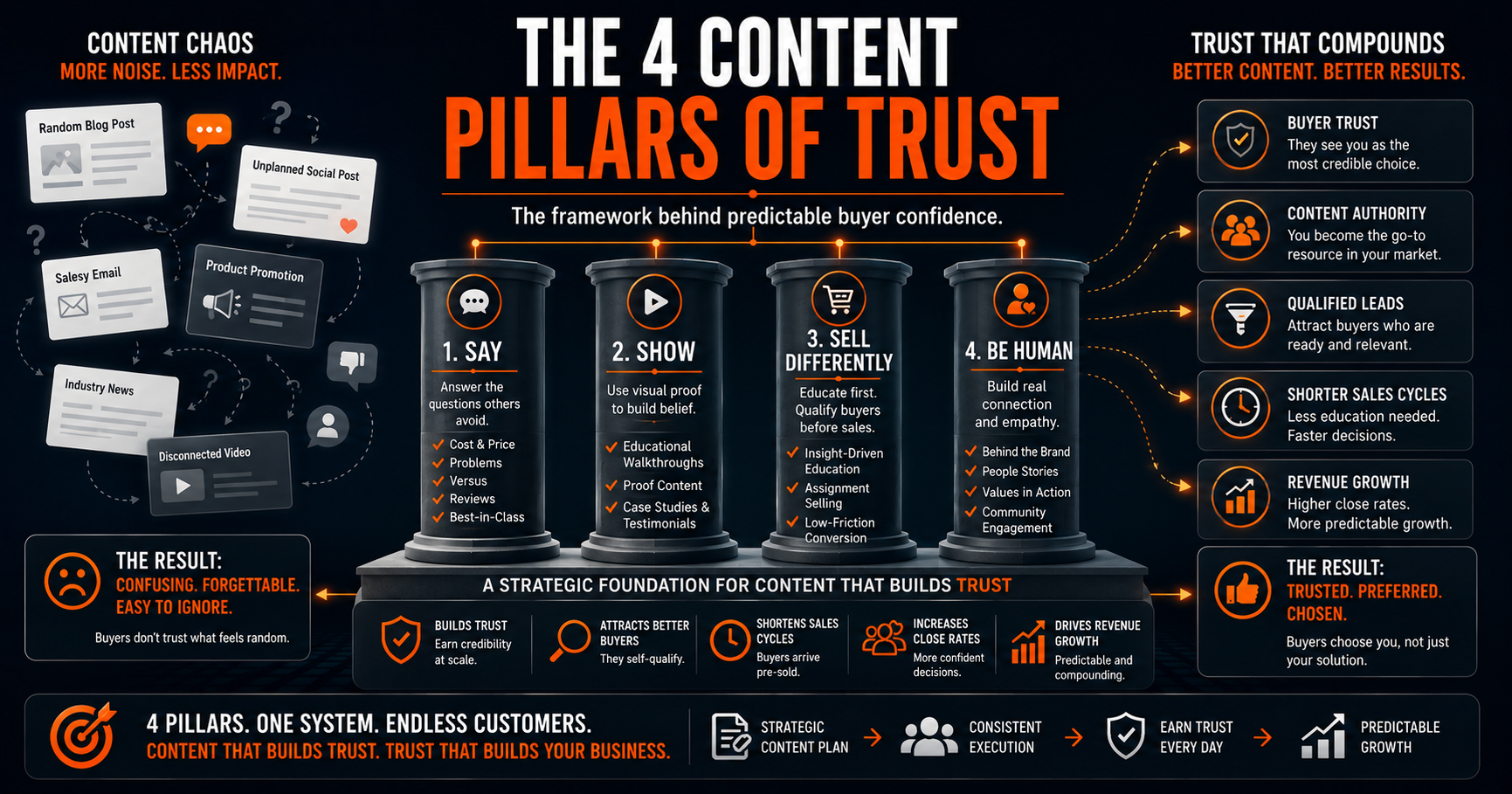
- The four content pillars, Say, Show, Sell Differently, and Be Human, form the strategic foundation of the Endless Customers System™, a trust-based content methodology used by businesses across every industry.
- Without a pillar-based strategy, most marketing teams produce undifferentiated, promotional content that trains buyers to decide on price alone.
- Research from Edelman shows 81% of consumers need to trust a brand before buying, yet most content strategies still promote rather than educate.
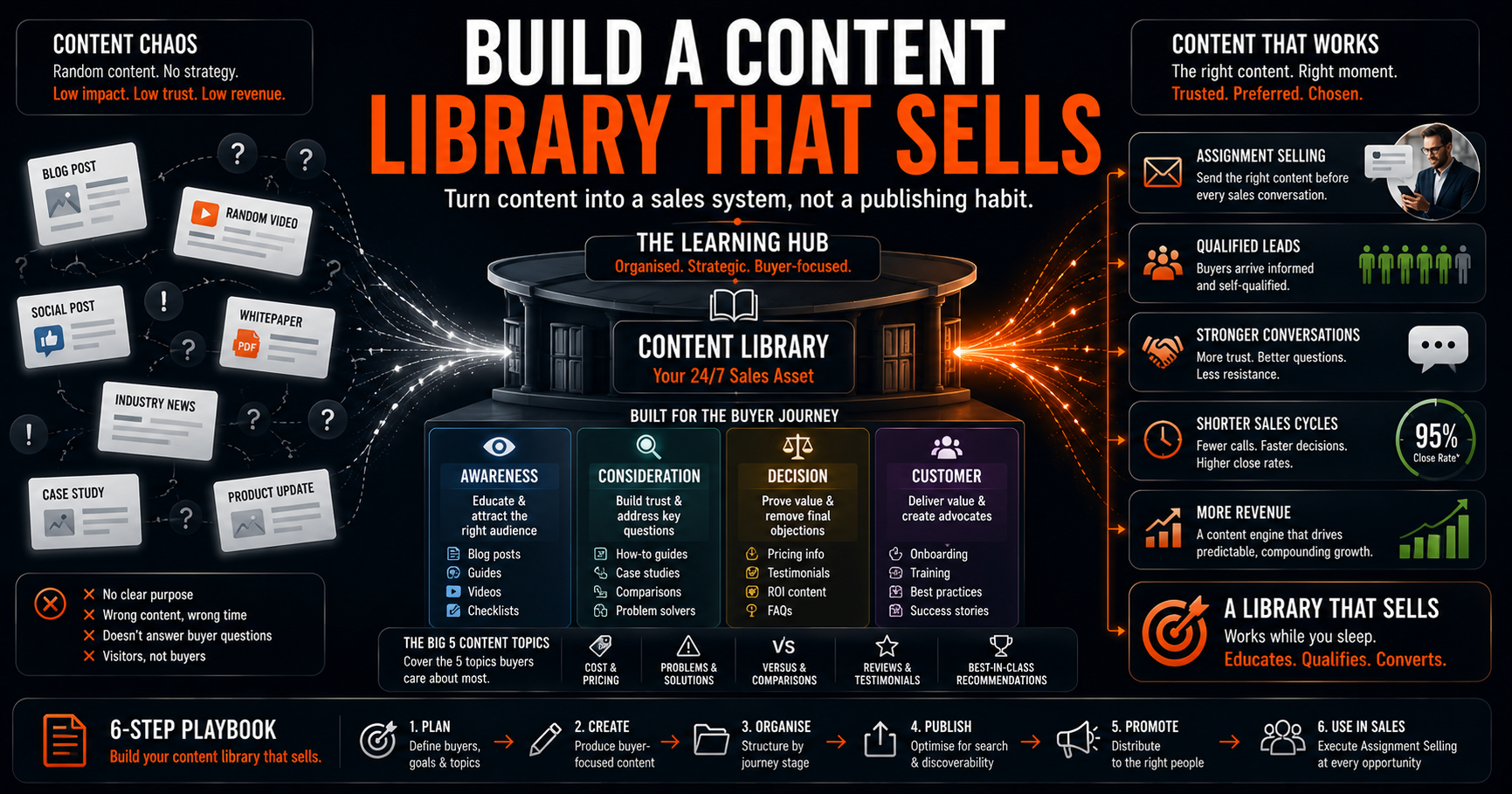
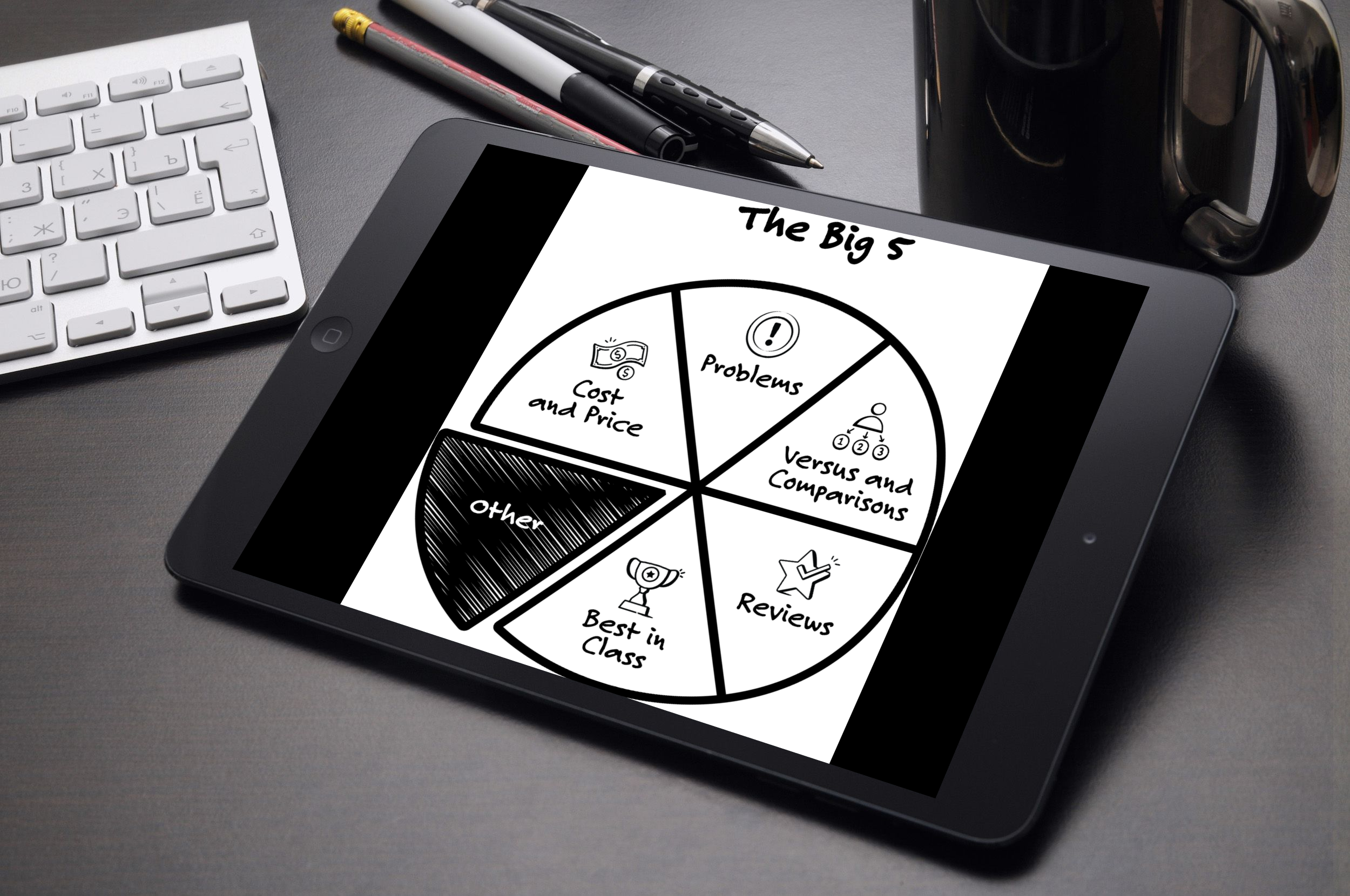
- The Big 5 content topics (Cost, Problems, Versus, Reviews, Best-in-Class) sit beneath Pillar 1 and address the questions that drive buying decisions in every sector.
- Assignment selling, using content to qualify buyers before sales meetings, consistently produces shorter sales cycles and higher close rates, as seen when River Pools and Spas achieved a 95% closing rate.
What are content pillars and why does every marketing team need them?
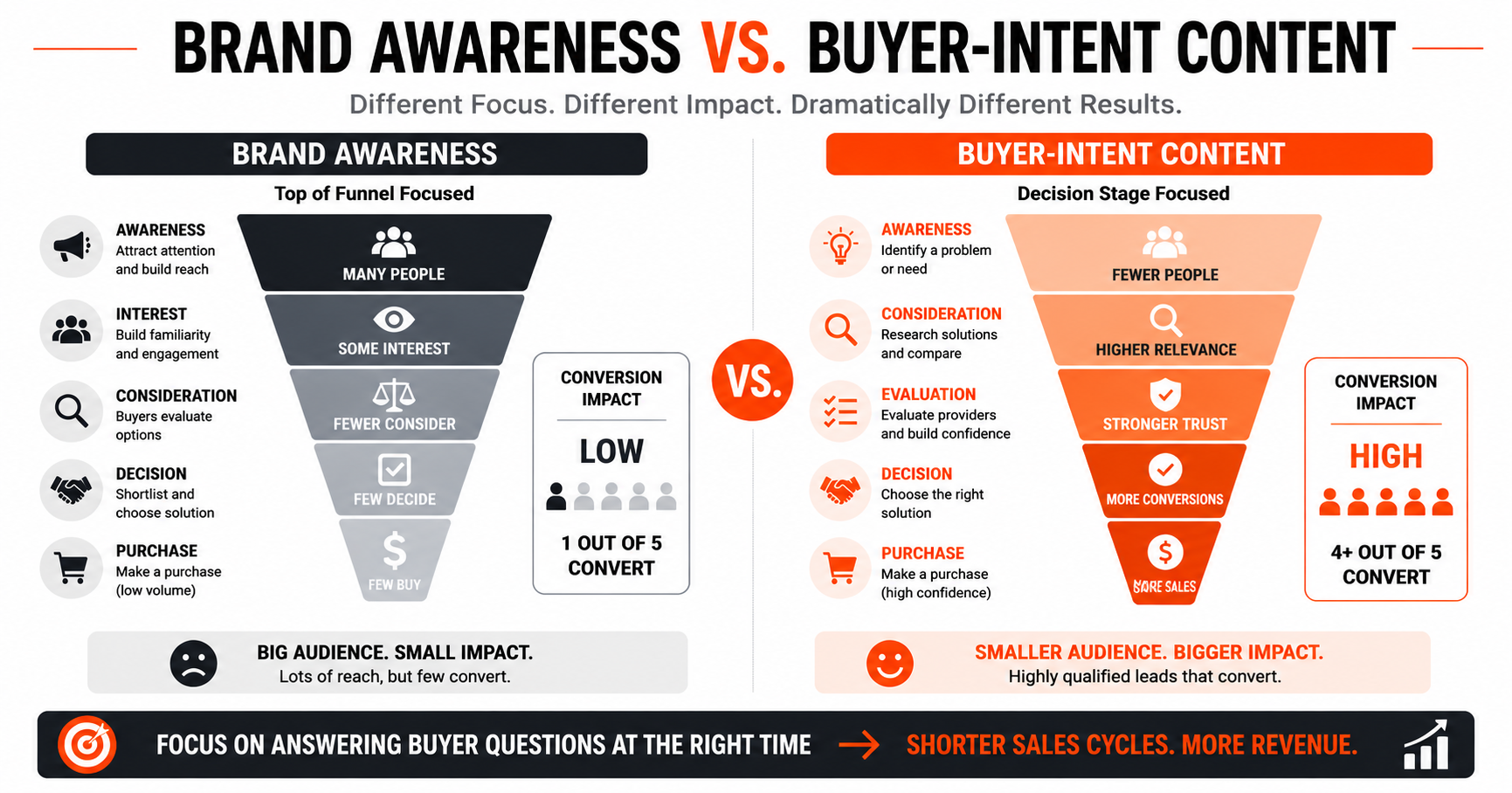
Content pillars are the strategic commitments that define what your marketing team creates, why it creates it, and what your brand stands for, without them, most teams drift into a "sea of sameness" that trains buyers to decide on price alone.
Research from Edelman shows that 81% of consumers need to trust a brand before they will buy from it. Yet most businesses still produce content that promotes rather than educates, eroding the very trust they depend on to grow.
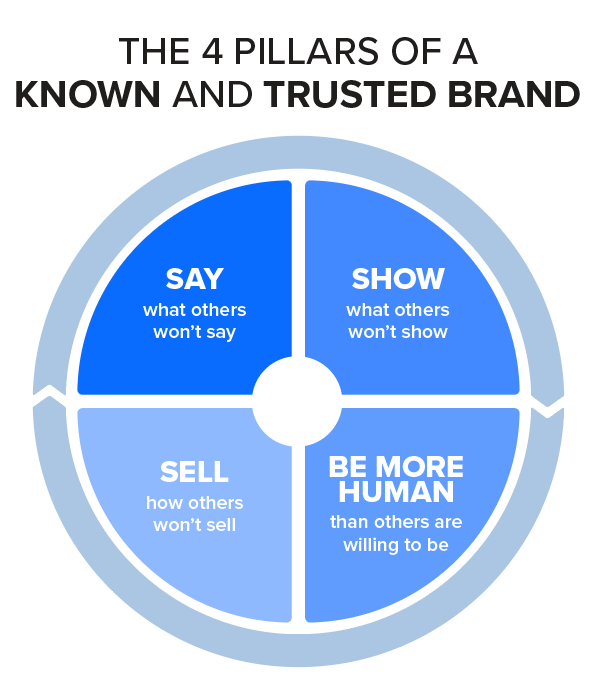
The four pillars of the Endless Customers System™, Say, Show, Sell Differently, and Be Human, each address a specific dimension of buyer trust. Together, they form a content strategy most competitors will not replicate.
Pillar 1: Say what others in your industry avoid
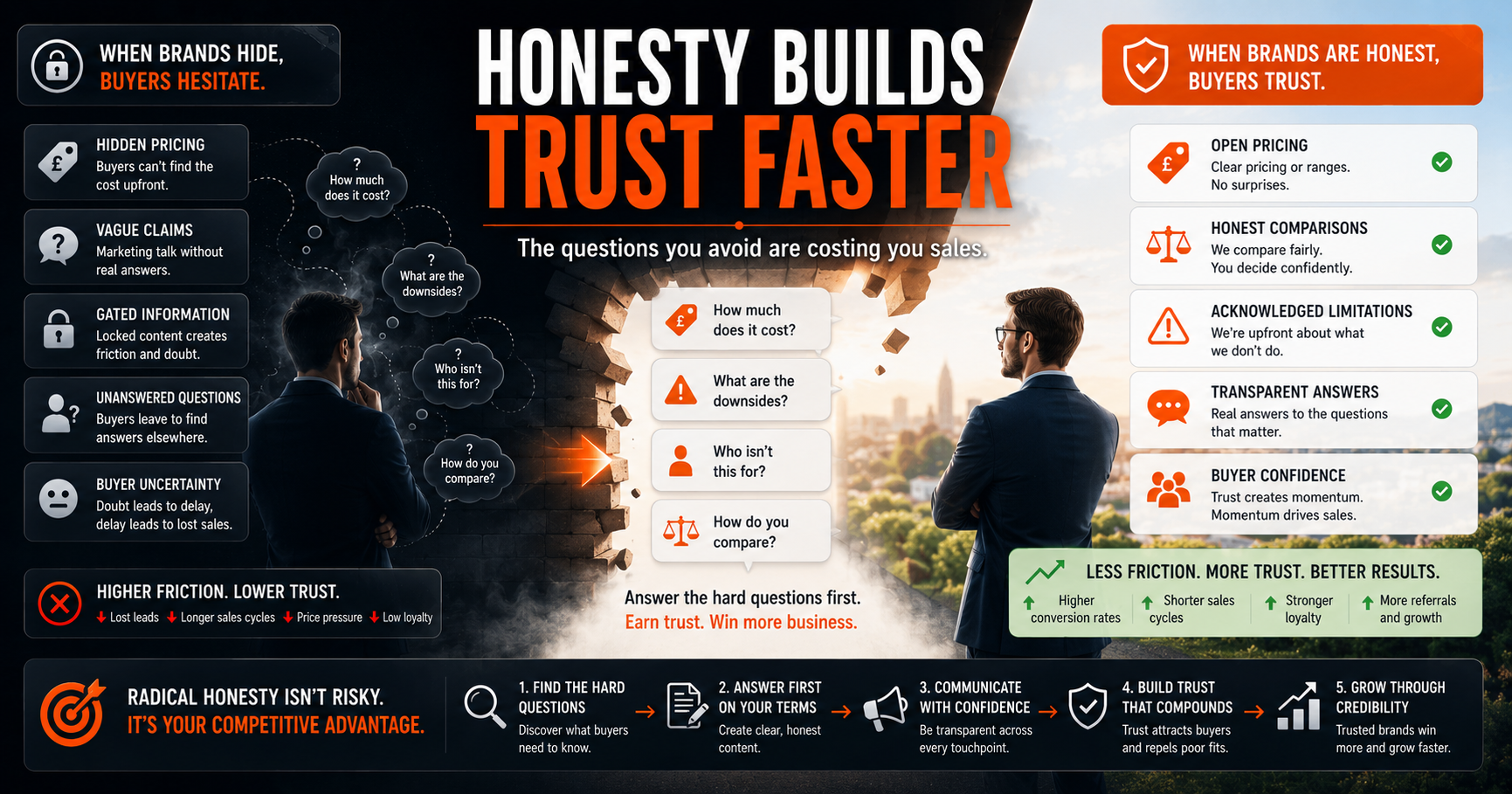
The first content pillar is radical transparency, the willingness to publish honest, uncomfortable information your competitors hide, including real pricing, genuine limitations, and unbiased comparisons.
This pillar is powered by the Big 5 content topics: five questions that drive buying decisions across every industry, regardless of sector or product type.
The Big 5 topics your content must cover
- Cost and price: Buyers will find an answer somewhere. Be the brand that gives them one honestly.
- Problems: Address known limitations openly. It builds more trust than hiding them.
- Versus and comparisons: Buyers are already comparing options. Guide them through the process rather than avoiding it.
- Reviews: Share what existing customers say, and who else might be worth considering.
- Best-in-Class: Identify the best options in your market, including your own and your competitors'.
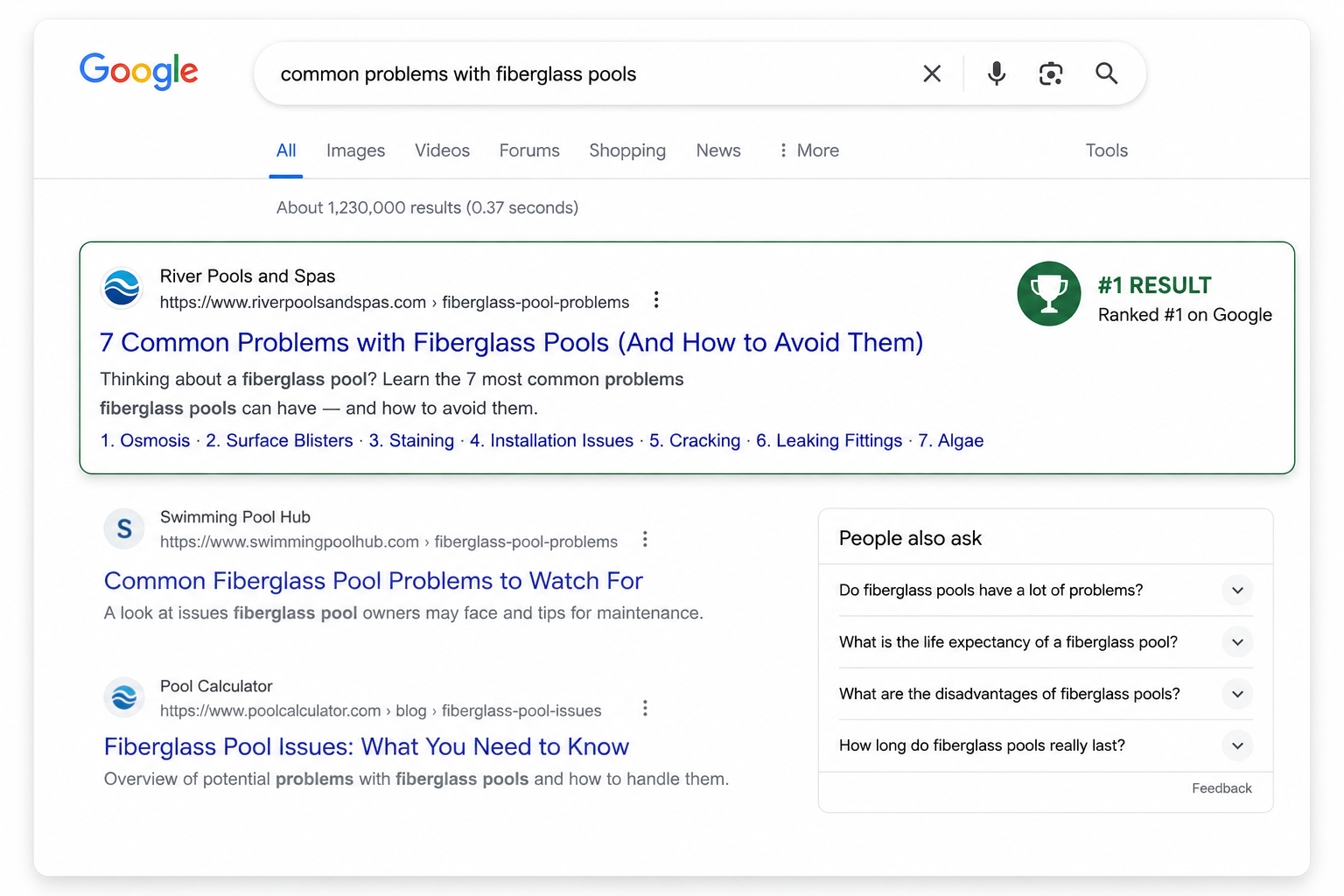
Marcus Sheridan's article "Top 5 Fiberglass Pool Problems" has been attributed to at least $2 million (£1.6 million) in direct revenue. Sheffield Metals' video "7 Common Problems of a Metal Roof" generated over 200,000 views in under two years and ranked first on Google for that search phrase.
The businesses that answer the questions their competitors avoid become the most trusted voice in their market.
External link: Edelman Trust Barometer
Pillar 2: Show what others in your space won't reveal
The second content pillar is visual proof, using video, demonstrations, and case studies to show buyers what competitors only describe in text.
According to Wyzowl's 2023 State of Video Marketing report, 94% of marketers say video has improved buyer understanding of their product or service, and 87% say it drives more traffic to their website.
In practice, this pillar covers three types of content that build buyer confidence at different stages of the decision process:
- Educational walkthroughs: Product demonstrations, installation overviews, and process explainers that answer practical objections before a sales conversation begins.
- Proof content: Facility tours, before-and-after case study videos, and client testimonials on camera that give buyers the evidence written case studies alone cannot provide.
- Expert content: Interviews with team members, technical Q&As, and behind-the-scenes footage that build familiarity and trust with the people behind the product.
Sheffield Metals illustrates the mechanism clearly. Alongside their written "problems" content, they produce detailed installation walkthroughs and product demonstration videos showing how metal roofing systems perform under real conditions. Buyers who watch those videos arrive at sales conversations with their technical objections already resolved, the content has done the qualifying work before anyone picks up the phone.
In-house video production does not require a professional crew. A basic camera, microphone, and lighting setup costs between £500 and £2,000 ($625–$2,500), sufficient for most B2B businesses to produce content that builds genuine buyer confidence at scale.

Pillar 3: Sell in ways your competitors won't dare to try
The third content pillar is assignment selling, a trust-based approach where educational content qualifies and informs buyers before any sales conversation takes place, not after.
River Pools and Spas achieved a 95% closing rate by asking every prospect to review specific content before a sales meeting. Buyers arrived informed, pre-qualified, and ready to decide, reducing the time and cost of each closed deal significantly.
The assignment selling system works across three clear stages
- First contact: Content that answers high-level questions and filters out poor-fit prospects early.
- Middle stage: Three paths: not a fit (polite exit), maybe interested (further education), or ready to buy (decision-stage materials).
- Decision stage: Content that addresses final objections and makes the next step obvious and simple.
If a prospect refuses to review pre-meeting content, that refusal is informative; buyers unwilling to invest time in learning are unlikely to be value-focused, making them a poor fit before a single meeting takes place.
Related reading: Why Every Sales Conversation Should Start With a Blog Post (Assignment Selling Explained)
Pillar 4: Be more human than your competitors
The fourth content pillar is humanisation, creating content that reveals the real people, genuine stories, and authentic values behind your brand in a way most competitors simply won't.
Yale Appliance grew from £37 million ($46 million) to £180 million ($225 million) by making content creation a company-wide responsibility, not just a marketing function. Every team, from service technicians to senior leadership, contributed to the brand's voice. The result was a brand that felt distinctively human in a commodity market.
Humanised content also performs better in AI search. AI platforms prioritise brands with clear, consistent, entity-level signals, real people, documented expertise, and authentic positioning. A brand that shows its team, shares its values, and takes a clear stance on who it serves will be cited by AI systems more readily than one trying to appeal to everyone.
This pillar does not require a large budget. It requires honesty: share your values, involve your team in content creation, and be willing to say "this is not for everyone", which builds faster trust with the right buyers than any amount of generic outreach.

Related reading: Be Unreasonably Helpful: How Honest Marketing Builds Trust
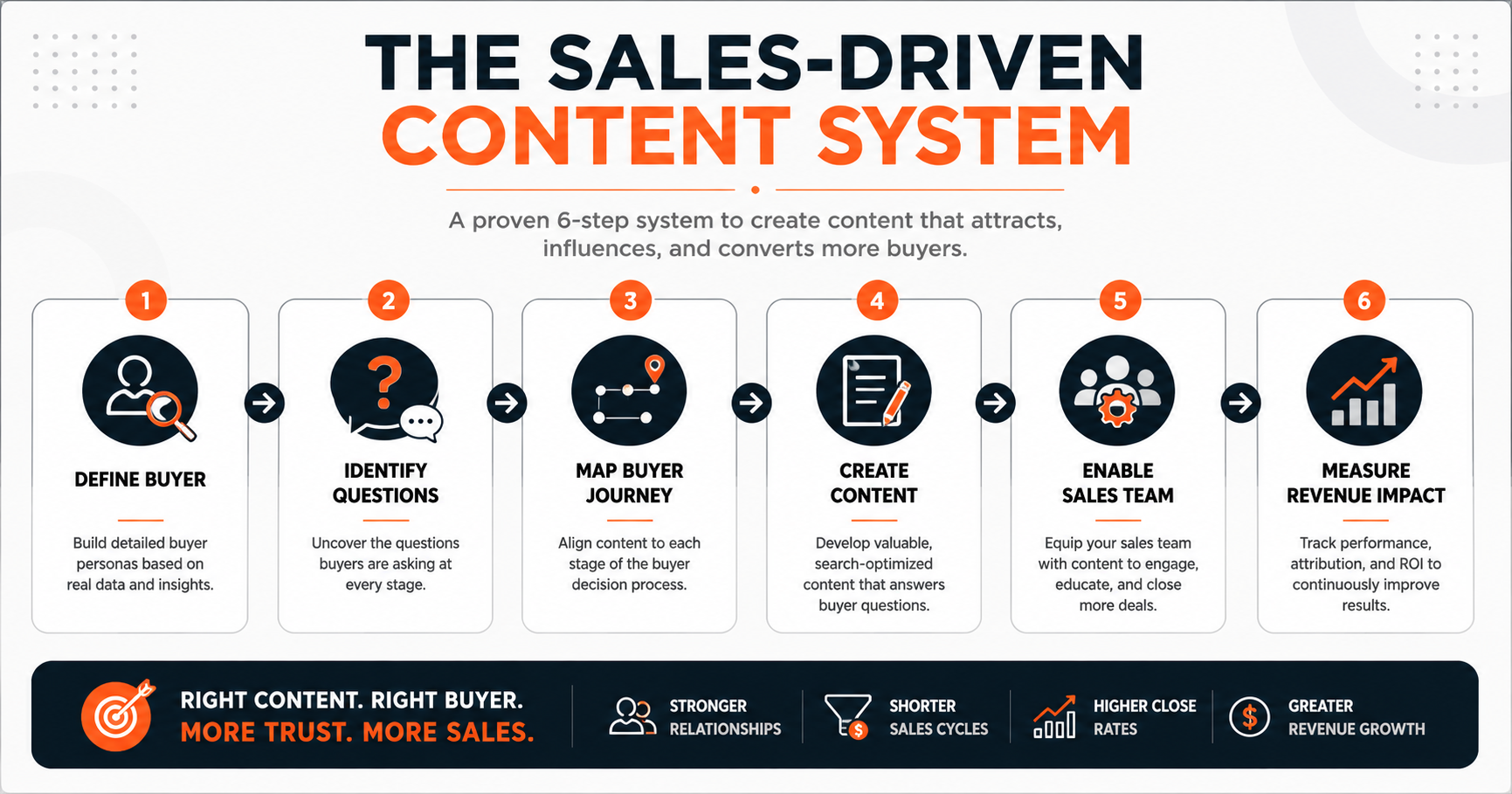
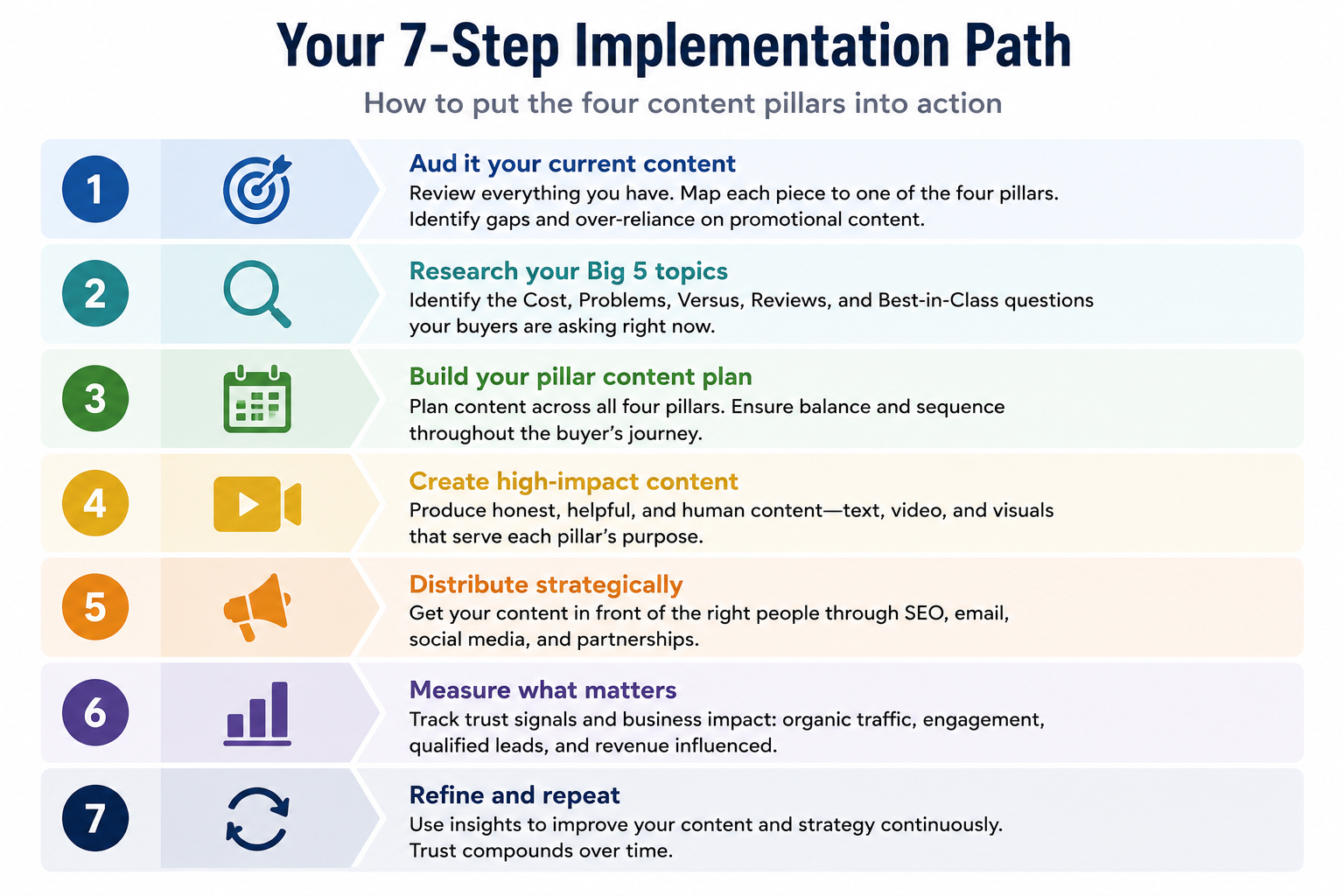
How to implement the four content pillars: a 7-step guide
Implementing the four content pillars follows a clear sequence: audit what you have, identify your Big 5 gaps, assign ownership, and build a phased production system that grows with your team.
The most important first step is a content audit; most marketing teams already partially cover one or two pillars. Identifying those gaps immediately shows where the highest-impact work sits.
- Audit your existing content: Map what you currently publish against each of the four pillars.
- Identify your Big 5 gaps: Which of the five topics are you currently avoiding? Start there.
- Assign pillar ownership: Each pillar needs a named owner within your team. Shared responsibility becomes no responsibility.
- Build in-house video capability: Start with a basic setup. Do not wait for perfect equipment before you begin.
- Brief your sales team on assignment selling: Train them to send content before meetings, not after.
- Create humanised content: Involve your whole team. Let real people speak for your brand.
- Track content-to-revenue attribution: Measure which pieces contribute to closed deals and refine from there.
Related reading: How to Measure Content Marketing ROI: KPIs That Actually Drive Revenue
Frequently asked questions about content pillars
The most common questions about content pillars come from marketing teams trying to decide whether to adopt a structured framework or continue producing content on an ad-hoc basis; these answers address the key decision points directly.
What is a content pillar in marketing?
A content pillar is a strategic commitment that defines the type of content your brand produces and why. In the Endless Customers System™, the four pillars, Say, Show, Sell Differently, and Be Human, each address a different dimension of buyer trust.
What is the difference between the four content pillars and the Big 5?
The four pillars are the strategic framework. The Big 5 (Cost, Problems, Versus, Reviews, Best-in-Class) are specific content topics that sit primarily beneath Pillar 1. The Big 5 tells you what to write; the pillars define how your entire content strategy is positioned.
How long does it take to see results from a content pillar strategy?
Most businesses see measurable improvements in lead quality and sales cycle length within three to six months of consistent publishing. Compounding organic authority, where content drives traffic and revenue long after publication, builds over 12 to 24 months. This is an investment in a durable asset, not a short-term campaign.
Do the four content pillars work for B2B businesses?
Yes. The Endless Customers System™ was designed for complex, considered purchases, precisely the environment most B2B businesses operate in. Assignment selling in particular is built for longer sales cycles where buyer education determines close rates more than any sales technique.
Four pillars, one system: what to do next
You came here because your marketing wasn't producing the trust or the pipeline it should. Most teams in that position are producing content; they're just producing it without a structure that connects effort to outcome.
Now you have one; four named, evidence-backed commitments that the most trusted businesses across every industry are already using to build authority and win buyers before a single sales conversation begins.
The sea of sameness is not going away. But the businesses that choose to say what others avoid, show what others hide, sell with content rather than pressure, and be genuinely human will stand apart, not because they outspent their competitors, but because they out-educated them.
How to take action now:
- Run a content audit against the four pillars this week
- Identify your highest-impact Big 5 gap and publish one piece of content that addresses it
- Brief your sales team on assignment selling before your next round of prospect meetings
- Assign a named owner to each pillar within your marketing team
Your next step is to read The Big 5 Questions Every Buyer Wants Answered, which goes deeper on the specific content topics that sit beneath Pillar 1, and where most marketing teams have their largest trust gaps.
If you want to move through this faster, I work with founder-led B2B businesses to install the Endless Customers System™ as a self-sufficient growth engine their teams own and run.

About the author
Tom Wardman is a fractional marketing consultant, author of Build a Trusted Brand, and one of the UK's first five certified coaches in the Endless Customers System™, trained directly under Marcus Sheridan. Tom works with founder-led B2B businesses to replace agency dependency with self-sufficient growth systems their teams own and control.
Pricing disclaimer: All GBP–USD price conversions are rounded estimates and correct at the time of publishing. Exchange rates fluctuate and figures should be treated as indicative only.
Topics: